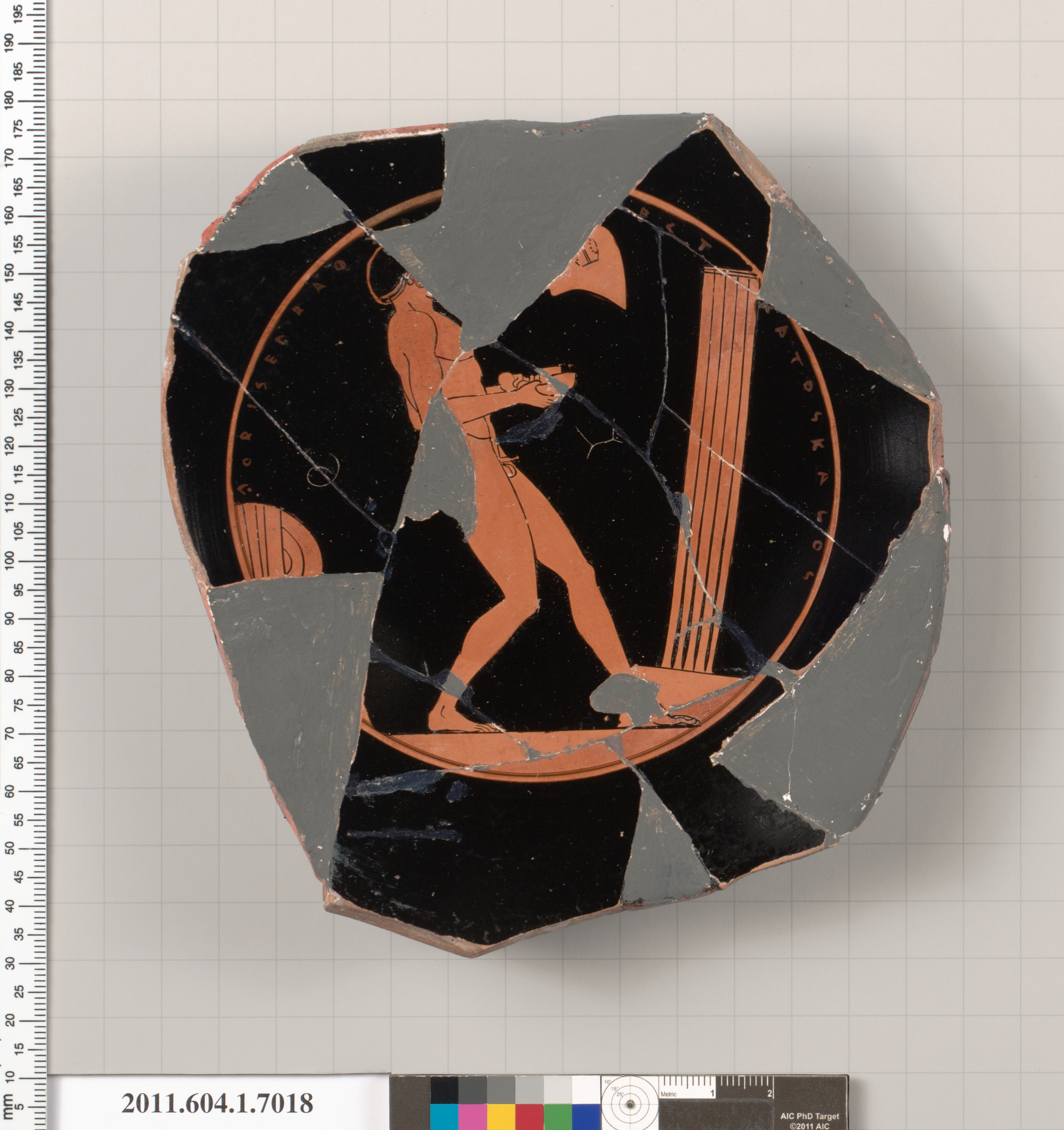
From Symposium to Salon: The Attic Kylix Fragment and the 2026 Old Money Silhouette
The pursuit of the “Old Money” aesthetic in fashion is, at its core, an exercise in cultural archaeology. It seeks not mere vintage replication, but the distillation of enduring codes of authority, taste, and restrained expression. For the 2026 iteration, Lauren Fashion Heritage Lab looks beyond the recent past, past the Gilded Age and Regency eras, to a foundational moment of Western cultural self-definition: Classical Greece. A terracotta fragment of an Attic kylix (drinking cup), circa 5th century BCE, serves not as a template for togas, but as a profound philosophical and aesthetic cipher. This artifact, a relic of the Athenian symposium—the intimate gathering where politics, philosophy, and pleasure converged—offers a masterclass in the principles of measured proportion, intellectualized leisure, and symbolic depth, principles that will define the next evolution of quiet luxury.
The Fragment as Philosophy: Unpacking the Attic Code
The kylix was no ordinary vessel. Its wide, shallow bowl and twin handles were designed for reclining consumption, its exterior often adorned with scenes of symposium life or mythological allegories. The fragment itself, a surviving piece of this social and intellectual ritual, embodies a triad of values essential to the 2026 Old Money silhouette.
First, the Principle of Calculated Asymmetry and Dynamic Balance. Unlike the rigid symmetry of medieval Finials or the hierarchical order they represent, the kylix’s decoration often followed a frieze-like narrative around its curve. A single surviving figure or motif on a fragment hints at a larger, circular composition that revealed itself only as the cup was rotated in use or drained of wine. This translates to silhouette as a move away from static, bilateral perfection. Imagine a tailored wool blazer where the only decoration is a single, exquisite heritage-black enamel button placed off-center, or a dress with a seam that follows a natural, non-mirrored drape. The silhouette possesses balance, but it is the dynamic, human balance of a poised figure, not the inert balance of a monument.
Second, the Ethos of the Figura Serpentinata in Rest. Contrasting with the explicit S-curve of the Shancai Tongzi琉璃造像, the Greek ideal, as seen in the draped figures on such pottery, was one of potential energy contained within repose. The chiton or himation folds are not wildly flowing but fall in rhythmic, weighty lines that articulate the form beneath while concealing it with dignity. This informs 2026’s approach to fabric and cut. Silhouettes will favor deadstock woolens, heavy silks, and structured cottons that hang with gravitational integrity, creating vertical lines that elongate and refine. The “drape” is not fluid like silk charmeuse, but architectural, like the folds in a marble statue. The body is understood, suggested, but never explicitly revealed—a sartorial expression of sophrosyne (temperance, self-control).
Third, the Semantic of the Fragment. The artifact’s very state—a fragment—is crucial. It speaks of survival, of a lineage that is partially lost but palpably present. It does not shout its history; it whispers it through patina and fracture. This directly informs the 2026 Old Money materiality and detail. The look will embrace the “honest fragment”: a cashmere sweater whose cuff shows the subtle, respectful reweaving of a cherished wear point; a leather bag with a handle darkened by time and use, paired with pristine body; a piece of jewelry incorporating an ancient intaglio or a repurposed Victorian setting. The new “logo” is not a monogram, but this evidence of a personal, cultivated history woven into the garment itself.
转译 to 2026: The Silent Symposium Silhouette
The design philosophy extracted from the kylix fragment allows for a precise转译 (translation) into a contemporary sartorial language for 2026.
Silhouette & Construction: The overarching shape is columnar and grounded, derived from the kylix’s stable, stemmed base and the dignified posture of its users. This manifests in straight-leg, high-waisted trousers in heavyweight flannel, tailored with a slight break to create a clean vertical. Jackets and coats are elongated, with minimal shoulder structuring—the shoulder is a slope, not a pad—echoing the gentle curve of the kylix handle. Necklines are high, often bateau or jewel, framing the face as the focal point, much as the symposium focused on the spoken word. Seaming is reduced and strategic, aiming for a sculptural wholeness rather than decorative complexity.
Material & Color Narrative: Here, the “流霞之色” (flowing haze color) of the琉璃 and the symbolic palette of the Finial are synthesized into a Greco-terracotta spectrum. The core palette is earth-bound and mineral: deep terracotta reds (oxidized iron), black-figure blacks (Heritage-Black, a black with warm, charcoal undertones), ochre, and the white of Attic clay. These are not flat colors but possess depth and texture—wools with a subtle lanolin bloom, linens with slub, brushed leathers. The “narrative” is not one of spiritual pilgrimage or divine order, but of cultivated earth, human craft, and the patina of intellectual and social engagement.
Detail as Allegory: Ornament, like the red-figure painting on the kylix, is sparse and meaningful. A single, continuous Greek key motif in contrasting matte-gold thread might run along a hem or cuff, a metaphor for eternal return and lineage. A clasp may take the form of a simplified amphora or lyre. The concept of the “精神容器” (spiritual container) is key: each garment is designed as a vessel for a certain mode of being—contemplative, conversational, authoritative. Pockets are deep and functional, interiors may be lined with a fragment of a historic document or map print, creating a private, intellectual space for the wearer alone.
In conclusion, the 2026 Old Money silhouette, informed by the Attic kylix, rejects ostentatious heritage for a philosophically-engaged classicism. It moves from the opulent, vertical aspiration of the Gothic to the horizontal, humanist communion of the Symposium. It exchanges the flowing, spiritual journey of the Buddhist seeker for the grounded, civic-minded contemplation of the Athenian citizen. The resulting style is one of profound quietness, intelligence, and embodied history. It is clothing not as armor or uniform, but as a well-crafted vessel for a modern life of considered action and taste—a silent, wearable symposium for the contemporary world.