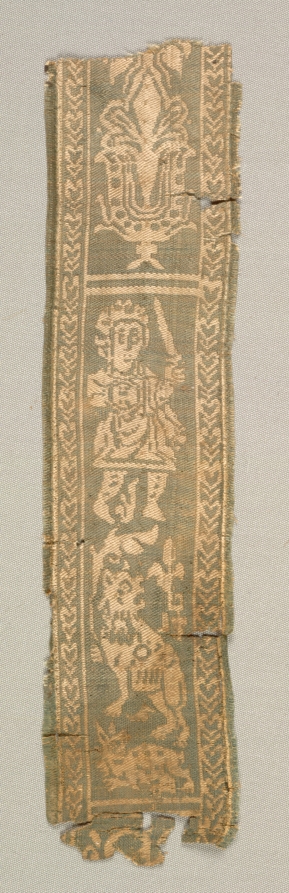
An Examination of Material Authority: The Silk Decorative Tunic Band with a Hunter
To comprehend the full measure of this artifact—a decorative band intended for a tunic, depicting with fine resolution the figure of a hunter in pursuit—one must first dismiss any notion of it as mere ornament. This is not embellishment; it is a statement of power, rendered in the most technologically advanced and politically controlled medium of the ancient and medieval worlds: silk. Its very existence speaks of a supply chain that was, for centuries, the most closely guarded state secret in human history, a monopoly enforced by imperial decree under penalty of death. The subject, the hunter, is not a casual pastoral scene but a direct invocation of sovereign prerogative, the royal chase being a long-established metaphor for dominion over both the natural and political realms. The band, therefore, is a compact manifesto of authority, its materiality inseparable from its message.
The Foundation of Monopoly: Sericulture as Statecraft
The legacy begins not at the loom, but in the mulberry grove. Imperial silk weaving was predicated on an absolute vertical integration, a model of production that would be the envy of any modern enterprise. The cultivation of the white mulberry (Morus alba), the rearing of the Bombyx mori silkworm, the careful unreeling of the continuous filament from the cocoon—these were not agricultural activities but acts of state. The Chinese empires, most notably the Han and the Tang, perfected this system, treating the knowledge of sericulture as a proprietary technology. The silk thread itself was a form of encrypted capital, its production a ritualised process within a complex bureaucratic apparatus. To wear silk, and particularly to wear silk of this pictorial complexity, was to demonstrate a connection to the very apex of this system. The hunter on the band is, by extension, a beneficiary and an emblem of this total control.
The Loom as a Instrument of Imperial Narrative
The depiction of the hunter—likely woven in a complementary weft-faced compound twill, a technique allowing for detailed curvilinear design and a rich polychrome palette—represents the zenith of this controlled industry. The drawloom, a formidable piece of engineering operated by a master weaver and a drawboy, was the supercomputer of its age. Its setup was a labour of immense time and cost, the pattern encoded into its intricate arrangement of heddles and cords. This was not art for art’s sake; it was narrative delivery via industrial means. Imperial workshops, such as those of the Byzantine gynaeceum or the later Islamic tiraz factories, operated under direct palace supervision. The output served a tripartite purpose: as elite vestment, as diplomatic currency of unparalleled value (where bolts of silk often spoke louder than treaties), and as a vehicle for iconographic propaganda. The hunter, frozen in pursuit, is thus a curated image. He communicates martial vigour, control over wilderness, and the leisure that signifies supreme status. Every thread is aligned in the service of this message.
A Comparative Analysis of Provenance and Patronage
While the precise provenance of this specific band requires further technical analysis—examination of dye compounds, thread spin, and weave structure—its typology places it within a fierce tradition of contested excellence. One must consider the great ateliers: the early Byzantine workshops of Constantinople, which inherited and adapted Sassanian motifs; the Umayyad and Abbasid tiraz institutions, whose inscriptions often framed figurative scenes; or the later specialist weavers of the Mongol Ilkhanate, synthesising Chinese pictorial style with Central Asian themes. The hunter is a trans-cultural archetype of authority, found in Sogdian, Persian, and Byzantine courtly art. The value of the band escalates significantly if it can be traced to a known imperial workshop, its quality acting as a de facto signature. The patronage is implicit in the fineness of the work. This was not commissioned; it was issued.
Material Endurance and the Continuity of Legacy
Silk’s enduring nature—its tensile strength, its stability when protected from light—is what allows this band to present its case to us centuries later. Unlike the fragile political dynasties that spawned it, the artifact has persisted. This longevity is a key component of its heritage. It connects, in an unbroken thread, the modern viewer to the precise technical ambitions and aesthetic sensibilities of a long-vanished court. The legacy of imperial silk weaving is, in essence, the legacy of managed excellence: the application of vast resources to a single, luxurious end to produce an object that is both beautiful and unequivocal in its social meaning. The hunter is not merely a decorative motif; he is the permanent embodiment of a system that sought to weave its own permanence into the fabric of history.
In conclusion, this Silk Decorative Tunic Band with a Hunter stands as a profound research artifact. It demands to be read not simply as a textile, but as a complex document of political economy, technological mastery, and symbolic communication. Its material, silk, is the foundational fact from which all its significance flows—a fibre so potent it shaped global trade routes, inspired espionage, and clothed the divine right of kings. The hunter, forever poised in the chase, is forever clad in the ultimate expression of imperial power. The cut of his garment, as it were, was always Savile Row.