An Examination of Poetic Artefact and Imperial Legacy
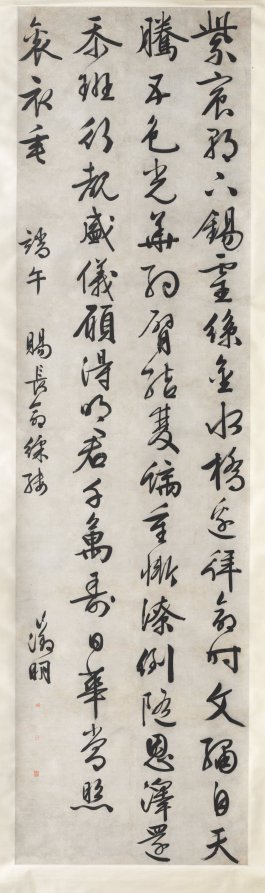
One must approach this piece not as a mere textile, but as a confluence of sovereign intent, technical mastery, and poetic diplomacy. The subject is a poem, executed in the hybrid xingkaishu—running-standard script—upon a ground of imperial silk. The medium is the message, and here, the medium is the very fabric of statecraft. To comprehend its full weight, we must consider the legacy of the imperial silk weaving establishments, institutions whose output was less about adornment and more about the articulation of power, hierarchy, and cultivated benevolence.
The Ground: A Fabric Woven with Authority
Prior to a single character of ink being applied, the silk itself spoke volumes. This was no common damask. It emanated from the Imperial Weaving and Dyeing Establishments, perhaps in Suzhou or Hangzhou, operating under the meticulous and often draconian supervision of the Ministry of Works. The thread count would be exceptionally high, the weave flawless, the finish possessing a subdued, dignified lustre—a sheen that whispered of exclusivity rather than shouted. This silk was a controlled substance. Its production, from sericulture to loom, was a state secret, its distribution a privilege strictly governed by sumptuary laws. To receive such a ground, blank, was already a significant mark of favour. It provided the perfect, resilient surface for the brush: absorbent enough to take the ink with clarity, yet strong enough to bear the weight of imperial sentiment. It was the silent, impeccable first act in a performance of prestige.
The Hand: The Script of Cultivated Fluency
The poem is rendered in xingkaishu, a script that occupies a deliberate and sophisticated middle ground. It is neither the austere, time-consuming formality of standard script (kaishu) nor the unrestrained abstraction of cursive (caoshu). Xingkaishu is the script of the confident connoisseur. It retains the legible structure of the former while introducing the graceful, connective flow of the latter. Its execution here is paramount. The rhythm of the brushstrokes—the modulated pressure, the deliberate speed, the calculated dryness of ink—would be as unique as a fingerprint, immediately identifiable to the courtly elite as the hand of the Emperor himself, or of a supremely trusted, high-ranking literati-official acting in his name.
This choice of script conveys a specific tonal quality. It suggests a certain approachability within the framework of majesty; a personal touch upon the impersonal machinery of state. It implies that the sentiments expressed, while polished and formal, flow from a place of considered, genuine imperial regard. The very aesthetics of the characters—their balance, their vitality (qiyun)—would be scrutinised not just for literary meaning, but as a direct reflection of the giver’s cultivated mind and stable virtue.
The Verse: The Gift That Binds
The poem itself is the centrepiece, a carefully calibrated instrument of policy. Its content, now lost to us but imaginatively reconstructed, would never be mere lyrical flattery. It would operate on multiple registers. On the surface, it might extol the recipient’s loyalty, wisdom, or military prowess, employing classical allusions that place the contemporary minister or general within a revered historical lineage. Beneath this, it would subtly reinforce Confucian ideals of duty and harmony, reminding the recipient of his place within the celestial-ordained hierarchy. The poem is an honour, yes, but it is also a gentle, inescapable reminder of obligation. It is a gift that cannot be reciprocated in kind, only through continued, redoubled service.
The integration of text and textile is complete. The poem is not applied to the silk; it becomes part of it. The ink sinks into the fibres, a permanent infusion of imperial will into a tangible object. This artefact was never intended for public display in a vulgar sense. It would be kept in the recipient’s ancestral hall, brought out on significant occasions to be viewed by family and privileged guests, serving as an immutable testament to the family’s proximity to the source of all honour. It was a cornerstone of social capital, woven from thread and verse.
Legacy and Connoisseurship
To hold such an item today—handling it with the requisite white gloves and tempered reverence—is to engage with the apex of a complex heritage system. The legacy of imperial silk weaving is here made profoundly personal. One analyses the degradation of the silk’s proteins, the subtle cracking of the ink, the faint shadows of fold lines where it was stored in rosewood boxes. These are not flaws, but chapters in its biography.
The Savile Row parallel lies in the totality of the bespoke commission, where the finest British cloth is canvassed, shaped, and stitched by a master’s hand to create a garment that is both an expression of the wearer’s station and the cutter’s art. So too with this embroidered silk. The imperial workshops provided the peerless ‘cloth.’ The Emperor or his proxy provided the ‘cut’ and ‘fit’ through the unique script and poetic content, tailored precisely for the recipient. It was a bespoke transaction of the highest order, where the currency was loyalty, the materials were sublime, and the product was a lasting emblem of intertwined destinies. It stands as a definitive statement: power, when exercised with the utmost refinement, expresses itself not through edict alone, but through beauty, poetry, and the silent, luxurious authority of silk.