A Fragmentary Testament: On the Material Imperative of Imperial Silk
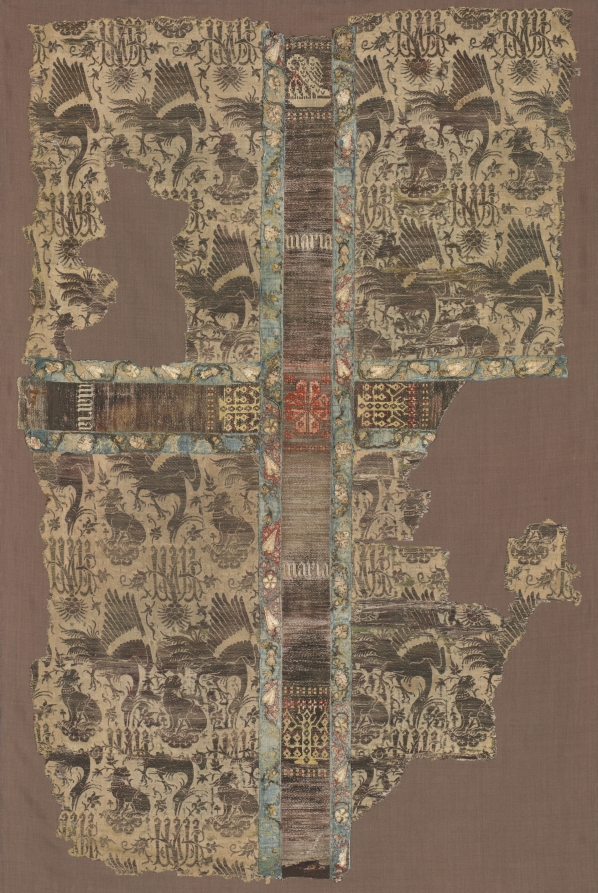
To engage with this artifact—a fragmentary chasuble bearing a woven orphrey band—is to undertake a consultation with history itself. One does not merely examine it; one is measured by it. The client, in this instance, is the past, presenting a case built not upon words, but upon threads. The garment, now a husk of its former liturgical grandeur, serves as a witness. Its very condition, fragmented and faded, speaks to a narrative of use, reverence, and inevitable decay, a narrative far more compelling than any pristine, archival specimen could hope to convey. Our focus, however, must fall upon the material. The silk is not merely the medium; it is the message, the motive, and the ultimate testament to a legacy of imperial ambition woven with divine aspiration.
The Orphrey as Statement: Woven Theology and Temporal Power
Consider first the orphrey band. This is not adornment in the common sense; it is a heraldic proclamation for the sacred. Woven with a precision that borders on the obsessive, its intricate patterns—likely depicting saints, celestial motifs, or intricate foliate designs—were a form of wearable theology. In the candlelit gloom of a great cathedral, this band would have been a focal point, a shimmering, tactile sermon. The technical proficiency required to execute such detail on a drawloom represents the apex of pre-industrial technology. This proficiency was not democratically held; it was fiercely guarded state intelligence. The workshops of Byzantium, later those of Lucca, Venice, and Lyon, operated under imperial or ducal patronage. The silks they produced were instruments of soft power, as strategic in their way as any treaty or marriage alliance. To vest a priest or bishop in such cloth was to drape him in the authority of the state that enabled its creation. The fabric thus becomes a seamless confluence—forgive the term—of spiritual and temporal dominion.
The Silk Itself: From Cocoon to Currency
We must then dissect the material substrate: the silk thread. Its journey, from the mulberry groves of China or later, the controlled cultivations of Sicily and Spain, to this fragile fragment in our care, maps the trade routes of empires. Raw silk was a commodity as valuable as spice or bullion. The ability to not only import it but to master its transformation was a hallmark of a sophisticated, economically potent realm. The hand that now hovers over this chasuble fragment touches the culmination of a vast, imperial supply chain. The sheen—the candle, as we might term its lustre—though dimmed, hints at its original glory. This was a surface that actively engaged with light, designed to catch and refract it, to announce the wearer as a being apart, invested with a luminosity both metaphorical and breathtakingly real. The weight, the drape, the subtle, resilient strength of the fabric: these are the qualities that made silk the ultimate cloth of distinction. It held colour with a depth and permanence unknown to wool or linen, allowing for the rich, symbolic hues of liturgical vestments—the scarlet of martyrdom, the gold of triumph, the violet of penance.
The Legacy of the Loom: An Unbroken Thread
The legacy of this imperial silk weaving is not confined to reliquaries and museum cabinets. One can perceive its echo, its genetic code, in the most exacting tailoring establishments of the modern age. The Savile Row cutter, after all, understands that true luxury is not about ostentation, but about integrity—integrity of material, integrity of construction, integrity of purpose. The imperial weavers knew this. Every thread in this orphrey was placed with intention; every colour change was a considered decision. There was no room for the provisional. This is the same philosophy that demands a canvas interlining be hand-stitched with a herringbone pitch, that a sleeve head be roped to create a clean, authoritative line. The pursuit of perfection within a rigid framework of tradition is the common thread. The chasuble was woven to a sacred pattern; a bespoke lounge coat is cut to a canonical silhouette. Both are testaments to the human desire to invest material with meaning, to craft objects that transcend their utilitarian function and speak to a higher order.
Conclusion: The Fragment as Whole Cloth
In conclusion, this fragmentary chasuble, in its dignified dissolution, offers a masterclass in the material foundations of influence. The silk is the through-line. It speaks of empires that understood the power of spectacle, of a Church that employed the most advanced material science of its day to manifest the divine, and of artisans whose skill elevated craft to the realm of the sublime. To analyse it is to understand that heritage is not a static concept to be preserved under glass. It is a dynamic principle of excellence, a commitment to the supremacy of the right material, employed with the right technique, for a purpose beyond the mundane. The woven orphrey band, though perhaps detached from its original ground, remains a potent stripe of history. It reminds us that true legacy is never merely owned; it is worn, it is used, and ultimately, it is woven, thread by deliberate thread, into the very fabric of human aspiration. The cloth, in the end, is the contract.