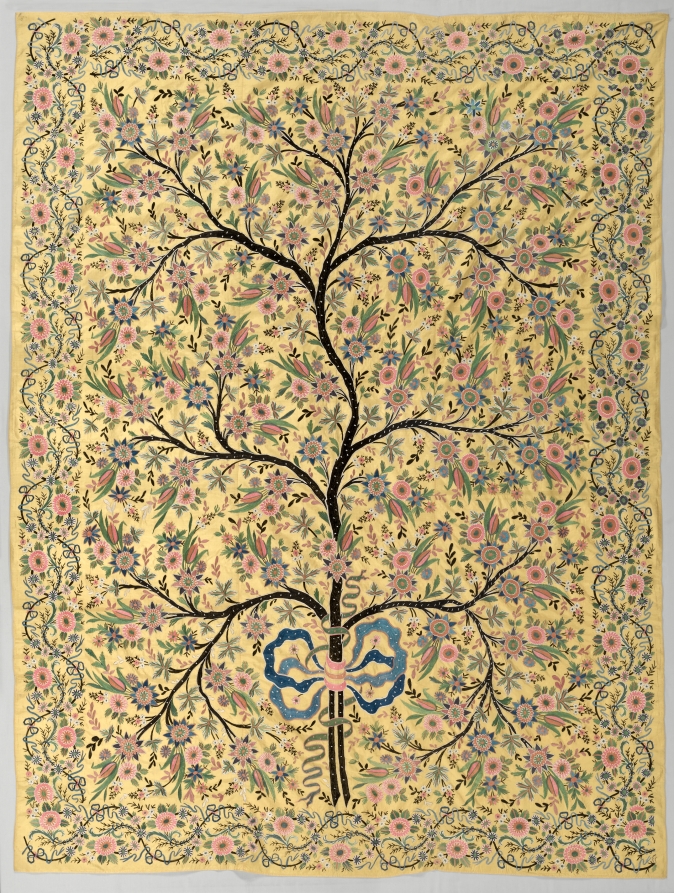
A Treatise on the Arboreal Tapestry: Silk as the Substrate of Sovereignty
To comprehend the object in question—a silk hanging of considerable age, embroidered with the archetypal ‘Tree of Life’ motif—one must first dismiss the modern inclination to view it merely as a decorative textile. This is not an article of furnishing; it is a heraldic device rendered in filament, a silent proclamation of imperial authority, cosmological order, and dynastic perpetuity. Its materiality is not incidental but foundational. The very fibre, the weave, the chromatic depth achieved through dyes reserved for the throne—each element conspires to elevate the symbol from mere representation to embodied ideology.
The Sovereign Thread: Imperial Sericulture as a Monopoly of Meaning
The legacy of imperial silk weaving is, at its core, a narrative of controlled exclusivity. From the Byzantine gynaecea to the Ming dynasty’s meticulously managed workshops in Suzhou, and onward to the royal manufactories of Lyon under lettre de cachet, silk production was seldom a commercial endeavour in the common sense. It was a state secret guarded with the fervour of military intelligence. The cultivation of the mulberry, the rearing of the Bombyx mori silkworm, the intricate looms capable of producing damasks and brocades—these were technologies of power as consequential as siege engines or tax-collection systems.
To drape a chamber in such silk, or to present such a hanging, was to perform a material assertion of one’s position within that rigid hierarchy. The silk itself, before a single supplementary thread of embroidery was added, communicated a formidable message: the patron commanded resources and access beyond the reach of the merchant or the minor nobility. Its handle, its weight, its luminous sheen—the result of thousands of hours of specialised labour—established an immediate, tactile hierarchy between the viewer and the commissioner.
The Embroidered Cosmogram: Anatomy of the Arboreal Motif
Upon this ground of sanctioned splendour, the embroidered Tree of Life is deployed. This is no pastoral scene. Observe its construction. The trunk, likely executed in couched gold-wrapped thread, rises with an unwavering verticality, a central axis mundi asserting order against chaos. Its roots, if depicted, delve into realms symbolic of ancestry and foundational strength, while its branches spread with a balanced, often symmetrical, grandeur. This is the architecture of the universe, rendered in stitch.
The foliage and fruiting bodies are of particular note. Here, the embroiderer—an artisan whose skill was honed within the imperial atelier—would employ a lexicon of stitches: the delicate shading of long-and-short stitch to suggest botanical volume, the precise sparkle of seed pearls or minute spangles to imitate dew or celestial influence. The species of tree is frequently syncretic, an idealised hybrid bearing the pomegranate of fertility, the peach of immortality, the pine needle of longevity. It is a tree that exists only in the realm of ideology, gathering the auspicious attributes of the natural world into a single, perfect emblem.
Fauna often inhabit this rarefied ecosystem: paired phoenixes denoting imperial consorts, coiled dragons of celestial mandate, or harmonious birds representing ministerial fidelity. Each creature occupies its ordained station within the branches, a microcosm of the well-ordered state. The entire composition, in its balanced complexity, serves as a visual treatise on benevolent rule—a rule that nurtures growth, ensures stability, and provides for all creatures under its canopy.
From Palace Wall to Patrimony: The Continuum of Legacy
The journey of such an artifact from an imperial context to the purview of contemporary heritage institutions like our own Lab is a transition from active propaganda to passive testament. Its power is no longer immediate and political but has been transmuted into historical evidence and aesthetic resonance. The silence that now surrounds it is not one of absence, but of accumulated meaning.
Our analysis, therefore, must be tripartite. First, a forensic appreciation of the material: the density of the silk warp and weft, the degradation of the dye molecules, the tarnishing of metallic threads—each tells a story of environment and use. Second, a decryption of the symbolic lexicon, requiring cross-cultural scholarship to interpret the specific dialect of iconography employed. Finally, and most critically, an understanding of its performative context: Was it a diplomatic gift, cementing an alliance between courts? A backdrop to a throne, framing the ruler as the living embodiment of the tree’s vitality? Or a didactic piece within an inner chamber, instructing heirs in the principles of their destined governance?
In conclusion, this silk hanging stands as a paramount heritage artifact. It represents the apogee of a system where material, motif, and manufacture were inseparable from the exercise of power. The imperial silk legacy is not merely one of technical mastery, though that is profound. It is the story of how a fibre, through absolute control over its creation and deployment, was woven into the very fabric of history’s most formidable empires. To study it is to understand that true luxury is never simply about expense; it is about the authoritative orchestration of meaning, from the silkworm’s first thread to the final, emblematic stitch upon the loom of state.