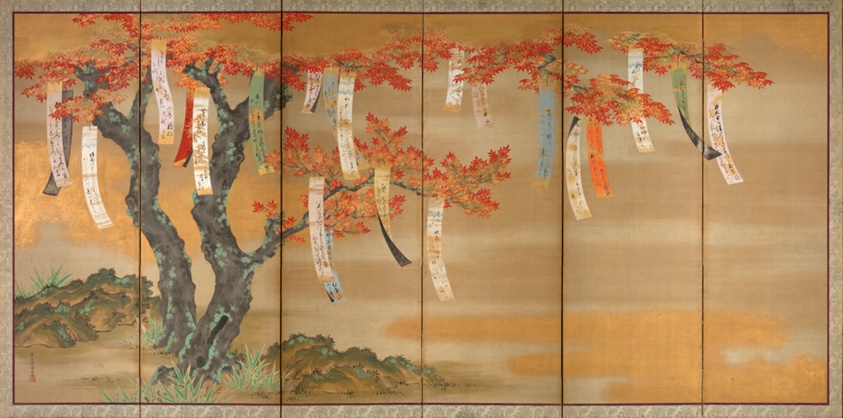
An Examination of Autumnal Majesty: The Six-Panel Screen as a Testament to Uncompromising Artistry
In the considered realm of heritage, where materiality and narrative converge to define a house’s enduring character, few artifacts possess the quiet authority of a finely executed screen. The subject piece, Autumn Maples with Poem Slips, is not merely a decorative object; it is a profound statement of cultivated taste and technical mastery. As one of a pair, it functions within a dialogue of space and perspective, a principle not unlike the bespoke tailoring of a double-breasted Chesterfield overcoat, where each panel must relate precisely to its neighbour to achieve a harmonious whole. The foundation of this dialogue, the very canvas upon which this autumnal drama is rendered, is silk. This is not a mere substrate but the essential, non-negotiable groundwork—the equivalent of a pristine length of hand-woven wool from the mills of Huddersfield. Its fine, luminous surface accepts ink and pigment with a receptive clarity, while its inherent strength and slight sheen provide a depth and dignity that lesser materials cannot emulate. The silk here is the silent partner in this enterprise, the impeccable canvas that justifies and elevates the artistry applied upon it.
The Grammar of Pigment and Precious Metal: A Composition in Fluidity and Restraint
The material palette employed—ink, colors, gold leaf, and gold powder—speaks to a hierarchy of application and visual effect that demands scholarly attention. The initial draft of the composition, executed in ink, establishes the architecture of the scene with the disciplined line of a master cutter’s chalk. The trunks and branches of the maples are defined with a fluid elegance that suggests both the organic vitality of the tree and the unerring confidence of the artist’s hand. Upon this assured skeleton, colors are laid with a deliberateness that avoids the vulgarity of mere ornamentation. The autumnal hues—the vermillion, the ochre, the lingering greens—are not flat washes but modulated tones that suggest the play of light through foliage, a technique requiring multiple layers of translucent pigment to achieve its resonant depth.
The deployment of gold, however, is where the artifact asserts its most distinguished character. Gold leaf is applied not as gaudy embellishment, but as structural accentuation, perhaps outlining a branch or highlighting a rocky outcrop with the discreet authority of a silk-knot cufflink. Its solid, reflective plane commands respect. The gold powder, by contrast, is the element of atmosphere and ethereal light. Meticulously sprinkled or blown onto the silk, often through a bamboo tube, it catches the ambient light to suggest mist rising from a mountain stream or the gentle, particulate haze of an autumn afternoon. This interplay between the solidity of leaf and the diffusion of powder creates a textural counterpoint of immense sophistication, a visual language that communicates luxury through nuance rather than excess.
The Poetic Interlude: Poem Slips as Intellectual Bespokery
The inclusion of the poem slips (tanzaku) transforms the screen from a purely landscape composition into an object of literary and philosophical contemplation. These are not afterthoughts, but integral elements of the design, carefully positioned within the visual flow like the placement of a ticket pocket or the angle of a bespoke lapel. Their calligraphy, executed with the same disciplined fluency as the painted lines, adds a layer of textual rhythm to the visual rhythm of branches and leaves. The content of the poems—likely classical verses reflecting on transience, beauty, and the season—engages the viewer in a direct, intellectual exchange. This integration of word and image represents the highest form of the patron’s and artist’s erudition, signalling a heritage that values the cultivation of the mind alongside the refinement of aesthetic sensibility. It is the equivalent of a perfectly tailored garment that reveals, upon closer inspection, a hand-stitched monogram of exceptional fineness—a detail for the connoisseur, affirming a shared language of discernment.
Context and Connoisseurship: The Screen in its Proper Sphere
The described context of classic silk craftsmanship and fluid elegance is not a vague attribution but the definitive summary of the artifact’s ethos. The craftsmanship is evident in every seam of the silk panels, in the flawless application of fragile gold leaf over a textured ground, and in the patient building of color. The fluid elegance is the result of that craftsmanship placed in the service of a poetic vision, where technical restraint allows naturalistic forms to emerge with graceful spontaneity. As one of a pair, this screen would have been used to define space within an important chamber, creating a room within a room, a backdrop for diplomacy, conversation, or private reflection. Its presence would have moderated light, sound, and movement, its narrative engaging the seated viewer from multiple angles.
In conclusion, Autumn Maples with Poem Slips stands as a peerless exemplar of heritage art. Its materiality—from the foundational silk to the strategic deployment of precious metals—obeys a logic of understated supremacy. Its composition balances botanical vitality with poetic contemplation, and its execution demonstrates a fluency born of generational knowledge and painstaking practice. To engage with this artifact is to understand that true heritage, whether in the East or the West, in a Kyoto atelier or on Savile Row, is never a matter of mere appearance. It is the profound synthesis of the finest materials, executed with peerless technique, and informed by a cultivated intellect. It is, in the final analysis, the standard by which all subsequent expressions of elegance are inevitably measured.