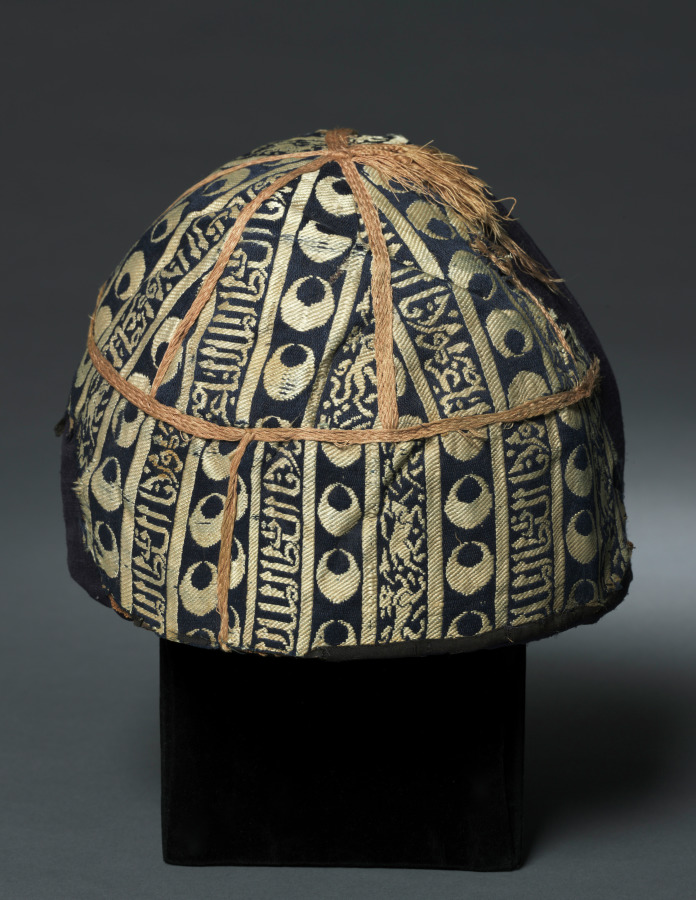
An Examination of the Striped Inscribed Silk Cap: A Confluence of Imperial Legacy and Personal Adornment
Within the refined purview of sartorial heritage, certain artifacts transcend their apparent simplicity to reveal narratives of profound cultural and technical significance. The subject—a cap constructed from striped inscribed silk—presents such a case. To the untutored eye, it may register as a mere accessory, a trifle. To the connoisseur, however, it represents a distilled embodiment of imperial ambition, a terminus of the most complex supply chains of the pre-modern world, and a statement of personal affiliation or aspiration. Its materiality, silk, is not merely a choice of fabric but the very medium of the story.
The Foundation: Imperial Silk Weaving as an Apparatus of State
One must first apprehend the context from which this material sprang. Imperial silk weaving, particularly as perfected in the Chinese and later Byzantine and Ottoman traditions, was never a mere industry; it was a deliberate instrument of statecraft and cosmological expression. State-controlled workshops, such as the famed Ming and Qing dynasty establishments in Jiangnan, operated with a precision and secrecy akin to a modern intelligence service. Patterns were decreed, their usage legislated by sumptuary laws—the dragon for the Son of Heaven alone, certain cloud forms for a magistrate of a specific rank. The silk itself, from the cultivation of the mulberry groves to the final beat of the loom, was a manifestation of imperial order and beneficence. It was currency, diplomatic gift, and a canvas upon which the iconography of power was rendered in breathtaking detail. To possess an object of this silk was to possess a fragment of that sanctioned, celestial order.
Decoding the Inscription: The Personal within the Imperial
This brings us to the cap’s defining characteristic: the inscribed stripe. Herein lies the artifact’s particular genius. The stripe itself is a fundamental grammar of textile design, yet in an imperial context, its width, colour sequence, and placement were often meticulously codified. The inscription woven within the stripe—likely a discreet repeat of characters or a monogram—shifts the object from the generic to the particular. It is the intrusion of the individual, or the institutional, into the stately language of the imperial weave.
Was this a cap bestowed upon a minor official, his rank and perhaps even his office encoded in those silken threads? Or was it commissioned privately by a merchant of immense wealth, one who, barred by birth from wearing the full imperial panoply, sought to align himself with its authority through this subtle, wearable cipher? The inscription is the key. It transforms the cap from a simple article of dress into a document. It speaks of affiliation, loyalty, or ambition. It is, in essence, a forerunner to the bespoke label—a mark not of the maker, but of the wearer’s chosen identity, woven into the very stuff of the garment.
Materiality and Making: The Tactile Testament
The hand, as ever, informs the mind. The materiality of the silk in this cap demands a tactile appraisal. The fineness of the filament, the density of the weave, the sheen that reflects light with a soft, pearlescent quality—these are the hallmarks of imperial-grade production. This is not the utilitarian silk of a peasant’s tunic; it is the product of countless hours of skilled labour, from the careful rearing of the silkworms to the mastery of the draw-loom operated by teams of artisans. The cap’ construction, likely lightweight and designed to be cool and comfortable, belies the immense industrial might required to produce its raw material. It is an object of luxury in the truest sense: its luxury resides not in ostentation, but in the flawless execution of an extraordinarily complex process, now rendered into a form of understated, daily use.
Conclusion: A Legacy in Microcosm
Thus, this striped inscribed silk cap stands as a heritage artifact of remarkable density. It is a microcosm of the imperial silk legacy, encapsulating its bureaucratic control, its technical sublime, and its role as a social signifier. It demonstrates how the grand narratives of empire and trade were ultimately digested and expressed on the scale of the individual. The cap served as a portable token of a vast, interconnected world—a world where the desire for connection, for status, and for beauty found its expression in the intricate interplay of thread, dye, and loom. In studying it, we are reminded that true heritage in fashion is rarely about the garment alone; it is about understanding the world that conceived it, the hands that built it, and the individual who chose to wear it. This cap, in its elegant simplicity, is a nexus where all those threads converge.