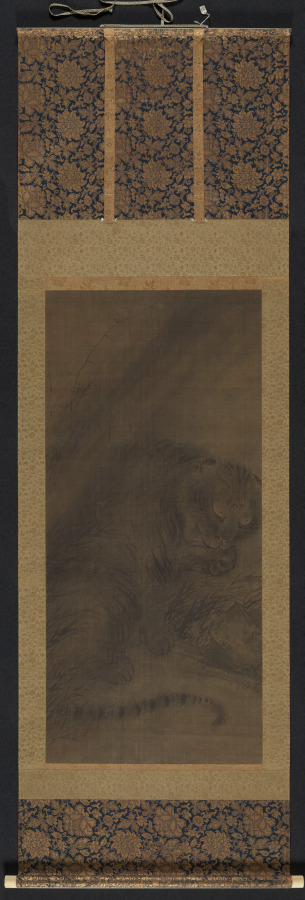
A Discourse on the Imperial Feline: The Tiger in the Grand Tapestry of Silk
To consider the tiger in silk is to engage with a subject of profound material and symbolic consequence. It is not merely the representation of a formidable creature; it is the embodiment of raw, untamed power rendered into the most refined and civilised of textiles. This confluence—the savage majesty of the beast captured within the exquisite, labour-intensive medium of imperial silk weaving—speaks to a central tenet of legacy: the aspiration to command, to aestheticise, and ultimately to wear the very essence of nature's most potent forces.
The Loom as a Domain of Command
The legacy of imperial silk weaving, from the ateliers of Suzhou to the workshops of Byzantium and beyond, was founded upon a principle of absolute dominion. Mastery was demonstrated not only over the delicate Bombyx mori and the complex drawloom but over the entire visual lexicon of the natural world. To commission a length of silk featuring the tiger was, therefore, a deliberate act of symbolic possession. The silk itself, a commodity of immense value, traversing continents along routes that bore its name, was the rightful substrate for emperors and sovereigns. To adorn it with the tiger was to claim kinship with the animal's uncontested authority, its role as the apex sovereign of the mountainous and forested realms.
This was not a simple depiction. The materiality of silk—its luminous sheen, its capacity to hold colour with unparalleled depth and clarity, its fluid drape—elevated the image beyond the pictorial. In a woven kesi (silk tapestry) or a finely detailed satin damask, the tiger’s pelt is not merely seen; it is suggested through the very play of light upon the weave structure. The raised threads of a brocaded stripe catch the illumination differently, creating a palpable texture, a suggestion of fur and muscle beneath the surface. The craftsman’s needle or shuttle did not paint a tiger; it architecturally constructed one, thread by strategic thread, within the matrix of the fabric. The beast is integrated into the very foundation of the cloth, becoming inseparable from its substance—a permanent and integral emblem of power.
Heraldry of the Unconquered Realm
In the context of imperial iconography, the tiger frequently served as a heraldic device, a symbol of military might, courage, and the protection of the state. Unlike the dragon, often reserved for the celestial authority of the emperor himself, the tiger could represent the highest echelons of the military command—the fierce and loyal guardian of the realm. On a ceremonial robe or a rank badge, a silk-woven tiger communicated a clear and immediate message: the wearer possesses and channels this formidable energy. The silk ground, in its splendour and cost, contextualises that ferocity within the framework of courtly order, civilisation, and immense wealth. The tiger does not roam wild here; it is regimented, framed by scrolling clouds or perched upon mountain crags within the disciplined border of the garment, its power now in service to the empire.
Furthermore, the technical execution required to portray the tiger with appropriate gravitas was itself a demonstration of imperial capability. The rendering of the sinuous musculature, the penetrating gaze of the eye, the intricate variegation of the stripes—each demanded the highest level of skill from the weaving bureau. A poorly executed tiger on such a precious ground would be an affront, a dilution of the very concept it sought to embody. Thus, the perfect silk tiger stood as a testament to the empire’s ability to marshal its greatest artistic and technical resources, to tame complexity itself, much as it aspired to tame the frontiers the animal represented.
A Legacy in the Modern Cloth
The resonance of this heritage for a contemporary sensibility, particularly one attuned to the language of bespoke craftsmanship, is significant. The principle translates. It is found not in literal reproduction, but in the conceptual understanding of fabric as a carrier of profound narrative and authority. The modern equivalent lies in the seeking of a cloth that possesses not just aesthetic appeal, but a depth of character—a history woven into its fibres.
Consider a bespoke lounge jacket, cut from a heavy silk twill or a jacquard-woven silk that features a subtle, abstracted interpretation of the tiger’s stripe. The reference is not overt, but the lineage is traceable. The wearer is not declaring martial prowess, but rather an alignment with values of strength, independence, and a certain untameable individuality. The silk bestows a luxuriance and a gravity that pure wool cannot replicate; it connects the garment to that ancient legacy of silk as a canvas for statements of personal and sovereign identity. The craftsmanship of the Savile Row cutter, sculpting this demanding textile to the individual form, mirrors the mastery of the imperial weaver—both exercises in commanding a material to express a specific, potent ideal.
In final analysis, the tiger in imperial silk is a supreme paradox: the wild made orderly, terror made beautiful, nature’s most fearsome predator rendered into an asset of cultural capital. It represents the apex of a system where material, motif, and craftsmanship were fused to articulate hierarchies and aspirations with silent, dazzling eloquence. To study this artifact is to understand that true luxury has never been merely about ornament. It is, and has always been, about the embodiment of power—softly spoken, impeccably dressed, and woven with the indelible stripes of legacy.