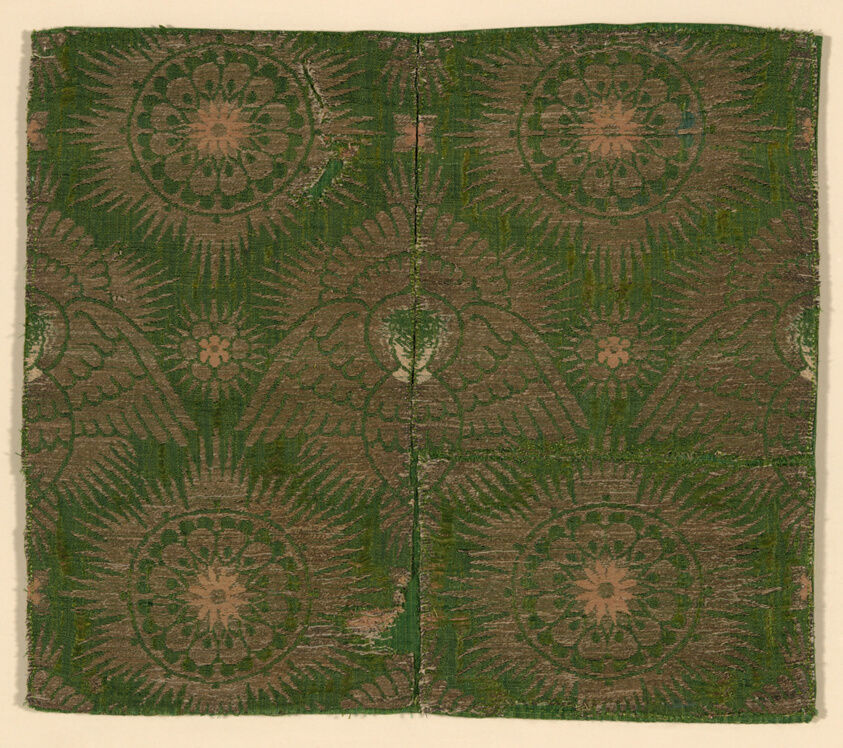
An Examination of the Fragment: Materiality as Narrative
In the considered pursuit of sartorial heritage, one must occasionally pause to examine the constituent parts, the foundational elements from which greatness is constructed. It is within this spirit that we present for analysis a singular Fragment. This is not merely a remnant, but a deliberate archive, a tactile testament to a dialogue between material, technique, and intent. Its value lies not in dimension, but in density—of information, of craftsmanship, of historical conversation. To engage with it is to engage with the very grammar of classic silk craftsmanship and fluid elegance.
Deconstruction of Substance: A Technical Interrogation
The primary substrate is one of understated authority: a twill weave linen. This is no mere canvas, but a carefully selected foundation, chosen for its inherent stability and dignified body. Upon this, the narrative is elevated through the application of a gilt-animal-substrate wrap. This precise terminology is crucial. It indicates not a simple coating, but a laborious process wherein the linen thread is meticulously bound with an ultra-fine membrane—traditionally gut or sericin—subsequently treated with gilding. This technique imparts a subtle, depth-laden luminosity to the ground, a suggestion of light from within rather than a superficial glare, preparing the stage for the principal actor.
That actor is, unequivocally, the silk. The structure is a complex twill interlacing of secondary binding warps and supplementary patterning wefts. This technical description belies its poetic outcome. The secondary binding warps provide a hidden architecture, a disciplined framework that ensures structural integrity. The supplementary patterning wefts are the artists of motion. Unburdened by structural duty, they are introduced with calculated liberty, floating across the gilt-ground to create the design. It is this very separation of function—binding versus patterning—that permits the signature fluid elegance. The pattern does not distort the cloth; it floats upon it, resulting in a design of remarkable softness and pliability, a fabric that moves with a liquid drape rather than a stiffened carriage.
The Philosophy of the Fragment: Integrity in Isolation
To the untrained eye, a fragment suggests incompletion. To the specialist, it represents a purer form of evidence. Stripped of a garment’s final form, freed from the distractions of silhouette and seam, the Fragment demands we focus solely on the essence of its making. Here, in this isolated state, we witness the unadulterated conversation between weaver and material. Every intersection of warp and weft is a deliberate decision; every passage of the supplementary weft is a brushstroke. The fragment becomes a lens, magnifying the maker’s hand and the inherent character of the silk itself—its tensile strength, its capacity to hold dye, its singular acoustic property (that distinctive "scroop" or whisper) which is as much a part of its identity as its visual lustre.
This particular artifact speaks of a confidence in material honesty. The gilt-linen ground is not concealed but acknowledged, its richness forming an integral part of the aesthetic whole. The silk patterning, while assured, does not seek to dominate through opacity, but often through a modulated translucency that respects the ground beneath. This creates a visual depth, a sense of layered history within the cloth itself. It is a philosophy akin to the finest bespoke tailoring: the internal structure—the canvas, the haircloth, the stitch—is executed with such integrity that it empowers the exterior cloth to perform with effortless grace.
Context and Continuum: From Loom to Line
The context of Classic silk craftsmanship is not a museum diorama but a living continuum. This fragment, while historically resonant, establishes principles that remain exigent for contemporary luxury. The understanding of weight, drape, and hand—all are dictated by the decisions evidenced here. The choice of a complex weave over a simple print, the investment in supplementary threads that yield a softer handle, the patience required for a gilt-wrapped substrate—these are the non-negotiable tenets of quality.
In the ateliers of Savile Row and the premier fashion houses, the lessons of such a fragment are perpetually relevant. It informs the selection of silks for a bespoke dressing gown where fluidity is paramount, or the development of a unique cloth for an evening tailcoat where a subdued gleam is required. It teaches that true luxury resides in the unseen, the foundational, and the meticulously integrated. The elegance is not applied; it is woven in.
Thus, this Fragment stands as a benchmark. It is a physical manifesto declaring that materiality is the first and most critical draft of any design narrative. Its twill interlacings are a syntax, its silk wefts a vocabulary, together composing a silent oration on the enduring principles of excellence. To study it is to understand that before a cut is made or a line is drawn, the dialogue with cloth—in all its technical, historical, and sensual complexity—must be both profound and respectful. It is, in the final analysis, the absolute foundation upon which all else—fluid elegance, timeless style, enduring prestige—is irrevocably built.