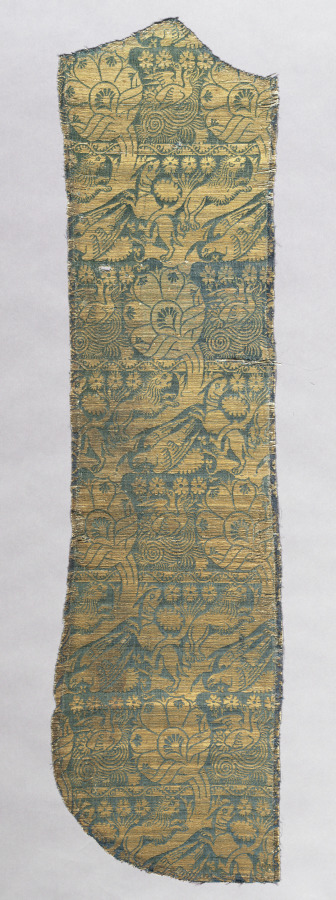
A Fragment of Dominion: On the Materiality of a Chasuble Embroidered with Realistic Animals
To comprehend the fragment—a singular panel of silk, once integral to a chasuble, now residing under museum glass—one must first dismiss the merely decorative. The subject is not "animals," in the pastoral or heraldic sense, but Realistic Animals. Herein lies the profound distinction. This is not the symbolic lamb or the stylised eagle of hagiography. This is the meticulous rendering of fur, feather, and sinew; a menagerie captured in warp and weft with a naturalist’s eye. Such verisimilitude was never an accident, nor a mere display of technical prowess for its own sake. It was, quite deliberately, a statement of imperial command.
The Loom as an Instrument of State
The material, of course, is silk. Not merely silk, but the product of a vertically integrated imperial monopoly. From the mulberry groves, through the secretive rearing of the *Bombyx mori*, to the vast, state-administered ateliers of weavers operating looms of breathtaking complexity, every inch was an exercise in controlled production. The silk itself, a filament of protein, becomes in this context a thread of sovereignty. To clothe the clergy in such stuff was to drape the Church in the tangible wealth and logistical might of the Crown. The fragment before us, likely a product of the Byzantine *gynaeceum* or a later Western imperial workshop, speaks of a supply chain as meticulously managed as any army—because, in essence, it was the logistical wing of the same entity.
The depiction of realistic fauna elevates this statement from one of opulence to one of encyclopaedic dominion. To render a hawk’s plumage with such precision, to suggest the musculature of a stag in mid-flight, required more than skilled artisans. It required access to, and patronage of, the best bestiaries, the royal menageries, the hunting parks where such creatures were kept for imperial pleasure and study. The imagery is a tapestry of possession. Each meticulously woven beast—the fox, the hound, the fantastical bird—is a testament to the empire’s reach: over nature, over knowledge, and over the very means to translate that knowledge into a luxury object.
The Sacred Garment: A Confluence of Authority
That this silk was fashioned into a chasuble is the final, and most potent, layer of its legacy. The chasuble, the outermost vestment of the celebrating priest, is a garment of singular focus, representing the yoke of Christ. To adorn it with these secular, naturalistic triumphs is a profound act of synthesis. It does not diminish the sacred; rather, it subsumes the imperial into the divine order. The message is unequivocal: the authority that commands the loom, the menagerie, and the natural world is the same authority that upholds and is upheld by the Church. The priest, elevating the host, becomes the focal point where spiritual and temporal power are literally woven together upon his shoulders.
Consider the wear. A garment of such exquisite and figurative silk was not for the parish priest. It was for the cathedral, the royal chapel, the Papal court—spaces where power was performed. In the candlelight, the shimmer of the silk would have brought these creatures to a subdued life, a moving panorama of created order behind the sacred rites. The fragment we study today, likely worn thin at the shoulders from the precise weight of vestments laid upon it, carries the ghost of that performance. The realism of the animals would have been a quiet, continuous sermon on the glory of God as manifested through the perfect order of His earthly kingdom—a kingdom administered, naturally, by His imperial steward.
Legacy in the Thread
What, then, is the enduring legacy encoded in this fragment? It transcends the aesthetic. It is a masterclass in the use of material culture as a tool of statecraft and ideology. The imperial silk weaving legacy is one of comprehensive control: of a biological process (sericulture), of a complex mechanical technology (the draw-loom), of artistic expression (the mandated realism), and finally, of symbolic narrative (its placement upon the sacred vestment).
In our contemporary context, where luxury is so often conflated with mere branding, this fragment instructs us. True luxury, in the imperial sense, was the removal of accident. It was the absolute assurance of quality, the suppression of the individual hand in favour of the institutional standard, and the seamless alignment of material object with political and theological doctrine. The silk is not just the medium; it is the message. Its durability, its sheen, its capacity to hold colour and detail—all these physical properties were harnessed to communicate an immutable truth about the world order.
To hold this fragment—metaphorically, in the mind’s eye—is to understand that the most powerful statements are often those worn closest to the skin. It is a relic of a time when an empire’s ambition was measured not only in territory or treasure, but in the precision of a hawk’s eye, woven in silk, and laid upon the altar. The legacy is one of total integration. The loom, the state, and the church were, in the end, parts of the same magnificent and formidable mechanism.