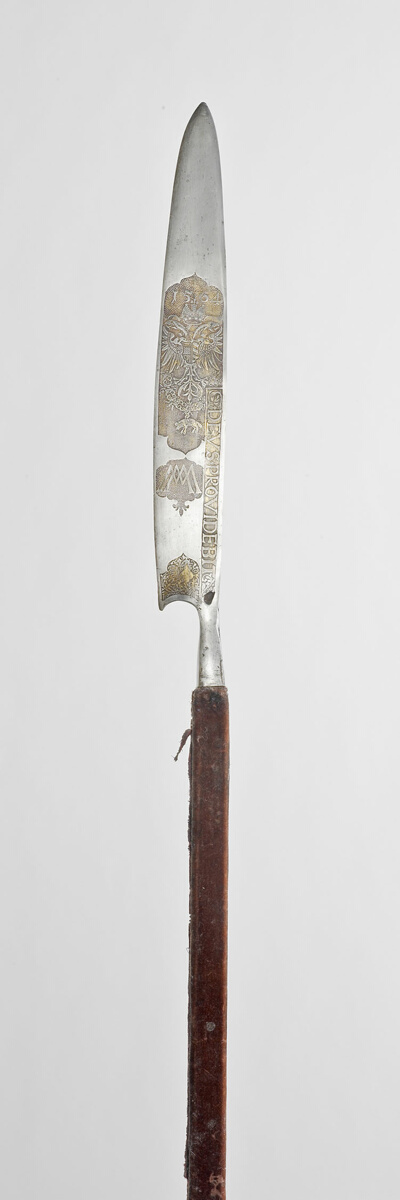
An Instrument of Sovereign Assurance: The Glaive of the Imperial Bodyguard
To consider the glaive—a polearm of formidable reach and decisive utility—is to engage with the purest principles of functional design. Its form is an essay in directed force, a geometry resolved for the singular purpose of protection. Yet, when such an instrument is elevated to the service of a Habsburg emperor, its material narrative transcends mere utility. The glaive commissioned for the personal bodyguard of His Imperial Majesty Maximilian II becomes, in the hands of the discerning observer, a profound artefact of sovereign theatre. It speaks not of the workshop alone, but of the court; not merely of steel, but of stature. Its true essence, we shall argue, is captured not in its tempered edge, but in the few, precise inches where its haft meets the blade: a collar of velvet.
The Foundation: A Architecture of Deterrence
The underlying structure adheres to an unimpeachable martial logic. The core is a shaft of seasoned Central European oak, selected for its resilient density and subtle flex—a wood that absorbs the shock of a parried blow without betraying the grip of its wielder. From this foundation rises the steel, the very embodiment of imperial authority. The blade itself, a broad, cleaving axe-head flowing into a robust apical spike, is forged from iron refined into steel of a notably fine grain. Its surfaces, where not reserved for the cutting edge, are adorned with restrained gilding. This is not the flamboyant, all-over gilt of a ceremonial mace, but rather a series of deliberate accents: perhaps a foliate border tracing the blade’s spine, or the Imperial eagle etched and fire-gilded upon the cheek. The message is one of lethal capability, aesthetically acknowledged but never compromised.
The Pivot: Where Function Meets Theatre
It is at the langets—the metal straps that descend from the blade to reinforce its union with the haft—that the narrative deepens. Here, steel embraces oak in a firm, protective clasp. And it is over this critical junction that a sheath of the deepest, most sumptuous velvet is drawn and fastened. This is the artefact’s sartorial centrepiece. The fabric is not an afterthought, not a mere wrapping to improve the grip, though it serves that practical end admirably. It is a deliberate, symbolic intervention.
The velvet employed would have been of the highest contemporary order: a silk pile of impeccable density, likely sourced from the legendary looms of Venice or Genoa. Its colour is paramount. One envisions a profound imperial crimson, derived from the precious kermes dye, or a profound black, achieved through multiple dippings in iron-based mordants—colours of authority, solemnity, and power. The pile’s direction, the nap, would be set with fastidious care, ensuring a consistent, light-absorbing depth of hue that no painted or gilded surface could replicate.
The Semiotics of the Silken Collar
This velvet collar performs a transformation. It mediates between the brutal functionality of the weapon and the refined atmosphere of the court. In the echoing halls of the Hofburg or during a stately progress, the bodyguard is not a soldier on a battlefield; he is an extension of the Emperor’s person, a component of the moving tableau of majesty. The glaive is held vertically, a static column of authority. At the eye level of courtiers and ambassadors, what is most visible is not the threatening blade above, but this rich, textural band of silk.
It signals several truths simultaneously. First, restrained opulence: it declares that even the tools of violence in the imperial sphere are subject to the laws of elegance and appropriate display. Second, tactile sovereignty: the velvet invites an understanding of quality that is felt as much as seen, a luxury understood through proximity, not just spectacle. Third, and most critically, it represents contained force. The velvet sheathes the weapon’s most violent junction, symbolically binding its lethal potential, much as the bodyguard’s discipline binds his capacity for action. The power is present, absolute, but veiled—released only upon command. This is the very essence of courtly power: ever-present, yet never unduly exhibited.
Context: Maximilian’s World and the Bodyguard’s Role
Emperor Maximilian II, ruling from 1564 to 1576, presided over a court of immense cultural and political tension. A man of intellectual curiosity positioned between the Catholic and Protestant worlds, his reign required a meticulous performance of strength and erudition. His personal guard, therefore, were not mere brutes. They were selected as much for their imposing stature and unwavering loyalty as for their ability to stand, immovable and impeccable, as living architecture within the imperial scene.
Their glaive, with its silken collar, was the key prop in this performance. It complemented the livery of the guard—itself likely of fine wool, trimmed with silk passementerie. It created a visual and material harmony between the man and his instrument. The fluid elegance referenced in the artefact’s context is not the elegance of a dancer, but the poised, ready elegance of a leopard at rest—a fluidity potential in every muscle and line, held in perfect check.
Conclusion: A Legacy in Thread and Steel
To deconstruct this glaive is to understand that heritage resides in the dialogue between materials. The oak provides integrity, the steel provides authority, and the gilding offers a nod to celestial sanction. But it is the silk velvet that provides the narrative intelligence. It is the stitch that sews the martial into the fabric of the courtly, transforming a weapon of war into an insignia of peace-through-strength.
In the modern atelier of Lauren Fashion Heritage Lab, we understand this language intimately. The principle demonstrated here—that the most powerful statement often lies in the strategic application of the finest, most considered soft furnishing to a structure of purpose—remains a cornerstone of true craftsmanship. The glaive of Maximilian’s bodyguard stands as a historical testament to the fact that whether one is armouring an emperor or tailoring a lounge suit, ultimate authority is always, in the end, softly spoken.