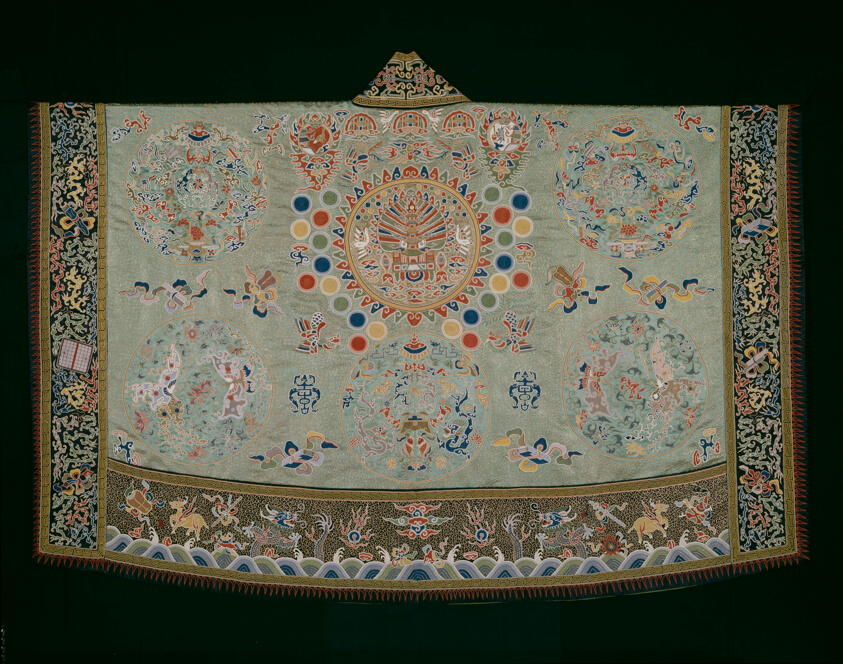
An Exegesis of Woven Sanctity: The Taoist Priest's Vestment
To engage with this artefact is to undertake a study in the confluence of profound spiritual intention and consummate material artistry. It stands, or rather flows, as a testament to a discipline where the sacred is not merely depicted but constituted through the medium itself. We are not observing a garment in any conventional sense; we are presented with a ritual instrument, a cosmological diagram rendered in the most exquisite of earthly fibres. The foundation, the very ground of its being, is silk. This is non-negotiable. In the canon of classical Chinese material hierarchy, silk occupies the apex, a substance born of a metamorphic process that has long been allegorised for spiritual transformation. Its selection here is the first and most fundamental doctrinal statement.
The Architecture of Fluidity: Ground and Form
The specified satin weave is of particular consequence. Unlike the robust honesty of a plain weave or the diagonal rhetoric of a twill, a satin weave presents an unbroken, luminous surface. It is the weave of maximum reflectance, where the warp threads dominate the face, creating a seamless, liquid plane that captures and softens light. This is not mere opulence for its own sake; it is the creation of a visual field of pure, serene potentiality—a tabula rasa of shimmering depth upon which the sacred iconography will be deployed. The fluid elegance mandated by the context is thus engineered at the very loom. The drape, the fall, the way the garment moves with the priest’s meditative gestures—this kinetic sacrament is predetermined by the satin’s inherent grace.
This foundational silk is then lined with a twill damask. A considered choice. The damask, with its self-patterned, reversible weave, introduces a subtle, ordered complexity—a hidden geometry against the wearer’s skin. It provides structural integrity, yes, but also a private, tactile reinforcement of the garment’s sanctified purpose. The twill’s diagonal line whispers of enduring strength, a quiet, inner fortitude beneath the luminous public face of the satin.
The Embroidered Cosmos: Technique as Theology
Here we depart from the merely sartorial and enter the realm of the cartographic. The embroidery is not adornment; it is inscription. The deployment of silk thread, silver-leaf-over-lacquered-paper strips, and gold-leaf-over-lacquered-paper-strip-wrapped silk represents a deliberate hierarchy of materials, each with its own cosmological valence. Silk thread embroidery forms the essential, organic matrix—the earthly flora, the cloud forms, the foundational lines of sacred characters.
The introduction of metal—silver and gold leaf applied over lacquered paper and then meticulously wrapped onto a silk core—is an act of alchemy. It translates mineral wealth into spiritual luminance. Gold, eternally associated with the sun, immortality, and the celestial realm (yang), and silver, with the moon, purity, and reflection, become the visual vocabulary of the divine. The techniques of laid work and couching are critical. Laid work, where long threads are placed across the surface and then secured, allows for expansive, unbroken fields of metallic splendour—perhaps in the depiction of a celestial palace or a deity’s aura. Couching, the method of securing these often fragile metal-wrapped threads by stitching over them with a finer silk, is an act of both protection and precise definition.
Every stitch in this schema is a deliberate act of placement, anchoring celestial symbolism to the silk ground. The motifs—likely encompassing the Eight Trigrams (Bagua), the Yin-Yang Taiji symbol, cranes, clouds, or specific talismanic characters—are not simply pictured. They are built into the fabric’s very substance, their raised, textured presence making them tangible to both sight and touch. The priest does not merely wear symbols; he is enveloped by their material reality.
The Holistic Instrument: Ties, Drape, and Deployment
No element of this vestment is ancillary. The ties, again of silk satin weave, ensure a closure that is secure yet fluid, without the vulgar interruption of foreign materials like metal clasps or buttons. The knot, a potent symbol in Taoist ritual itself, becomes the final, personal act of sealing the priest within the sacred microcosm of the robe.
In its totality, the garment is a masterclass in controlled elegance. Its fluidity is not laxity but a disciplined, purposeful motion. When the priest performs the intricate steps of a ritual dance (Bugang, or Pacing the Void), the satin ground flows like water or swirling cosmic ether, while the embroidered metallic elements catch the light of altar candles, appearing to ignite with a divine fire. The vestment becomes an active participant in the liturgy, its visual language changing with every movement, a dynamic interface between the human officiant and the unseen powers he invokes.
In conclusion, this First-degree Taoist Priest’s vestment represents a pinnacle of heritage where materiality and metaphysics are indivisible. From the strategic selection of a satin-weave silk ground to the alchemical embroidery and the holistic consideration of its drape and closure, every decision serves a doctrinal and ritual end. It is a garment that understands its purpose transcends the corporal. It is, in the most refined sense, woven doctrine—a silent, splendid sermon on the interplay of Heaven, Earth, and Humanity, articulated in the timeless language of silk and sacred thread. Its preservation and study are not merely matters of textile history, but of safeguarding a profound language of spiritual and artistic intelligence.