On the Distinction of Material: A Consideration of Imperial Silk
To speak of heritage, one must first address the fundament of substance. In the realm of sartorial distinction, the material is not merely a substrate; it is the first and most eloquent statement of intent. Here, we concern ourselves with silk—not as a generic commodity, but as the paramount expression of woven authority. Imperial silk, specifically, represents a confluence of political will, agricultural precision, and technical mastery so profound that its very production was, for centuries, a state secret guarded with formidable diligence. The legacy of imperial silk weaving is not one of mere ornamentation; it is the legacy of power made manifest through thread. It establishes a paradigm wherein the fabric is, from its inception, destined for a purpose beyond the quotidian—a purpose of symbolic weight and ceremonial gravity.
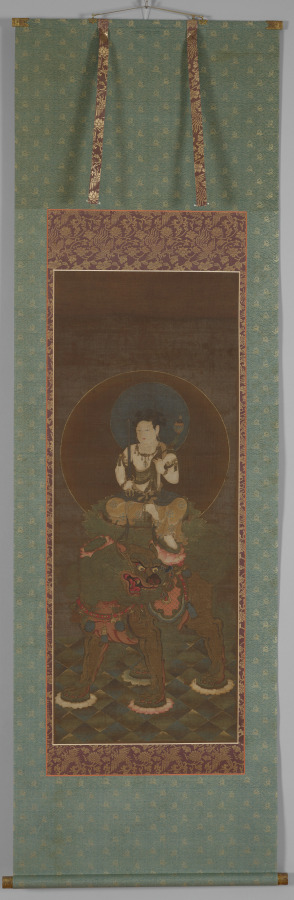
The Artifact: A Formal Analysis of the Monju with Five Hair Knots
The subject under examination—a depiction of the Bodhisattva Monju (Mañjuśrī) distinguished by the singular arrangement of five hair knots—presents itself not as a religious image alone, but as a consummate exercise in the language of imperial silk. One must appreciate the canvas before the iconography. The ground is a silk of formidable density and a sheen that speaks of exceptional filament quality, the result of sericulture practices refined to an exacting standard. This is not a fabric that concedes to light; it commands it, offering a luminous depth that becomes the essential medium for the narrative to follow.
The weaving technique itself is the silent, crucial text. We observe kesi, or slit-tapestry weave, a method wherein the weft threads of coloured silk are built up in discrete areas to form the design, while the warp threads remain concealed. This permits a painterly precision and a chromatic subtlety unattainable by embroidery or print. The effect is one of seamless integration; the deity is not applied to the silk but emerges from its very matrix. The contours of the figure, the intricate folds of the monastic robe, the serene composure of the countenance—all are born from the deliberate, painstaking interlacement of warp and weft. It is a construction of immense patience, where the passage of time is embedded within the structure of the cloth.
Iconography as an Expression of Woven Authority
The depiction of Monju, embodiment of transcendent wisdom, is itself a subject reserved for patronage of the highest order. The five hair knots—a direct reference to the five peaks of Mount Wutai, his celestial abode—are rendered with a geometric clarity that showcases the technical prowess of the loom. Each knot is a perfect, taut sphere of woven colour, a testament to the weaver’s ability to master complex, non-linear forms within the rigid grid of the warp. The implements of wisdom, the sword to cut through ignorance and the sutra resting upon the lotus, are delineated with a sharpness that verges on the heraldic. This is no softly rendered devotional image; it is a statement of doctrinal and cultural authority, executed with the precision of a state document.
The colour palette, derived from mineral and vegetable dyes of the utmost permanence and rarity, further enunciates its provenance. The subdued yet rich hues—deep azures, ochres, and cinnabar reds—are not chosen for mere decorative effect. They adhere to a strict symbolic lexicon and, more practically, demonstrate access to the most exclusive colourants of the imperial workshops. The stability of these colours across centuries speaks of a chemical knowledge as guarded as the weaving techniques themselves.
The Legacy of the Loom: A Continuum of Excellence
To understand this artifact is to understand the ecosystem that produced it. The imperial silk workshops were not ateliers in the romantic sense; they were precision institutions. They operated on a vertical integration of staggering scale: from the mulberry groves and silkworm nurseries under imperial supervision, through the reeling, dyeing, and finally the looms operated by craftsmen whose roles were hereditary and whose skills were the property of the state. The design would have originated from a court artist, transferred to a cartoon, and then interpreted by the master weaver. The process was one of translation—from ink to thread, from idea to material fact.
This legacy informs a modern philosophy of heritage. It is not the replication of a motif that signifies value, but the upholding of a standard—a standard of material integrity, of technical mastery, and of intentionality. The Monju with Five Hair Knots stands as a benchmark. It reminds us that true luxury resides in the unseen effort, the controlled environment, and the relentless pursuit of an ideal form. The silk is not a background; it is the protagonist. The weave is not a method; it is the message.
In conclusion, this research artifact compels a refined perspective. It positions imperial silk not as a historical textile, but as the foundational language of a specific, elevated heritage. The value of the Monju lies in its uncompromising synthesis of medium and meaning. It represents a world where the cloth was, in every sense, sovereign. For the contemporary custodian of heritage, the lesson is clear: distinction begins at the loom. It is a matter of accepting nothing less than a material and execution worthy of the idea it is destined to embody. The legacy, therefore, is a charge—to uphold the principle that excellence is woven in, from the very first thread.