On the Consideration of the Fragment
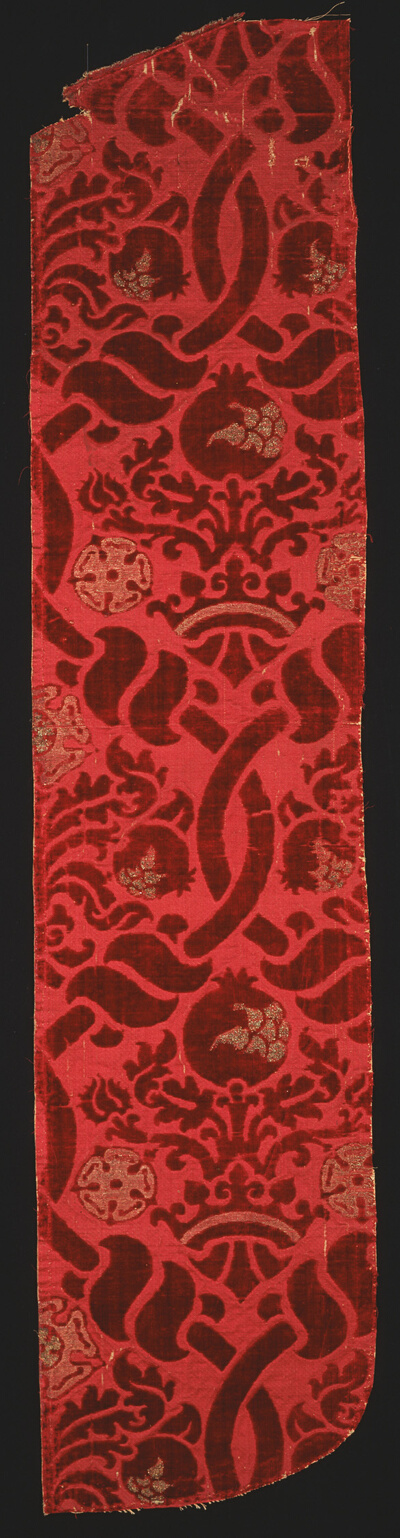
In the rarefied atmosphere of the bespoke salon, completeness is the assumed standard. The garment, presented in its final, impeccable form, is a testament to a concluded dialogue between craftsman and client. To introduce a fragment—a torn, isolated swatch—would be, to the uninitiated, an act of profound incongruity. Yet, for the dedicated scholar of sartorial heritage, it is within such fragments that the most eloquent narratives reside. They are not mere remnants; they are concentrated archives, demanding a forensic level of attention that the finished article, in its distracting totality, often obscures. The presented artifact, a specimen of late nineteenth or early twentieth-century silk craftsmanship, serves as our subject: a portal into the complex dialogue between material intelligence and aesthetic ambition.
Material Intelligence: A Structural Autopsy
Let us first dispense with the superficial. The description provided—silk and gilt-metal-strip-wrapped silk, satin weave with supplementary brocading wefts forming weft loops in areas and supplementary pile warps forming cut voided velvet—is not a mere list of components. It is a technical blueprint, a record of deliberate and costly decisions. The foundation is a satin weave, chosen not for austerity but for its capacity to provide an unbroken, luminous ground. It is the silent, flawless stage upon which a performance of texture and light is to be enacted.
The performance itself is a masterclass in additive technique. The supplementary brocading wefts introduce narrative. These non-structural threads, laid with precision, create raised patterns. The formation of weft loops in select areas indicates a pursuit of tactile variation—a subtle, bubbled texture meant to catch the finger as well as the eye. This is brocade not as mere image, but as topography.
Most significant, however, is the concurrent deployment of supplementary pile warps forming cut voided velvet. This is an operation of considerable ambition. Here, additional warp threads are raised over wires and cut, creating a plush, isolated pile that contrasts dramatically with the satin ground. The term "voided" is crucial: the velvet pattern is not a continuous field, but a defined motif—a crest, a floral spray, an abstract emblem—emerging from and receding into the glossy foundation. The simultaneous use of brocaded loops and voided velvet on a single ground represents a zenith of the weaver’s art, a conscious layering of effects speaking of a client and a context where expense was secondary to expressive impact.
The Alchemy of Surface: Gilt and the Patina of Use
The material specification yields a further, critical detail: gilt-metal-strip-wrapped silk. This is not a metallic yarn in the modern, synthetic sense. It is a slender ribbon of metal, often silver gilt, wound with meticulous care around a core of silk thread. This amalgam achieves a specific luminosity—a light reflected, not merely diffused. In the fragment, one must assess the behaviour of this gilt. Does it retain a sharp, if mellowed, brilliance in protected folds? Has it tarnished to a gentlemanly black in exposed areas, or has the fragile metal worn away entirely, leaving only the ghostly silk core as a record of its former glory?
This patina is the fragment’s autobiography. The wear along a fold line, the slight fraying at a cut edge, the tension set into the threads from decades of graceful movement—these are not flaws to be lamented. They are evidence of life. They tell of a garment that was not archived, but inhabited. The contrast between the enduring, matte resilience of the silk satin and the vulnerable, luminous decay of the gilt becomes a central part of the object’s poetry. It speaks of ephemerality, a central tenet of true elegance—the recognition that beauty exists in a state of graceful attenuation.
Context and Conjecture: From Loom to Salon
The stated context, Classic silk craftsmanship and fluid elegance, provides our directional cue. This fragment does not hail from the theatrical exuberance of the court. Its language, however complex, is one of refined sophistication rather than overt proclamation. The combination of fluid satin, textured brocade, and plush velvet suggests a garment of dynamic, multi-faceted character—perhaps an evening waistcoat for the Edwardian aesthete, or the cuff and collar details of a *robe de style* for a lady of discerning taste. The very density of technique implies areas of focused display: a chest panel, a sweeping cuff, a hem border.
The "fluid elegance" is achieved not in spite of the technical complexity, but because of it. The satin ground ensures the drape and movement, the *fluidity*. The brocade and velvet provide the structured, visual *elegance*. The fragment, in its isolation, allows us to appreciate this dichotomy intimately. We can observe how the velvet pile, though dense, springs from a ground designed to flow. We can hypothesise how the gilt, catching candlelight, would have provided a punctuated sparkle against the deeper, light-absorbing velvet and the shimmering satin field.
Conclusion: The Authority of the Partial
To conclude, the heritage value of this silk fragment resides precisely in its incompleteness. A full garment would command the view, presenting a unified front. The fragment, by contrast, invites interrogation. It forces the eye to consider the warp and weft in isolation, to marvel at the engineering of the velvet void, to trace the delicate corpse of the gilt thread. It makes the private, structural genius of the craftsman publicly legible.
In the tradition of Savile Row, the inside of a jacket—the clean fell seams, the pick-stitching, the breath of the cupro lining—is where the house’s true character is revealed. This fragment operates on the same principle. It is the inside story of elegance. It reminds us that the most profound statements of style are built from a foundation of silent, intricate excellence, and that sometimes, the most complete story is told by what remains.