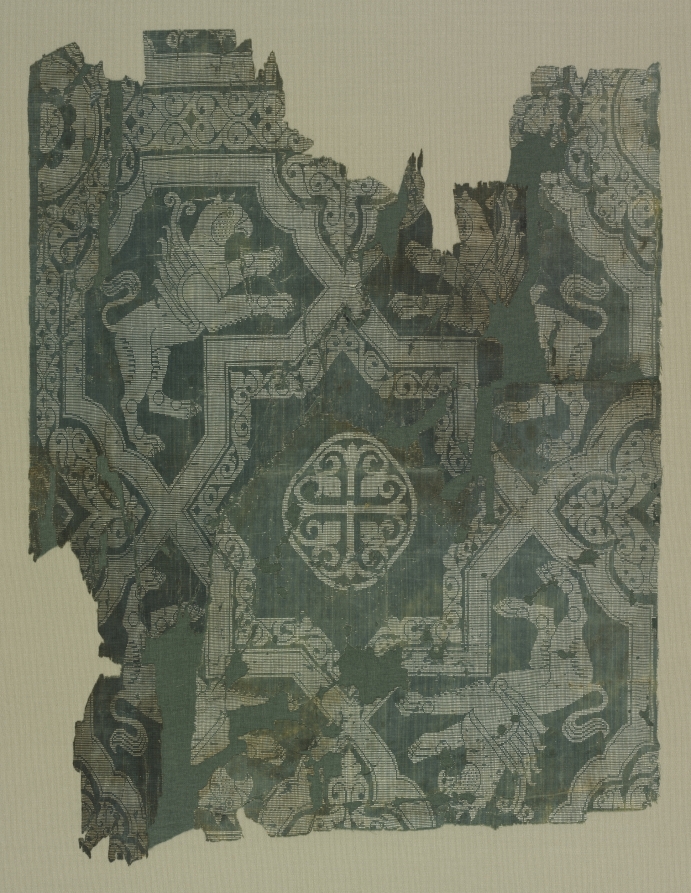
A Fragment of Dominion: Star, Griffin, and the Loom of Empire
One does not merely examine such a fragment; one is received by it. It is an audience, granted by history, in a material that speaks not in whispers but in the clear, costly language of absolute authority. The specimen in question—a fragment, yes, but in its partial state, a more potent testament than a whole bolt of lesser cloth—presents a confluence of symbols rendered in silk. Its very existence is a statement of geopolitical fact, a soft yet imperious assertion of power woven with the patience of empires.
The Foundation: Silk as the Substrate of Sovereignty
To appreciate the narrative, one must first understand the stage upon which it is displayed. Silk, in this context, is far more than a fibre; it is the pre-eminent medium of state communication prior to the age of mass media. Its production was a fiercely guarded imperial monopoly, a closed loop of cultivated knowledge, from the meticulous husbandry of the silkworm to the staggering mechanical complexity of the draw-loom. The very possession of such a textile, particularly one of this evident complexity, was a direct index of proximity to sovereign power. It was currency, diplomacy, and coronation robe all at once. The density of the weave, the fineness of the thread, the enduring brilliance of the dye—these are not aesthetic choices alone. They are demonstrations of bureaucratic reach, of control over men, materials, and trade routes spanning continents. This fragment, therefore, arrives not as a discarded piece of cloth, but as a physical shard of a administrative and artistic machinery of the highest order.
The Heraldry of Power: Decoding the Motif
The pattern preserved on this fragment is a deliberate and sophisticated lexicon. The star pattern, often a hexagram or octagram within these contexts, is celestial cartography rendered in thread. It speaks of cosmic order, a mirroring of the heavens in the earthly realm of the court. It is a geometric assertion of harmony and eternal recurrence, a visual promise that the dynasty’s mandate is as fixed and regular as the stars in their courses. This is not mere decoration; it is ideological underpinning, woven into the very garment that might adorn the emperor or be bestowed upon a vassal king.
And then, the griffin. This mythical syncretic beast—leonine body, aquiline head and wings—is the ultimate heraldic creature of transcultural empire. It is a composite, a ruling synthesis of the king of beasts and the king of birds. In the context of imperial silk weaving, from Byzantine to Sassanian to later Islamic empires, the griffin served as a guardian symbol of divine power and unimaginable treasure. It protected, it presided, it projected a fearsome majesty that was both terrestrial and celestial. The griffin does not suggest authority; it embodies it, claws and beak and piercing gaze, in perpetuity. The repetition of this motif amidst the stellar field creates a rhythm of absolute power, a beat that marches across the fabric, and by extension, across the realm it was destined to adorn.
The Loom as Legislative Chamber
Consider the manufacture. The intricate, symmetrical repetition of such a complex pattern was the work of the draw-loom, a machine of profound sophistication and labour intensity. Its operation required a master weaver and a team of assistants, the latter acting as human memory for the pattern, lifting thousands of warp threads in precise sequence. This was not craft in the cottage industry sense; it was a form of industrial-scale, state-sponsored programming. Each finished centimetre represented an enormous investment in time, skill, and capital. The imperial workshop—the *kesi* workshop of China, the *tiraz* factory of the Islamic caliphates—was thus as crucial an institution as the mint or the armoury. It produced the visual and tactile language of rule. To wear or display this silk was to align oneself with the technological and artistic apex of the known world, to cloak oneself in the output of a system so advanced it bordered on the alchemical.
The Fragment’s Eloquence
Today, as a fragment, the artifact possesses a different, perhaps sharper, eloquence. Its frayed edges speak of use, of integration into the ceremonial life of a court since vanished. It has survived the empire that created it. The silence of the torn border is as loud as the shout of the griffin. We are left with a core sample, a cross-section of imperial ambition. In studying its weave, its colour fastness, the precise twist of its gold-wrapped thread (if such exists), we perform a forensic audit of prestige. We see how power wished to be seen—not merely strong, but splendid; not merely administrative, but ordained.
This star-and-griffin silk fragment is, in the final analysis, a document. It is the polished minutes from the loom of empire, recording a meeting between human ambition and sublime material possibility. It reminds us that before the press release, there was the brocade; before the national anthem, there was the rustle of a sovereign’s robe. Its legacy is the understanding that true influence has always known the value of a superb lining, and that the most enduring proclamations are often those woven, with infinite patience, into the very fabric of the world.