An Exegesis on the Fabric of Transcendence
To engage with this hanging scroll, Nehan: Death of the Buddha, is not merely to observe an image; it is to conduct a thorough appraisal of a masterwork, executed in the most demanding of substrates. One must approach it with the same discerning eye reserved for a bespoke lounge coat cut from the finest, most unforgiving Barathea or a waistcoat in antique silk brocade. The materiality is not incidental; it is the very foundation of the statement. Here, the silk is not a passive ground but an active participant, a testament to a heritage of craftsmanship that demands respect. The weaver’s art, producing a surface of formidable consistency and latent luminosity, establishes the parameters for the painter’s endeavour. Much like the canvas of a Savile Row silhouette, the integrity of the underlying structure is paramount; any flaw in the foundation renders the most exquisite decoration moot.
The Substrate: A Foundation of Silent Opulence
The silk upon which this scene of ultimate repose is rendered is of a particular character. It possesses a weight, a substantial hand-feel, that speaks of high thread count and impeccable preparation. This is not the flimsy gauze of casual attire but the heavy, draped solemnity of a formal mourning garment. Its inherent sheen—a subdued, inner light—is crucial. It provides a mid-tone luminosity against which the master’s ink and mineral pigments must perform, their opacity and transparency calculated with precision. The application of gold, whether in leaf or powder, relies entirely upon this silk’s capacity to accept and then reflect light, creating a celestial glow that appears to emanate from within the scene itself, rather than lying superficially upon it. The fabric’s tooth, its readiness to accept successive layers of wash and detail without bleeding, indicates a preparation of the highest order—a sizing and priming process as meticulous as the fitting of a garment’s canvas interlining.
The Draughtsmanship: Fluid Elegance as a Doctrinal Imperative
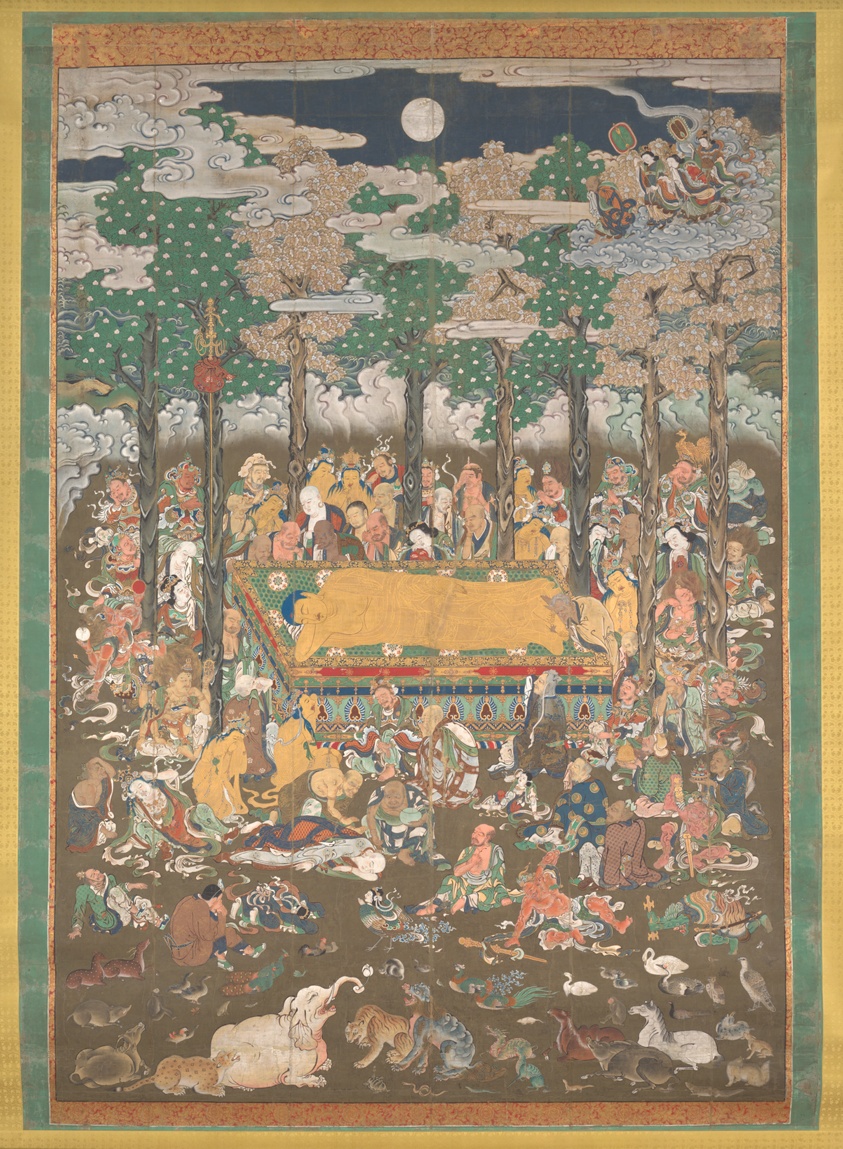
The scene depicts the Mahāparinirvāṇa, the Buddha’s final release from the cycle of rebirth. The composition, a long horizontal frieze of mourning figures arranged around the reclining Śākyamuni, is a study in controlled pathos. The line work, executed with brushes of the finest taper, exhibits a fluid elegance that is the pictorial equivalent of a perfectly rolled lapel or a gorge line resolved with absolute clarity. This elegance, however, is not mere aesthetic preference; it is doctrinal. The lines describing the folds of the monks’ robes, the flowing curves of the celestial beings, even the subdued anguish of the assembled animals, possess a continuous, unbroken quality. This visual fluency mirrors the Buddhist concept of dependent origination and the uninterrupted flow of consciousness, even at the moment of its final cessation. The brushwork manages a profound paradox: it captures a moment of supreme stillness through the vitality of its own movement.
Each figure, from the distraught disciple Ananda to the composed bodhisattvas, is tailored. Their forms are cut by the brush into the silk with a clarity of purpose that defines their role within the narrative. There is no superfluous detail, no redundant flourish—every stroke serves the composition and the doctrine, much as every stitch on a well-made garment serves its form and function.
The Palette and Gilding: A Grammar of Colour and Light
The colour scheme is restrained, speaking in a muted, authoritative register. The mineral pigments—malachite greens, azurite blues, iron-oxide reds—are applied with a mastery that understands their granular, sedimentary nature. They sit upon the silk with a dignified weight, their earthy resonance grounding the scene. They are the foundational tones, the classic navy and charcoal of a wardrobe. Against this, the gold performs its transcendent role. It is not used lavishly, but with pinpoint strategic intent: halos, the rim of the nimbus, the delicate patterns on celestial raiments. This application is the sartorial equivalent of precious horn buttons or a discreet silk-knot closure—accents of pure, uncompromising value that elevate the whole without vulgar display.
The gold interacts with the silk’s inherent sheen and the ink’s matte depths to create a complex visual hierarchy. It guides the viewer’s eye, not with garishness, but with a whispered authority, from the serene countenance of the Buddha across the tapestry of grief and understanding that surrounds him. The luminosity speaks of the parinirvāṇa not as an end, but as a sublime, luminous transformation.
Conclusion: A Garment for the Soul
In final analysis, this artifact, Nehan: Death of the Buddha, stands as a peerless example of heritage craftsmanship where medium, technique, and message are inseparably fused. The silk is the foundational canvas, prepared to a standard that would satisfy the most exacting tailor. The draughtsmanship executes its fluid, elegant line with the confidence of a master cutter, each stroke purposeful and clean. The palette and gilding employ a grammar of restrained opulence, where value is communicated through material integrity and strategic highlight rather than excess.
To behold it is to understand that the depiction of the ultimate departure was an occasion demanding the ultimate in material and artistic commitment. It is, in the most profound sense, a bespoke creation—a garment of imagery tailored precisely to clothe a moment of cosmic significance. The scroll does not simply tell the story of the Buddha’s death; it embodies, through its every fibre and pigment, the serene majesty, the compassionate order, and the luminous release at the heart of the event. It is a legacy piece, designed not for seasonal fashion, but for eternal contemplation.