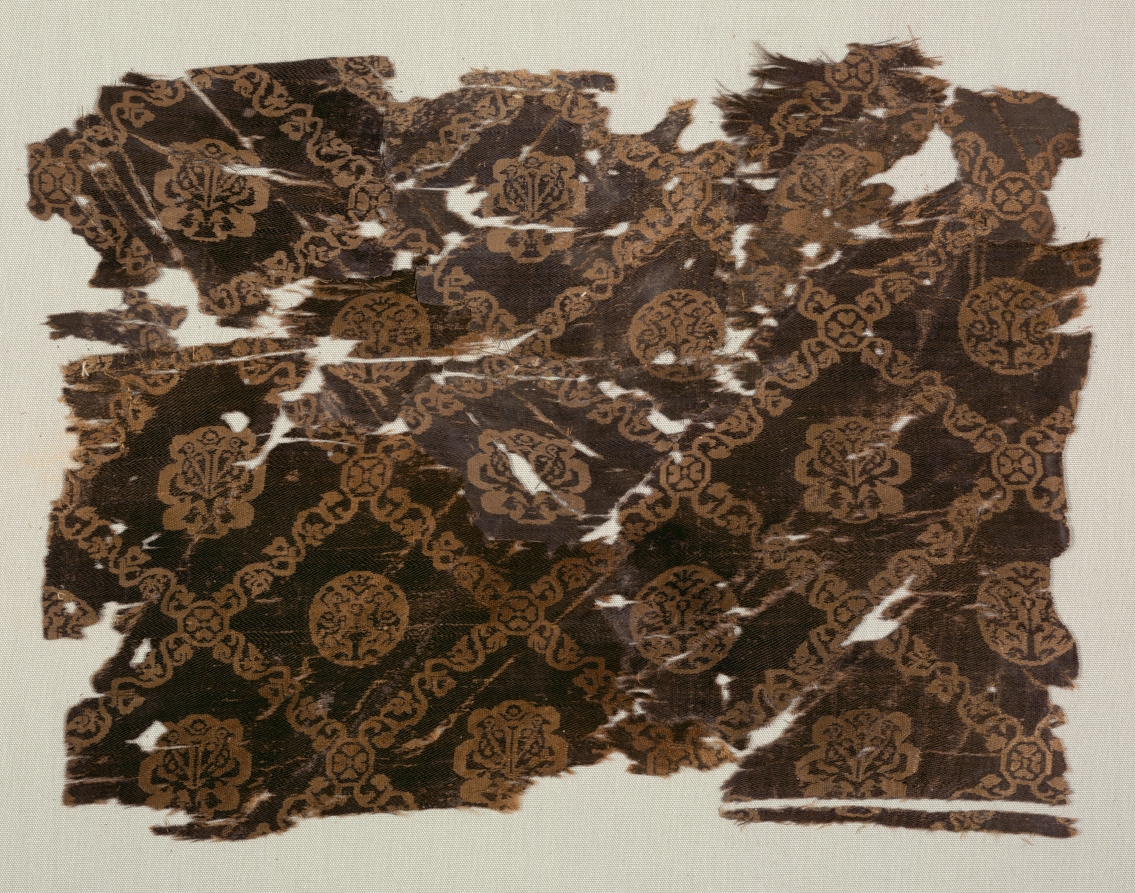
On the Articulation of Power: A Treatise on the Medallion Silk
To consider the medallion silk—specifically, the iteration featuring a lattice of animals enclosed within those roundels—is to engage with a fabric that operates not merely as a textile, but as a statement of governance. It is a sartorial protocol, woven in thread. The materiality, silk itself, establishes the first and most fundamental parameter: this is not a democratic fabric. Its very production, from the cultivation of the mulberry grove to the ceaseless labour of the silkworm, and onward to the monumental investment in the draw-loom workshop, speaks of a system of concentrated capital and control. It is the physical manifestation of a supply chain entirely commanded by the imperial hand, a tangible expression of reach and administrative capability.
The Architecture of the Pattern: Lattice and Medallion
The pattern under discussion is one of profound structural intelligence. The lattice—a repeating, geometric grid—provides the foundational armature. It is the unseen framework, the constitutional document of the design, establishing order and jurisdiction across the field. Upon this disciplined ground, the medallions are imposed. These roundels are not casual embellishments; they are sovereign territories, defined and bordered. Within their confines, the narrative unfolds.
This combination is a masterstroke of visual rhetoric. The lattice represents the immutable law, the continuous, unyielding application of imperial authority. The medallion, in contrast, is the sphere of privilege, the defined arena where power is not only exercised but also displayed in its most symbolic form. The one cannot exist without the other; the medallion derives its potency from the rigid context of the lattice, just as the lattice finds its purpose in framing these pockets of concentrated significance.
The Heraldry of the Beast: Iconography as Imperial Dialogue
Within the medallion’s circumference, we encounter the animals. These are never mere fauna. They are a curated bestiary, each creature selected for its specific symbolic resonance—the dragon for celestial authority and transformative power; the phoenix for renewal and empressly virtue; the lion for martial prowess and guardianship. They are participants in a silent, woven diplomacy.
Their arrangement within the lattice of medallions creates a deliberate rhythm, a heraldic conversation across the fabric’s expanse. This repetition is a key to its function. A single such symbol might be an assertion; a field of them, perfectly regimented, is an overwhelming demonstration of systemic power. It communicates that the empire’s symbolic language is so entrenched, so replicable, that it can be produced on an industrial loom-scale. The wearer of such a fabric does not simply bear an image; they are cloaked in the very machinery of iconographic production, becoming a mobile testament to the regime’s cultural and artistic output.
The Legacy of the Loom: From Imperial Atelier to Modern Consciousness
The legacy of this imperial silk-weaving tradition is twofold, pertaining to both technique and concept. Technically, the development of the complex draw-loom, capable of executing such precise and repeatable patterns, was a feat of engineering akin to developing a proprietary manufacturing process for a luxury motorcar. It created a product that was, for centuries, virtually impossible to counterfeit outside of state-sanctioned workshops. The knowledge was the asset, fiercely guarded.
Conceptually, the legacy is even more enduring. The medallion silk established a grammar of prestige in textile design that transcended its original context. It articulated a principle: that the highest form of decorative art is that which imposes a sublime order upon vibrant life (the animals), framing it within a structure (the lattice) that speaks of control and permanence. This principle migrated along trade routes, influencing textile traditions from Sassanian Persia to Byzantine Constantinople, and echoing in the formal silks of later European courts.
In the modern context, to engage with a fragment or a reproduction of such a textile is not an exercise in nostalgia. It is an examination of the foundational languages of material prestige. The meticulous construction, the symbolic density, the sheer authority of its execution—these are the qualities that define any heritage object of consequence. They remind us that true luxury is never accidental; it is always, like the lattice and the medallion, deliberately architected. The imperial silks did not just adorn the body; they articulated an entire worldview, one thread, one symbol, one perfectly contained roundel at a time. Their study, therefore, is not merely textile history. It is an advanced seminar in the non-verbal communication of power, a subject of perpetual relevance.