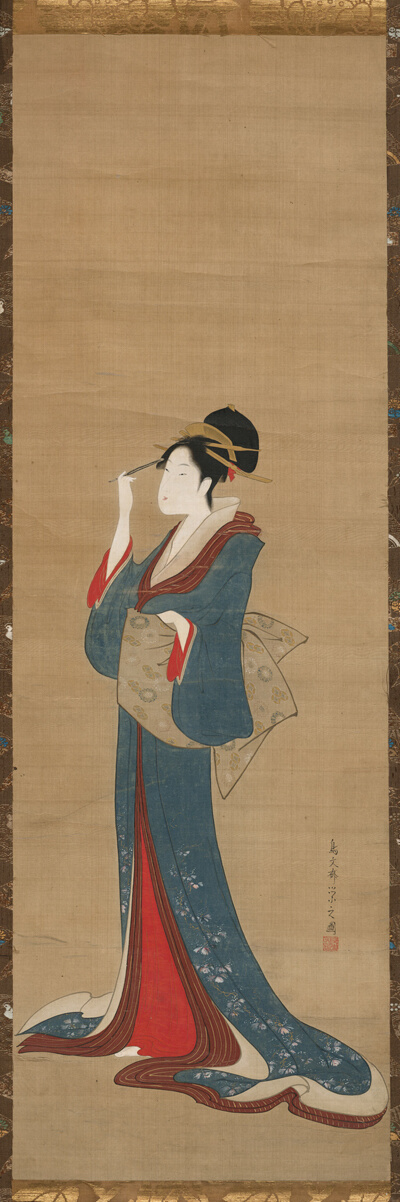
An Analysis of Material Consequence and Sartorial Lineage
To engage with a hanging scroll of the classical tradition, executed in ink and colour upon silk, is to enter into a dialogue with the very bedrock of sartorial and artistic heritage. The medium is not merely a support; it is the first and most profound statement. The silk ground, with its particular tooth and luminous sheen, dictates the behaviour of the pigment and the ink, demanding of the artisan a supreme confidence of hand. There is no room for equivocation or correction; each stroke is a commitment, much like the final cut of the shears through a definitive cloth. The resulting artifact, Beauty Replacing Her Hairpin, thus operates on two inseparable levels: as a depiction of a refined act and as a physical testament to the cultivated discipline required for its own creation.
The Grammar of Craft: Silk as the Foundational Cloth
Consider the silk not as canvas, but as the most exquisite of under-cloths. Its preparation—the stretching, sizing, and smoothing—parallels the meticulous preparation of a bespoke garment’s foundational layers. The silk’s inherent properties impose a rigorous grammar. The ink, once applied, is absorbed with a deliberate immediacy, locking the artist’s intention into the very fibres. Washes of colour settle with a soft, granular diffusion, creating depths of tone that are impossible to replicate on absorbent paper. This is the equivalent of working with a spongy woollen flannel versus a crisp tropical wool; the material dictates the design language. The fluid elegance cited in the artifact’s context is not an abstract concept but a direct physical outcome of this interaction. The lines describing the drape of a sleeve or the fall of a robe are granted a liquidity, a soft authority, because the silk both receives and restrains the medium. It is a masterful exercise in controlled release.
The Composition: A Study in Bespoke Poise
The subject—a beauty in the act of replacing her hairpin—is a moment of intimate, self-referential adornment. This is not a passive portrait but a captured gesture of self-maintenance, a private performance of elegance. The composition likely arranges the figure with an emphasis on the elegant line of the neck, the incline of the head, and the graceful arc of the arm raised to the coiffure. These lines are the silhouette lines of the piece, as critical as the line from collar to waist on a morning coat. The artist’s brushwork must delineate the complex, layered drapery of traditional attire, conveying both the weight and the fineness of the fabric through modulation of ink and subtle tonal variation. This is akin to the work of a master tailor using pad-stitching and steam to shape a lapel, creating structure that appears effortless. The empty space surrounding the figure is not void but considered negative space, a Savile Row principle where what is omitted is as deliberate as what is included, allowing the subject to breathe and command attention.
Symbolism and the Language of Adornment
The central action, the replacing of the hairpin, is rich with sartorial metaphor. The hairpin is an accessory, a detail, yet its proper placement is essential to the integrity of the whole. In the canon of bespoke attire, this parallels the fastening of a cufflink, the positioning of a pocket square, or the precise angle of a boutonnière. These are not mere decorations but functional elements that complete a system of dress, signifying attention to detail and respect for form. The beauty’s focus on this task underscores a cultivated awareness of personal presentation—an understanding that elegance is maintained through continuous, careful adjustment. The hairpin itself, depending on its depicted design, could signify status, taste, or even cultural allegiance, much as a signet ring, a particular weave of tie silk, or the pattern of a waistcoat lining communicates a nuanced message to the discerning eye.
Heritage as a Living Practice
This artifact, therefore, transcends simple representation. It is a confluence of heritage practices: the ancient sericulture and loom craftsmanship that produced the ground, the generations of pigment preparation and brush technique, and the cultural codes of deportment and adornment being depicted. To preserve and study such an object is akin to maintaining a historical ledger of cuts, cloths, and client measurements. It is a reference point. The fluid elegance it embodies is not a relic but a continuing standard. It speaks to a philosophy where beauty arises from the harmonious relationship between material, maker, and wearer (or subject). The discipline required to produce the scroll mirrors the discipline required to don the attire it depicts with propriety.
In conclusion, Beauty Replacing Her Hairpin stands as a peerless research artifact for any heritage lab concerned with the intersection of material, craft, and aesthetic code. It demonstrates that true elegance is never accidental. It is engineered—from the selection of the silk, to the stroke of the brush, to the final, considered gesture of placing a pin. It reminds us that heritage is not a static archive but a dynamic language of making and presentation, where every detail, no matter how small, is accorded the profound respect of perfect execution. The scroll does not simply hang; it instructs.