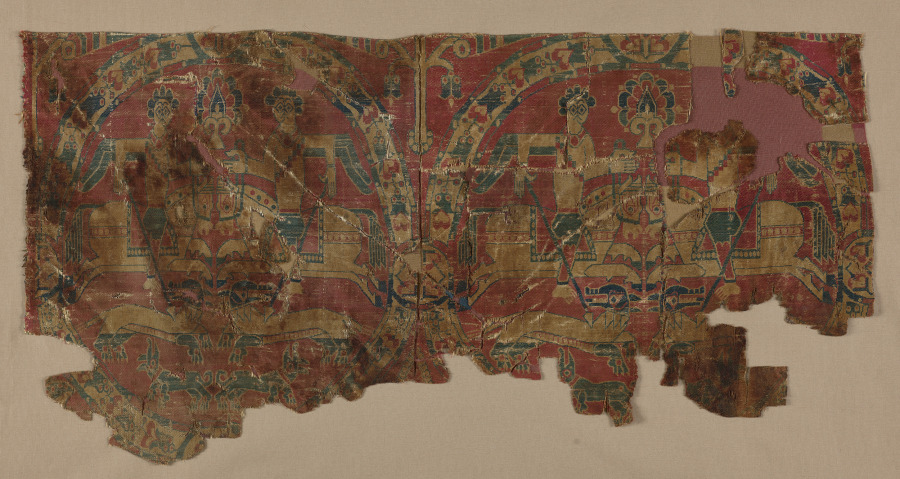
On the Aristocracy of Thread: A Disquisition on Imperial Silk Roundels
To consider the silk roundel, gentlemen, is to engage not merely with a textile but with a manifesto of power, rendered in the most exquisite vocabulary the loom has ever known. It is a sartorial heraldry, a mobile blazonry worn upon the person, declaring allegiance, authority, and a cultivated taste that transcends the vulgarity of mere ornament. Our subject here—the roundel depicting the hunt—is perhaps the most potent of all such declarations. Woven in the ateliers of imperial China, most notably under the Tang and later Ming auspices, these medallions represent the zenith of a material tradition where silk was not a fabric, but a currency of state.
The Foundation: Imperial Sericulture as a Command Economy
One must first apprehend the foundational truth: in the East, silk was never a mere industry. It was, from its mythic origins, an imperial monopoly. The cultivation of the silkworm (Bombyx mori), the stewardship of mulberry groves, the complex alchemy of the dye vat, and the engineering of the draw-loom—these were processes guarded with a severity befitting state secrets. The imperial workshops, such as those at Nanjing, Hangzhou, or Suzhou, operated with a precision and hierarchy that would impress the most exacting of modern boardrooms. Here, master weavers, dyers, and pattern-makers laboured under direct patronage, their output destined not for the open market, but for the court, for diplomatic gift-giving, and for the conferment of honour upon loyal officials. The silk itself, in its weight, its lustre, its flawless consistency, was the first and most non-negotiable mark of quality—a base cloth against which the narrative of the roundel was to be played.
The Motif: The Hunt as Imperial Metaphor
The choice of the hunting scene within the confines of a circular or lobed frame is a masterstroke of symbolic communication. The hunt, gentlemen, is never simply about the pursuit of game. In the context of imperial iconography, it is a meticulously staged allegory for rulership. The mounted hunter, often depicted with falcon or bow, embodies control over the untamed forces of nature. The quarry—a stag, a lion, a mythical beast—represents chaos, rebellion, or the challenges of the frontier. The containment of this dynamic, often violent narrative within the strict, harmonious geometry of the roundel speaks directly to the imperial mandate: the imposition of order upon a disordered world.
This was not a private fantasy but a public proclamation. When such silks travelled the Silk Roads, bestowed upon nomadic chieftains or foreign potentates, the message was unequivocal. The recipient was enveloped, quite literally, in the aesthetic and political cosmology of the donor court. To wear a robe fashioned from such cloth was to become a walking satellite of imperial authority, a beneficiary of its civilisation and, by extension, a participant in its hierarchical view of the world.
The Execution: A Technical Virtuosity Beyond Reproach
The material realisation of this concept demanded a technical virtuosity that remains, to this day, a benchmark of the weaver’s art. The kesi (slit-tapestry) technique, perfected during the Song dynasty, allowed for a painterly subtlety unheard of in standard loom weaving. Like the finest Savile Row embroidery, each colour change was a discrete event, creating sharp outlines and graduated hues that gave the hunter and his steed a remarkable vitality. The use of gold-wrapped thread (filé) for highlights—the harness of the horse, the trim of a saddle—introduced a literal luminosity, catching the light with a quiet, authoritative gleam rather than a garish sparkle.
Consider the drape. A heavy silk damask or kesi panel, dense with such roundels, possessed a substantive, sculptural quality. It fell not with a flutter, but with a deliberate, gravity-conscious sweep. The pattern, repeated in precise, regimented rows across the garment’s surface, created a rhythm that animated the wearer’s movements with a sense of contained power. This was clothing as architecture, engineered to elevate the physical form and project an image of immutable stability.
The Legacy: A Continuum of Exclusive Craft
What, then, is the enduring legacy of these imperial silks for the modern purveyor of heritage? It is a legacy of uncompromising standards. It reminds us that true luxury resides in the marriage of profound symbolic meaning with peerless technical execution. The imperial roundel teaches the value of restraint within opulence—the complex scene is bounded by the circle; the lavish use of colour and gold is disciplined by the rigours of the loom.
In our own realm, the principles hold firm. The bespoke suit is our roundel. The flawless English wool, sourced from specific flocks and woven in exclusive mills, is our imperial silk. The cut, with its silent language of silhouette and seam, is our hunting motif—a narrative of power, tradition, and personal authority. The hand-stitching, the roped shoulder, the precise roll of the lapel: these are our kesi techniques, our gold filé, the discreet but essential hallmarks of a rarefied craft.
The hunter in his roundel, forever pursuing his quarry across a field of silk, is thus more than a decorative artifact. He is a permanent envoy from a world where material culture was wielded as an instrument of statecraft and identity. To study him is to understand that the highest expressions of textile art are never simply worn. They are deployed, with intention and understanding, as the final word in a silent, elegant discourse on power. It is a discourse that, in its essential principles, continues to this day in the ateliers of those who understand that heritage is not about the past, but about the perpetual re-crafting of excellence for the discerning individual.