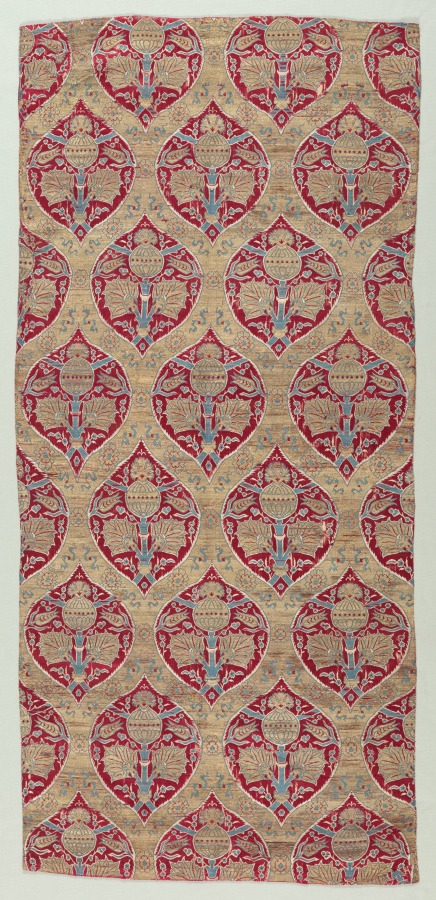
The Ogival Lattice: A Cartography of Imperial Order in Woven Silk
To consider the ogival lattice in silk is to engage not merely with a decorative motif, but with a profound articulation of imperial ideology, rendered in the most prestigious of materials. It represents a confluence of mathematical precision, territorial ambition, and consummate craftsmanship—a silent language of power spoken through the loom. The specimen before us, a horizontal iteration of the form, is particularly instructive; it eschews the more common vertical ascension for a lateral, encompassing spread, suggesting not aspiration to the heavens but dominion over the earthly plane. This is not mere fabric; it is a mapped territory, a heraldic field, and a testament to a supply chain of staggering complexity and control.
The Architecture of the Motif: Form as Doctrine
The ogive, at its essence, is a pointed arch. Its adoption in woven textiles from the medieval periods onward—particularly within the spheres of Byzantine, Islamic, and later, European imperial courts—was never accidental. The arch is an architectural gesture, one that speaks of fortified gates, sacred spaces, and vaulted ceilings. To transpose this into a repeating lattice upon silk is to drape the body or adorn the chamber in a metaphor of structured, enduring power. The lattice itself, the interconnected network born of these repeated arches, creates a system. Each cell is a defined space, a contained unit within a boundless, expandable grid. This is the visual rhetoric of empire: the imposition of a rational, repeatable order upon the organic chaos of the world. The horizontal emphasis of our subject piece amplifies this. It flows like a river of jurisdiction, suggesting endless replication to the left and to the right—a borderless authority.
Materiality: Silk as the Imperial Substrate
The message is inseparable from the medium. Had this lattice been rendered in wool or linen, its statement would be diminished, provincially quaint. Silk was, for centuries, the exclusive currency of empires. Its production—from the meticulous cultivation of the mulberry grove and the fragile husbandry of the Bombyx mori silkworm, through the secret alchemies of dyeing, to the monumental investment in the draw-loom—constituted one of history's most formidable and guarded industrial complexes. To command silk was to command bio-technology, botany, chemistry, and a vast, disciplined labour force. The Chinese imperial monopoly, later fragmented and zealously pursued by Byzantine, Persian, and Italian city-states, was a state secret on par with any military strategy.
Thus, when an imperial workshop set out to weave an ogival lattice, it was deploying the ultimate material expression of sovereignty. The silk’s inherent luminosity, its capacity to hold and transform light through its triangular prismatic filaments, meant the lattice did not lie flat. It glimmered, its geometry shifting with the movement of the wearer or the sun. The fabric possessed a tactile authority—a weight and a whisper—that affirmed the status of the individual privileged enough to wear it. The lattice, in this context, becomes the official seal pressed into the very flesh of empire.
Horizontal Dominion: A Legacy of Woven Cartography
The horizontal orientation of the design is a critical, often overlooked, nuance. Vertical lattices guide the eye upward, often enclosing a secondary motif—a flower, a heraldic beast—suggesting a hierarchy within the grid. The horizontal lattice, however, speaks of expanse. It evokes the scroll of a map, the unfurling of a legal document, or the panoramic frieze of a triumphal procession. One might interpret this as the weave of bureaucracy itself: systematic, enveloping, and administrative.
This design philosophy finds its purest expression in the legacy of imperial silk weaving centres: the sericulture mandates of Tang China; the regimented splendour of Ottoman court velvets and brocades produced in the state-controlled karkhanas of Bursa and Istanbul; the sophisticated weave diagrams of Renaissance Italy, where cities like Lucca and Florence vied for dominance in the luxury trade. In each, the ogival lattice, particularly in its horizontal mode, served as a foundational grammar. It was the ground upon which more explicit symbols of power—eagles, lions, fleurs-de-lis—were displayed, the ordered grid that gave those symbols their contextual authority.
Conclusion: The Enduring Weave
The study of this artifact, therefore, transcends textile appreciation. It is an exercise in decoding the material language of governance. The ogival lattice in horizontal silk is a blueprint of control, a manifestation of an empire’s ability to organise nature, labour, and art into a coherent, repeatable, and dazzlingly beautiful system. It reminds us that before empires built walls and navies, they built supply chains and workshops. The true legacy of imperial silk weaving lies in this demonstration of holistic power—a power that could transform the ephemeral thread of a silkworm into a permanent symbol of order, woven to endure long after the thrones that commissioned it have turned to dust. The lattice remains, a silent, elegant testament to a world meticulously arranged, one thread at a time.