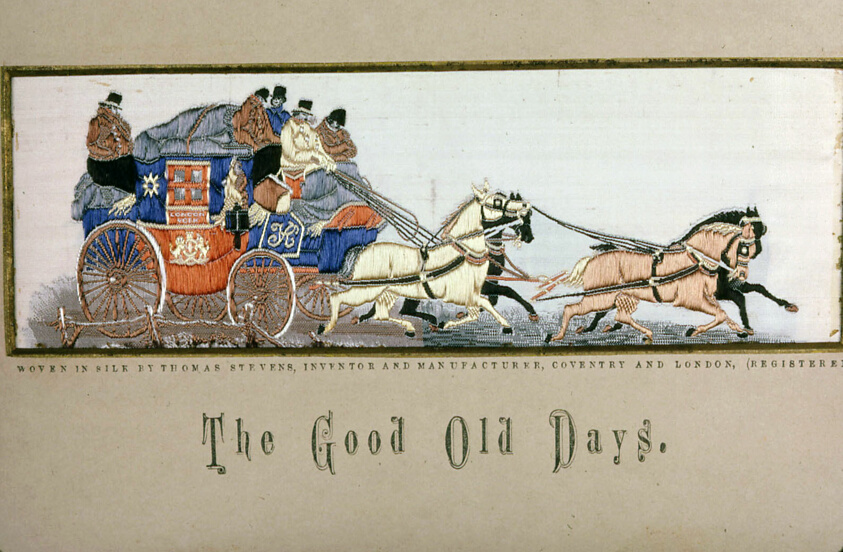
The Conveyance of Status: An Analysis of the Royal Mail Coach Motif in High Artisanal Silk
The notion of "The Good Old Days" is, in the sartorial lexicon, a perilous one. It implies a nostalgic retreat, a softening of rigour. At Lauren Fashion Heritage Lab, we reject such sentimentality in favour of forensic appreciation. The era invoked by the Royal Mail Coach—the late Georgian and Regency period—was not one of mere pastoral romance; it was an age of unprecedented velocity, systemic innovation, and the meticulous codification of public status. The translation of this motif onto a ground of plain weave silk, elevated with supplementary brocading wefts, is not a whimsical decoration. It is a profound statement of technical mastery and social intelligence, a deliberate alignment with the pinnacle of pre-industrial British organisation and the emergent theatre of public life.
The Ground: Plain Weave as the Turnpike of Elegance
One must first consider the foundation: the plain weave silk. This is the quintessential cloth of the well-appointed gentleman of the period, the same that lined the interiors of those very coaches and constituted the understated waistcoats of the passengers within. Its virtue lies in its fluid drape and subdued lustre—a quiet authority. Like the surveyed and metalled turnpike roads upon which the Mail Coaches ran, this silk provides a flawless, reliable substrate. It represents order imposed upon nature, the essential infrastructure for elegance. The plain weave is the silent partner in this composition, the necessary canvas that refuses to compete with the narrative to be imparted. It is the sartorial equivalent of the disciplined silence maintained by a skilled driver on a challenging stretch: an absolute prerequisite for excellence.
The Motif: The Coach as Herald of a New Temporal Order
The Royal Mail Coach itself was a revolution in miniature. It operated to the clock, a mobile emblem of a nation standardising time itself. Its celebrated velocity—averaging a hitherto unimaginable 8-10 miles per hour—was a function of brutal engineering discipline, specialised breeding of horseflesh, and a militaristic adherence to schedule. To brocade this image onto silk is to capture a symbol of relentless, scheduled progress. The chosen moment in the depiction is critical: is the coach depicted at full gallop, a blur of controlled momentum? Or is it stationary at a coaching inn, a hub of commerce and social exchange? Each tells a different story. The former speaks of unimpeded purpose, the latter of consequential pause—the moment a passenger, perhaps a gentleman of affairs, alights and becomes the observed centre of a provincial stage.
The Artisanship: Supplementary Brocading Wefts as the Coach's Harness and Livery
Here we arrive at the heart of the matter: the application of supplementary brocading wefts. This is where the Savile Row ethos finds its purest textile expression. This technique is not embroidery, an additive process. It is an inlay, woven into the very structure of the cloth during its creation on the loom. Each coloured thread—the vermilion of the coachwork, the gilt of the royal arms and fittings, the rich leather brown of the harness—is integrated with a precision that mirrors the coach's own assembly. The brocading weft creates a raised, tactile topography, catching the light as the polished fittings and lacquered panels of the coach would have caught the sun on a fast run to Bath or Edinburgh.
The density and complexity of these brocaded elements are a direct measure of the artisan's skill. The intricate tracing of the coach's scrolling ornament, the delicate rendering of the horses' trappings, the sharp definition of the guard's horn and blunderbuss—these require a draughtsman’s eye and a surgeon’s hand. This is the point of material confluence: the fluid, silent elegance of the plain weave ground is juxtaposed with the precise, declarative brilliance of the brocade. It mirrors the societal dynamic of the coach itself—a vehicle of state function (the mail) enabling and showcasing private ambition and personal theatre (the passengers).
Context and Confluence: The Fluid Elegance of Arrival
The final analysis must consider the context of wear. A garment fashioned from this silk—be it a dressing gown of considerable grandeur, a panel for a bespoke screen, or an exceptional waistcoat—carries a complex narrative. Its fluid elegance in motion speaks of the wearer's own grace and assurance. Yet, upon closer inspection, the brocaded coach emerges, declaring an allegiance to a specific set of values: punctuality, systemic efficiency, national reach, and the privilege of accelerated passage.
It is a statement that understands heritage not as a faded memory, but as a legacy of performance standards. The "Good Old Days" referenced are not days of languor, but days when excellence in craft—whether in coach-building, road-making, horse-breeding, or silk-weaving—created systems and objects of enduring authority. To clothe oneself in this artifact is to align with that relentless pursuit of calibrated perfection. It is to wear not a picture of a coach, but the embodiment of the discipline that made its legend possible. The silk flows, the brocade gleams with purpose, and together they convey, with impeccable timing, a message of arrival that was two centuries in the making.