An Examination of Avian Motifs in Late Antique Imperial Sericulture
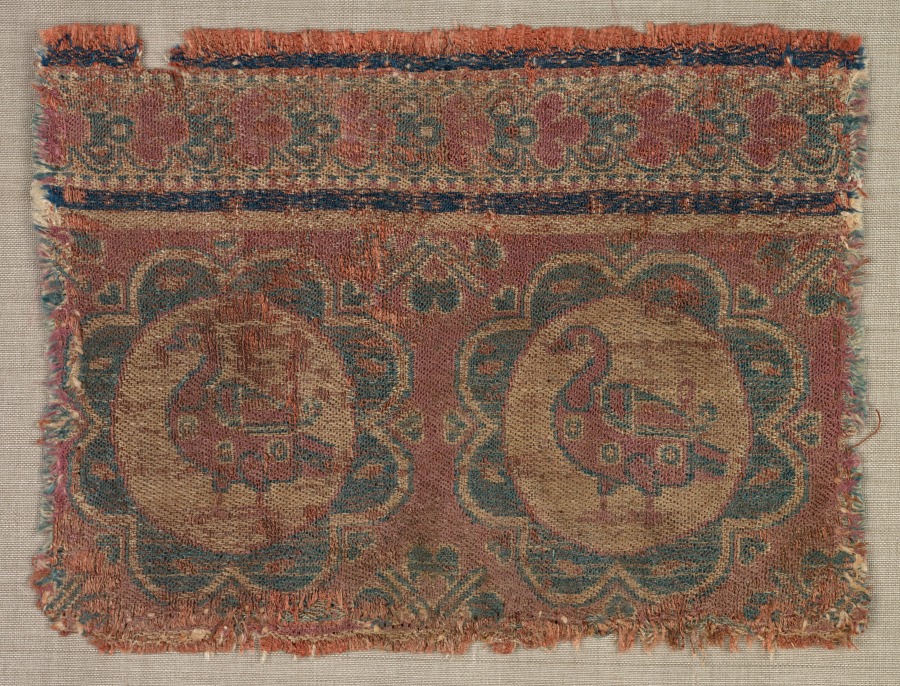
One must approach this fragment with a certain solemnity, for it is not merely a piece of fabric, but a testament to a system—a physical articulation of power, commerce, and transcendent artistry. The material, of course, is silk: the sine qua non of ancient prestige economies. Its very presence in the archaeological record, far from its point of origin, speaks of corridors of diplomacy and caravans weighted with symbolic capital. This particular specimen, with its polychrome roundels enclosing confronted ducks, belongs not to the realm of mere decoration, but to the rigorous grammar of imperial iconography. The weave is a declaration.
The Grammar of the Roundel
The deployment of the roundel, or clipeus, is the first point of structural analysis. This is not a casual aesthetic choice. In the visual language of the late Roman and early Byzantine spheres, the rounded frame is inherently hierarchical. It isolates, it sanctifies, it elevates the subject within from the continuous flow of the patterned field. To encase a motif within a pearl-bordered medallion is to bestow upon it an official, almost heraldic, significance. The repetition of these roundels across the textile surface creates a rhythm of contained power, a visual echo of the imperial court's own ordered, ceremonial splendour. The duck, therefore, is not simply a duck; it is a subject worthy of this framed presentation, transformed into an emblem.
Ornithology as Ideology
The selection of the duck—or more precisely, often the mallard or the mandarin duck—as the central motif is a matter of deliberate symbolic import. In the context of Sasanian and Central Asian art, from which this textile idiom heavily draws, paired animals within medallions represent cosmic harmony, royal fortune, and paradisiacal abundance. Ducks, frequently associated with freshwater and fecundity, symbolise prosperity and a blissful state. When rendered in symmetrical confrontation, as seen here, they embody order, balance, and conjugal fidelity—pillars of a stable realm. This imagery, produced on state-controlled looms, disseminated an ideology of naturalised, harmonious rule. The silk was a vehicle for a message: the empire that commands such artistry also commands the natural order, ensuring peace and plenty.
The Machinery of Magnificence
To appreciate the fragment fully, one must consider the formidable apparatus behind its creation. Imperial silk weaving was, first and foremost, a state monopoly. The knowledge of sericulture, the careful breeding of silkworms, the labour-intensive reeling of filaments, and the complex dyeing processes using rare pigments like true kermes or indigo, constituted a closely guarded technological supremacy. The weaving itself, likely on a sophisticated draw-loom, required a division of labour akin to a modern atelier: designers translating court-approved patterns into weave schemes, master weavers, and numerous assistants. This fragment, therefore, is an end-product of a vertically integrated system of production, where control over material and message was absolute. The precision of the duck's plumage, the crispness of the roundel's border—these are not accidents of craftsmanship, but evidence of institutionalised excellence.
A Currency of Distinction
The ultimate function of such silks extended far beyond the decorative. They operated as a liquid currency of status within the political economy of the ancient and medieval world. Imperial workshops produced these textiles specifically for the Silk Diplomacy. They were bestowed upon allied sovereigns, gifted to favoured generals, or presented as ambassadorial offerings of unparalleled value. A length of silk such as this would be incorporated into the vestments of a Frankish king, the reliquary of a Byzantine saint, or the altar cloth of a cathedral, thereby weaving the prestige of the donor empire into the very fabric of foreign power structures. Our fragment, perhaps cut down over centuries, whispers of this journey—from imperial atelier to treasured possession, a mobile asset of immense symbolic weight.
Conclusion: The Fragment's Full Measure
In final analysis, this silk fragment with its roundels of ducks demands a reading on multiple levels. Materially, it is a supreme achievement of technical sericulture. Iconographically, it is a loaded statement of imperial ideology, promoting harmony and prosperity through its carefully curated avian motif. Economically, it was a potent instrument of statecraft, a non-verbal communicator of alliance and favour. To hold it—figuratively speaking—is to grasp a node within a vast network of power, artistry, and exchange. It is a relic of a time when cloth was not merely covering, but a coded language, and the loom was as consequential a tool of state as the sceptre. Its legacy endures in the very expectation of excellence we continue to associate with the most rarefied forms of material culture. The thread, once spun in imperial workshops, remains unbroken.