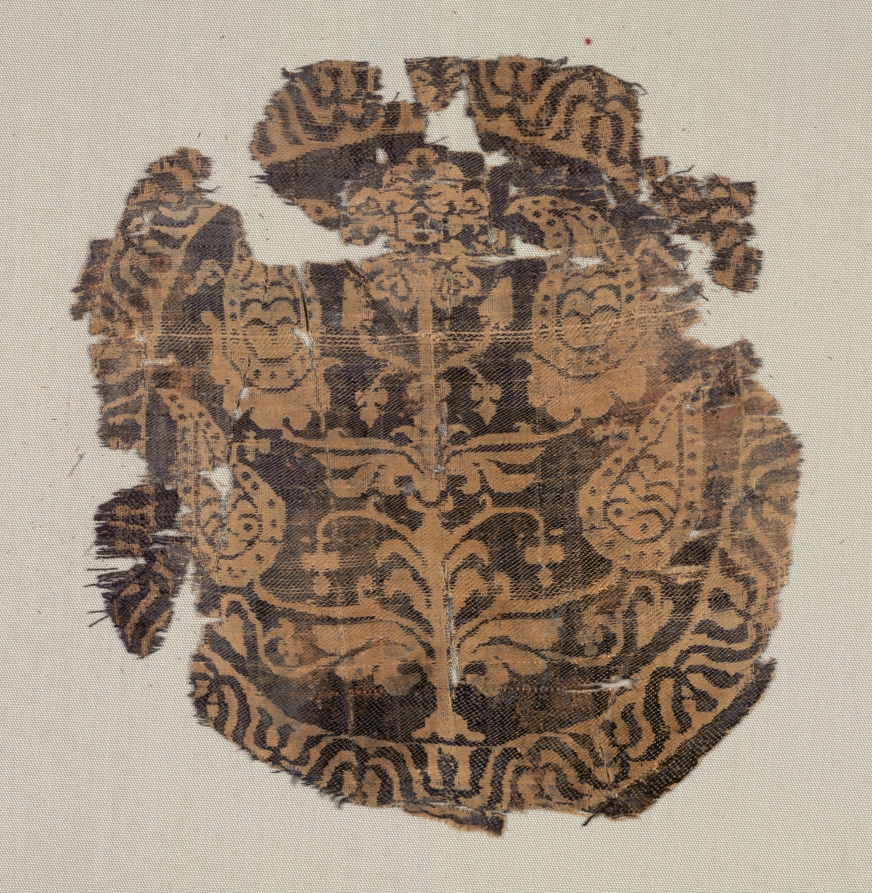
A Disquisition on the Imperial Roundel: Silk as the Substrate of Sovereignty
To consider the artefact in question—a silk roundel featuring a curvilinear palmette tree, extracted from the context of a tunic—is to engage with a subject far exceeding mere decorative appeal. It is to examine a fundamental instrument of statecraft, a deliberate and potent manifestation of imperial ideology rendered in the most precious of fibres. The piece, though now a fragment, speaks with unimpeachable authority of a system where aesthetics and power were indivisible, woven as tightly as the warps and wefts of the loom upon which it was created.
The Inherent Authority of the Material
One must first appreciate the primacy of the silk itself. In the epochs of which we speak, silk was never simply a textile. It was a controlled substance, a monopoly of the court, and a physical metaphor for order, refinement, and celestial favour. Its production, from the meticulous cultivation of the silkworm to the operation of vast, state-sanctioned ergastula, was a secretive and hierarchical process. To be clad in such material was not an act of personal adornment but a statement of inclusion within the imperial continuum. The very touch of the fabric, its lustre, its weight, and its capacity to hold colour with unparalleled intensity, communicated status in a language more immediate than any edict. Thus, the roundel begins its discourse before a single motif is deciphered; its medium is its first and most profound declaration of legitimacy.
The Architecture of the Roundel: A Microcosm of the Cosmos
The form of the roundel is itself a philosophical construct. The perfect, closed circle is a universal symbol of eternity, unity, and celestial perfection. By enclosing the palmette tree within this bounded space, the imperial workshops performed a act of symbolic possession. The organic, flourishing vitality of the natural world is captured, ordered, and framed by the geometry of imperial authority. It is a visual assertion that the realm of the sovereign is the ordained structure within which all life—natural, spiritual, and political—unfolds. This was not a pattern; it was a heraldic device of dominion, replicated across the expanse of a garment to envelop the wearer in a repeating field of power.
The Curvilinear Palmette: Symbolism in Serpentine Form
The central motif, the curvilinear palmette tree, demands the most careful exegesis. The palmette, with its ancient lineage tracing to sacred groves and paradisiacal imagery, is here transformed. Its traditional rigidity is supplanted by a sinuous, almost serpentine curvature. This is of paramount importance. The curvature suggests movement, life, and generative force—the very essence of fecundity and prosperity that a wise ruler was expected to cultivate and guarantee for his subjects. Yet, this vitality is never chaotic. It is contained, rhythmic, and perfectly balanced within its circular precinct.
This arboreal symbol, often interpreted as the Tree of Life, becomes, in this context, the Tree of Imperial Beneficence. It represents the dynasty itself, its roots deep in tradition and divine mandate, its branches (the scrolling volutes of the palmette) offering protection and sustenance to the empire. The curvilinear treatment softens the symbol without diminishing its authority, suggesting a grace and natural order inherent to the regime’s rule. To wear this emblem was to be both a beneficiary and a propagator of this ordained, flourishing order.
The Garment as Canvas: The Legacy Woven into Wear
We must, finally, restore the fragment to its original context: the tunic. A garment such as this was not passive attire. It was an active, mobile billboard of imperial affiliation. As the wearer moved through courtly or administrative spaces, the repeating roundels would create a shimmering, pulsating field of imagery, a visual mantra of power. The individual became an extension of the imperial body, a living testament to the reach and consistency of the sovereign’s influence. The silk, with its subtle rustle and captivating sheen, ensured this testimony was both seen and heard.
The legacy of imperial silk weaving, therefore, is not merely a technical history of loom advancements or dye recipes. It is the story of how a civilisation codified its worldview into its most luxurious material. The roundel with the curvilinear palmette tree is a quintessential artifact of this legacy. It demonstrates how aesthetic refinement was inseparable from political rhetoric, how beauty was deployed as a tool of cohesion and control, and how the very threads that clothed the elite were imbued with narratives of eternity, order, and divinely-sanctioned rule.
In conclusion, this fragment, now silent in a museum case, once spoke with profound eloquence. It articulated a complete philosophy of governance through the language of silk and symbol. To study it is to understand that in the ateliers of empire, the weaver was not merely a craftsman, but a scribe; the loom was not merely a tool, but a pulpit; and the finished textile was not merely a garment, but a manifesto.