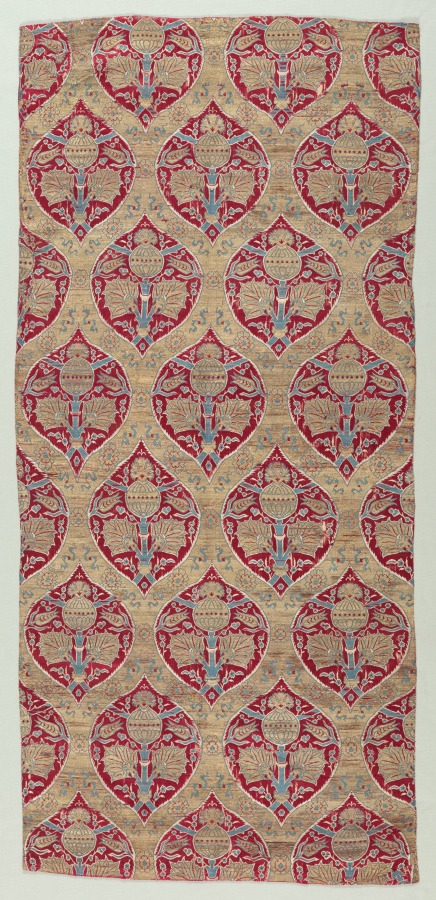
The Ogival Lattice: A Cartography of Imperial Order in Woven Silk
To consider the ogival lattice in silk is to engage with a fundamental grammar of imperial aesthetics, a language of power and precision rendered in the most supple of mediums. It is a study in controlled grandeur, where the inherent fluidity of the filament is disciplined into a testament of geometric authority. The specimen before us—a horizontal ogival lattice—is not merely a textile; it is a cartographic document. It maps the confluence of technical mastery, cosmological aspiration, and administrative will that defined the legacy of imperial silk weaving at its zenith.
The Architecture of the Ogival Form
The ogive, in its purest architectural sense, is a pointed arch. Its migration from the vaults of sacred structures to the plane of a textile is a profound act of translation. In stone, it directs the eye and the spirit heavenward; in silk, it establishes a framework of contained, repeating majesty. The lattice constructed from these interlocking arches creates a field of regulated space, a repetitive yet dynamic cellular structure that implies infinite extension. This is no pastoral meander. It is urban planning in thread, a woven blueprint for a perfectly ordered universe. The horizontal orientation of the design is particularly significant. It speaks not of aspiration towards the divine, but of dominion across the terrestrial plane—a declaration of stability, reach, and enduring legacy that stretches from horizon to horizon.
Materiality as Mandate: The Imperium of Silk
The choice of silk as the medium is, itself, an imperial decree. This was no democratic fibre. Its production—from the meticulous cultivation of the mulberry grove and the silent metabolism of the Bombyx mori to the orchestrated complexity of the drawloom—was a state-controlled endeavour, often a closely guarded secret. The very substance embodies a chain of command. The resulting fabric possesses a paradoxical authority: a tensile strength belying its ethereal lustre, a density of weave that captures light rather than repelling it. To drape oneself in such a lattice was to wear a manifest of sovereignty. The pattern did not simply rest upon the silk; it was emergent from it, the design and the substrate forming an indivisible unit of cultural power. The cool, liquid hand of the silk, its subdued rustle, was the sensory accompaniment to the silent, imposing visual rhetoric of the lattice.
Weave as Will: The Loom's Administrative Logic
The execution of such a precise, mathematically coherent pattern demanded more than artisan skill; it required a form of mechanical bureaucracy. The drawloom, with its complex system of cords and lashes—each controlling a specific warp thread—operated like a proto-computational device. The pattern was pre-ordained, "programmed" into the loom's apparatus by the master weaver. The horizontal progression of the ogival repeat across the width of the cloth is a testament to flawless systemic execution. There is no room for improvisation in an ogival lattice; a single mis-tied cord would fracture the geometry, exposing the fragility of the imposed order. Thus, the weaving process mirrors the imperial administration it served: a centralised design, executed through a hierarchical, meticulously managed system, resulting in a perfect, reproducible standard. The silk becomes a document of flawless compliance.
A Legacy in the Horizontal Plane
The legacy of this imperial silk weaving tradition, as exemplified by the horizontal ogival lattice, is one of imposed harmony and symbolic control. It represents the zenith of a culture's ability to sublimate a natural, organic substance into an emblem of its own intellectual and political structures. The pattern travelled, as empires do, along trade routes, influencing and being influenced. Yet, its core statement remains: an assertion of rationality, of space defined and beautified by rule.
To commission a garment incorporating such a heritage today—a bespoke lounge jacket lining, perhaps, or a distinctive waistcoat back—is to engage with this profound narrative. It is not an act of mere adornment, but a subtle alignment with a history of precision, authority, and the transformative imposition of order upon chaos. The horizontal ogival lattice in silk is, therefore, a permanent artifact. It is a silent, shimmering testament to the age-old human endeavour to weave not just thread, but meaning, power, and a vision of perfect, enduring structure into the very fabric of existence.