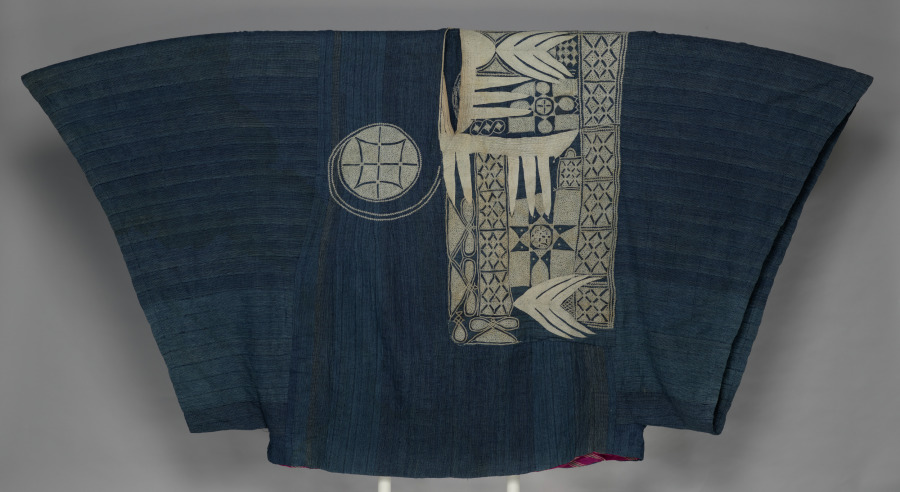
On the Material Confluence of Power and Thread
To comprehend the riga—the prestige robe of West African eminence, most notably within the historic Sokoto Caliphate—one must first dismiss any notion of mere garment. This is not apparel in the common understanding. It is, rather, a sovereign pronouncement woven in thread; a portable, wearable architecture of authority. Its essence, its very soul, is inextricably bound to its materiality: silk. But not merely any silk. We speak here of a specific, transcontinental dialogue in textile, a narrative of borrowed prestige and recontextualised power that traces its lineage directly to the legacy of imperial silk weaving. The riga is the apogee of this conversation, a masterpiece of sartorial diplomacy.
The Imperial Loom: A Legacy of Exclusivity
Our investigation begins far from the Sahel, in the ateliers of Byzantium, Persia, and later, the Ottoman Empire. Here, silk was never a simple fibre. It was a state-controlled instrument of geopolitics and theological theatre. Byzantine kaftania and Persian ceremonial robes established the paradigm: complex drawloom techniques creating intricate, non-figurative patterns—abstract geometries, arabesques, and later, stylised floral motifs—that spoke a language of celestial order and imperial divinity. The Ottoman court elevated this to a bureaucratic art form, with the seraser (cloth of gold) and velvets of Bursa constituting a rigid, sumptuary-coded visual language. This was silk as a heraldic system, a wearable grant of arms, where the density of pattern and the lustre of the metal-wrapped thread communicated rank with silent, devastating clarity. The legacy is one of intentional, manufactured rarity. The technology was guarded, the distribution channeled through diplomatic gift-giving (hil'at, the robe of honour), making the silk robe itself an actor in statecraft.
Trans-Saharan Translation: The Riga's Acquired Grammar
The arrival of these imperial silks in West Africa via the trans-Saharan caravan routes was an event of profound sartorial consequence. Local elites, particularly the Islamic scholarly and ruling classes of what would become the Sokoto Caliphate (1804-1903), did not simply adopt a foreign fashion. They engaged in a sophisticated act of cultural translation. They recognised in these Byzantine-Ottoman patterns a compatible language of abstraction and power, perfectly suited to Islamic aesthetic principles that favoured aniconism. The intricate, repeating patterns—now often referred to as "Moorish" or "Islamic" designs—were dissected, studied, and ultimately reproduced.
Critically, the local weavers, often using a vertical loom, began to recreate these patterns not in imported silk alone, but in a ingenious blend with local cotton. This was no mere compromise. It was a statement of agency. The resulting fabric, known as saki al-hariri (literally, "silk-like cloth"), embodied a hybrid virtuosity. From a distance, it possessed the luminous, dignified drape of imperial silk. Upon closer inspection, the textured weave revealed its indigenous character. The riga, typically a wide-sleeved, ankle-length gown, became the canvas for this hybrid cloth, often further ennobled with intricate hand-embroidery (dinki) at the neck, chest, and pocket flaps, adding a deeply personal, localised script to the global textile dialogue.
A Garment of Sovereign Performance
The power of the riga, therefore, resides in its compound material statement. To don a riga of true, historically-informed silk (or its masterful saki analogue) was to perform sovereignty on multiple stages simultaneously. It declared the wearer's connection to a global umma and the prestige economies of the Islamic world. It demonstrated access to distant, luxury trade networks. Yet, through its adaptation and embellishment, it firmly rooted that global prestige in local authority and taste. The slow, dignified movement of a figure enveloped in the heavy, lustrous folds of a riga was a performance of calculated gravitas. The rustle of the silk was a sound of office; the play of light on its patterns, a visual manifestation of wisdom and stability.
In the court of the Caliph, the riga operated as a uniform of high office, its quality and decoration meticulously calibrated to hierarchy. It was the civilian counterpart to martial regalia, representing the pen, the law, and spiritual leadership. Its materiality commanded silence, demanded respect, and visually articulated a chain of being that linked the wearer to a legacy of empires both foreign and domestic.
Conclusion: The Enduring Weft of Legacy
The contemporary riga, even when fashioned from modern, industrially-produced silks and brocades, carries within its cut and its customary patterns the DNA of this profound historical intersection. It remains a garment that burdens the wearer with expectation, much like the finest Savile Row morning coat or diplomatic uniform. To study the riga is to understand that luxury, in its most potent form, is never merely about aesthetic or comfort. It is about the embodiment of narrative. The silk of the riga is a thread connecting the wearer to the looms of Byzantium, the bazaars of Damascus, the caravans of the Sahara, and the courts of Sokoto. It represents a conscious choice to wear a history of influence, translation, and sovereign identity. The legacy of imperial silk weaving was not merely imported; it was naturalised, mastered, and ultimately, made to serve a new, potent vision of authority—one woven as much from local intellect and adaptation as from the very filaments of the silkworm. The cloth, thus, is not a background. It is the very text.