An Examination of Line, Form, and Sartorial Discipline
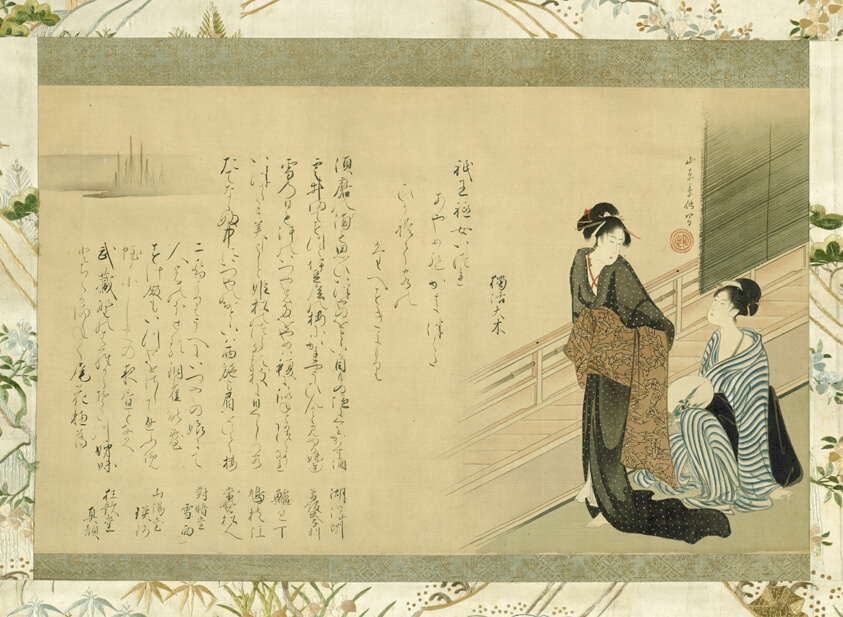
The artifact under consideration, Two Beauties on a Veranda, presents not merely a scene of repose but a masterclass in the application of foundational principles to a demanding medium. The work is a hanging scroll, executed in ink and colours upon silk, a combination that demands of the artist a preternatural discipline and a profound understanding of his materials. To approach this piece is to engage with the very essence of tailored execution, where every stroke is a considered decision and the substrate is not a passive ground but an active participant in the final statement. The silk, a material of inherent luxury and particular challenge, serves here as the ultimate test of the artist’s hand. There is no room for the hesitant mark or the corrective flourish; the silk accepts the ink and pigment with a finality that mirrors the commitment required of a master cutter laying blade to the finest woolens of Savile Row. The resulting image, therefore, is one of assured fluency, a visual articulation of confidence earned through rigorous practice and respect for the material’s own character.
The Architecture of Elegance: Structure Beneath the Fluidity
Upon first appraisal, one is struck by the fluid elegance of the drapery and the lyrical poses of the figures. This, however, is not mere decorative whim. A closer inspection reveals the underlying architecture that supports this apparent ease. The lines defining the veranda’s rails, the sharp angle of a discarded book, the precise fold of a sleeve where it meets the wrist—these elements provide a structural framework as critical as the canvas of a well-constructed jacket. They establish a spatial discipline within which the softer, more organic forms can play. The composition is balanced with the quiet authority of a bespoke garment: seemingly effortless, yet achieving its harmony through calculated proportion and strategic emphasis. The two beauties are not arbitrarily placed; they are positioned within the pictorial space with the same deliberate consideration given to the placement of pockets or the roll of a lapel—each element serving the whole, contributing to a posture of composed grace.
Palette as Wardrobe: A Restrained Statement of Distinction
The colouration, applied with translucent mastery upon the silk, speaks to a refined and deliberate sensibility. This is not a riot of hue but a carefully curated palette, where muted ochres, soft vermillions, and subtle mineral greens are deployed with strategic intent. The colours function as a sartorial ensemble might: a statement of discernment rather than ostentation. A sash of cerulean provides a focal point, a "spoil of colour" in the manner of a pocket square or a vibrant lining, offering a controlled point of visual interest without disturbing the overall composure. The silk ground itself, through the artist’s skill, modulates these tones, lending them a depth and warmth that a less receptive surface could not achieve. The material absorbs and softly diffuses the pigment, creating a luminous quality that emanates from within the work, much as the patina on aged leather or the lustre of rare silks speaks to a history of careful use and inherent quality.
The Drapery of Line: Tailoring in Ink
The treatment of the robes worn by the figures constitutes the central demonstration of technical prowess. The artist’s brushwork in rendering the cascading folds is where the analogy to the highest form of tailoring becomes most acute. Each line describing the fall of a skirt or the pull of fabric across a shoulder is both descriptive and expressive. There is a profound understanding of weight, tension, and the behaviour of cloth over form. The lines are not uniformly fluid; they vary in pressure and velocity, suggesting where the silk garment clings and where it flows freely, much as a master tailor considers the drape of cloth over the shoulder blade or the break of the trouser over the shoe. This is figurative portraiture informed by an exacting knowledge of textile behaviour. The "fit" of the painted garments to their wearers is impeccable, implying the body beneath without explicit delineation, a triumph of suggestion over statement.
Conclusion: The Heritage of Execution
Two Beauties on a Veranda stands, therefore, as a definitive heritage artifact within the canon of silk painting. Its value resides not in narrative complexity but in its exemplary embodiment of principle. It champions the supremacy of material knowledge, the necessity of structural integrity beneath aesthetic appeal, and the eloquent power of restrained statement. The scroll does not shout; it converses, in a tone of quiet assurance. It represents a standard of craftsmanship where the medium is fully understood, the technique is honed to an instinct, and the final composition carries the unmistakeable air of authority that comes only from unwavering adherence to discipline. In this, it shares the very soul of the finest tailored traditions: a legacy built not on fleeting fashion, but on the eternal verities of line, form, material, and the dignified confidence that is their result. It is, in the final analysis, a peerless example of how heritage is woven, stroke by deliberate stroke, into the very fabric of a masterpiece.