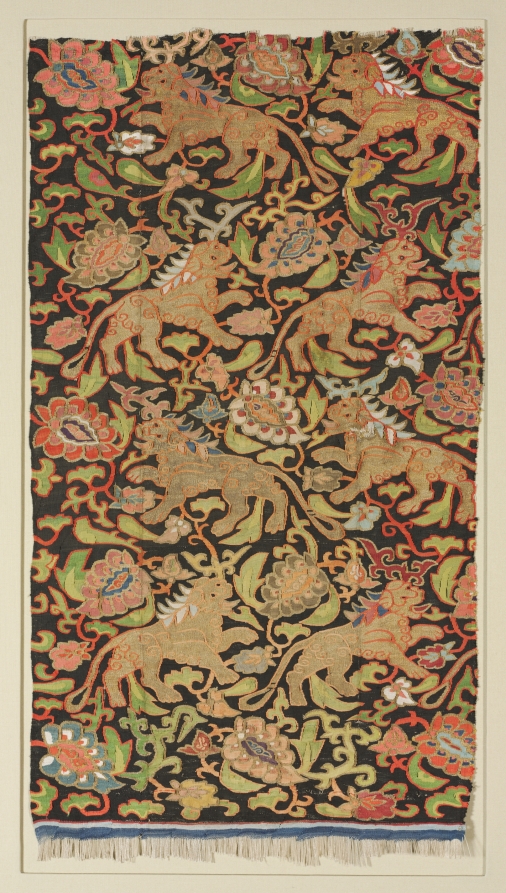
A Scrutiny of Substance: The Imperial Silk Tapestry
To comprehend the artefact in question—a tapestry of silk, depicting golden lions amidst a field of palmettes—one must first dismiss the merely pictorial. The image is a consequence, a magnificent symptom, of the material. The foundation is not wool, nor linen, but sericulture incarnate: the continuous filament of the Bombyx mori silkworm. This is the non-negotiable premise. Its possession was, for centuries, a state secret guarded with a severity befitting nuclear codes, a monopoly that defined geopolitical power and cultivated an aesthetic language of unparalleled authority. The very fibre speaks of control, of a supply chain so delicate and elongated that its mastery was the exclusive purview of an imperial apparatus. To commission such a piece was not merely to order a decoration; it was to activate the entire machinery of state-sponsored luxury, from mulberry grove to loom.
The Grammar of Opulence: Decoding the Motif
The design, however, is where intention declares itself. The lion, rendered in gold-wrapped silk thread, is not a creature of the savannah but a heraldic entity of pure sovereignty. Its posture—rampant, regnant, or passant guardant—is a carefully constructed dialect of power, borrowed from the bestiaries of West Asia and perfected within the ateliers of Byzantium and later, the serial workshops of the Holy Roman Empire and the Ming Dynasty. This is no whimsical fauna; it is a statement of territorial and dynastic assertion. The palmette, that stylised fan of foliage, provides the rhythmic counterpoint. Its origins lie in the ancient acanthus, but here it is refined into a purely decorative syntax, a vegetative motif stripped of wildness and ordered into a repeating, predictable pattern. Together, they form a visual lexicon where nature is not represented but subjugated and codified into an emblematic language of rule.
The Loom as Legislative Chamber: Weaving as Imperial Policy
Consider the context of manufacture. Imperial silk weaving was never a cottage industry scaled up. It was, invariably, a vertically integrated state enterprise. The looms—often vast, complex draw-looms requiring multiple operatives—were housed in imperial workshops, frequently within palace precincts or closely governed municipal quarters. The weavers were less artisans in the romantic sense and more highly skilled civil servants, their techniques and patterns prescribed by court officials. The designs, such as our lions and palmettes, were approved at the highest levels, often carrying specific symbolic weight for diplomatic gift-giving or reinforcing dynastic mythology. The tapestry, therefore, is a physical manifestation of bureaucratic will. Each pass of the shuttle was an act of policy, each knot an affirmation of a controlled aesthetic economy. The gold thread, likely silk wrapped in a minute ribbon of gilt membrane, further amplifies this, transforming light itself into a commodity to be deployed by the state.
A Comparative Analysis: The Silent Language of Thread Count
The true connoisseur, the individual who appreciates the cut of a garment from a Savile Row establishment, understands that quality resides in the unseen: the canvas, the hand-stitching, the integrity of the cloth. So it is with this tapestry. The density of the weave, the prodigious thread count, is the silent metric of imperial ambition. A higher count denotes not just finer imagery but greater expenditure of labour, time, and material—a deliberate and conspicuous consumption of resources that only a treasury could sustain. Compare it, if you will, to a provincial piece. The latter may depict a similar lion, but the execution will be coarser, the silk perhaps mixed with lesser fibres, the gold thread replaced with yellow dye. The difference is not one of artistic merit alone; it is the chasm between the official seal and the provincial imitation. The imperial piece speaks in the received pronunciation of silk; the other, in a dialect.
Enduring Legacy: From Palace Wall to Modern Code
The legacy of this imperial silk-weaving complex is profound and pervasive. It established a global benchmark for luxury that shifted the axis of trade and inspired centuries of emulation, from the silkworks of Lyon to the attempts at sericulture in the New World. More abstractly, it bequeathed a model of brand management avant la lettre. The imperial workshop was the ultimate ‘house,’ its output consistent in quality, instantly recognisable in style, and unassailable in provenance. The lions and palmettes were its signature, a logo woven in thread. In today’s parlance, it mastered supply chain integrity, quality control, and symbolic storytelling—the very pillars of a modern heritage luxury brand. To possess such a tapestry was to possess a fragment of that authority, a tactile share certificate in the empire’s cultural capital.
In final analysis, this tapestry is far more than a textile. It is a multifaceted document. It is a testament to biological mastery (the silkworm), a certificate of technological and administrative sophistication (the loom and the workshop), and a declarative political manifesto (the motif). The silk is its paper, the dyed and gilt threads its ink, the intricate weave its syntax. To study it is to read a chapter in the history of power, written not by scribes, but by weavers executing a state-sanctioned pattern, one glorious, golden lion at a time. Its value persists not merely in its beauty, but in its embodiment of a system where excellence was not an accident, but an imperial command.