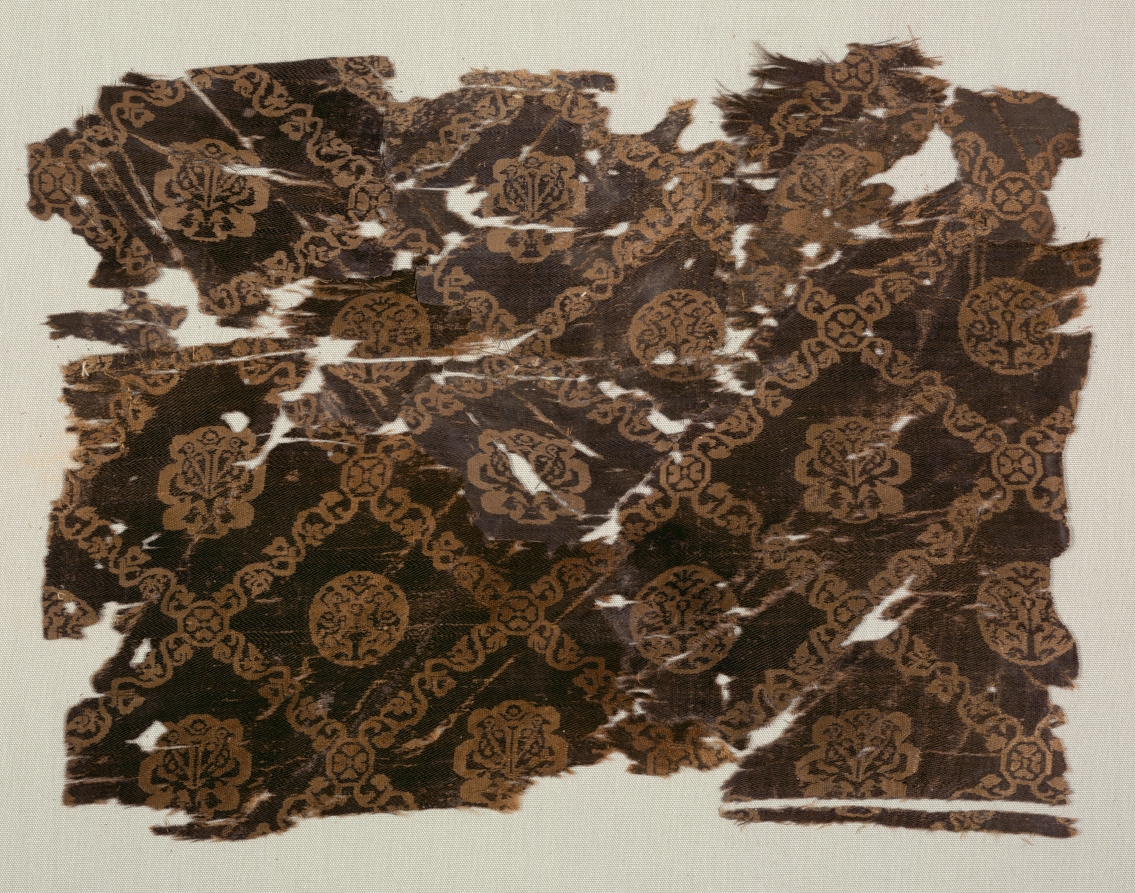
The Fabric of Dominion: A Discourse on Medallion Silks
To comprehend the silk bearing a lattice of animals enclosed within medallions is to engage with a fabric that is, in its very essence, a manifestation of imperial authority. This is not mere textile; it is a heraldic system rendered in thread, a portable assertion of dominion and cosmic order. The materiality of silk itself provides the foundational gravitas. Its acquisition, a jealously guarded secret for millennia, established it as the ultimate luxury fibre, a tangible representation of a civilisation’s technological and cultural ascendancy. The inherent sheen, the formidable strength concealed within a deceptive delicacy, the capacity to hold colour with a jewel-like intensity—these are the non-negotiable prerequisites. They form the impeccable canvas upon which the greater narrative of power is meticulously inscribed.
The Architecture of Authority: The Medallion and the Lattice
The design schema is one of deliberate, imposing hierarchy. The medallion, or roundel, is the central tenet. It operates not as a mere decorative motif, but as a framed field, a tondo of sovereignty. By encircling the emblematic fauna, it performs a function akin to the sealing of a decree or the bounding of a sacred precinct. It declares: what resides within is of singular importance, set apart from the profane continuum of the background. The lattice, then, is the supporting armature—the unseen but essential infrastructure. Whether a stark trellis or a more fluid scrolling vine, it establishes a relentless, repeating geometry. This order imposes a rigid control upon the composition, a visual corollary to the administrative grids of empire: provinces surveyed, territories mapped, populations regulated. The animal kingdom, vast and untamed, is thus brought to heel within this man-made, rational framework.
The Heraldry of the Hunt: A Symbolic Taxonomy
The fauna selected for enclosure are never arbitrary. They constitute a curated bestiary, each species a bearer of specific, universally understood attributes. One observes the lion, or the simurgh, representing unassailable royal power and solar authority. The eagle or falcon speaks of celestial aspiration and sharp, far-reaching judgement. Paired animals in combat—the predator and prey—are a timeless allegory for the natural order of strength and the inevitable triumph of imperial force. Even the gentle gazelle or peacock, symbols of paradise and beauty, are enrolled into this system, representing the benevolent prosperity that flourishes under stable, protective rule. These are not animals as found in nature; they are icons, stripped of incidental detail and elevated to their archetypal forms. Their arrangement within the medallions along the lattice is rhythmic, predictable—a procession of power that marches across the wearer’s form, transforming the body itself into a walking assertion of sanctioned authority.
The Loom as an Instrument of State
The production of such textiles was, invariably, an imperial enterprise. The sophisticated drawlooms required were monumental investments, their operation demanding teams of highly specialised weavers—designers, heddle-makers, drawboys—functioning with the precision of a military unit. The kesi tapestry technique or the intricate compound weaves used to achieve these designs were state secrets. The workshops, whether in Byzantine Constantinople, Sassanian Persia, Tang China, or later, in the Ottoman Imperial manufactories, were direct appendages of the court. Here, the aesthetic was dictated by palace officials, and the output was strictly allocated: for diplomatic gifts to awe and bind subordinate rulers, for ceremonial vestments to sanctify and elevate the imperial person, for adorning palace interiors to create an environment of overwhelming magnificence. The fabric was a tool of statecraft, its distribution a carefully calibrated exercise in soft power. To bestow a length of such silk was to impart a fragment of your aura; to wear it without sanction was an act of profound lese-majesty.
A Legacy in the Modern Lexicon
The resonance of this imperial language in silk endures, though its grammar has adapted. The Savile Row cutter understands, intuitively, the power of a framed motif—the crest on a blazer button, the regimented stripe of a regimental tie, the discreet paisley on a silk lining. These are the diminished, democratised heirs to the medallion. The modern luxury fabric house presenting a jacquard weave with a bold, repeating pattern engages, whether consciously or not, with this ancient dialect of control and display. To drape a space with a bold, medallion-patterned silk damask is still to make a statement of entrenched, confident taste—a domestic sovereignty. The lattice of animals within medallions thus transcends its specific historical incarnations. It stands as a permanent case study in the confluence of material excellence, technical mastery, and symbolic communication. It reminds us that the most enduring luxuries are those that successfully objectify an idea—in this instance, the immutable, ordered, and majestic hierarchy of the world, as seen from the throne. It is, in the final analysis, the fabric of dominion, woven to perfection.