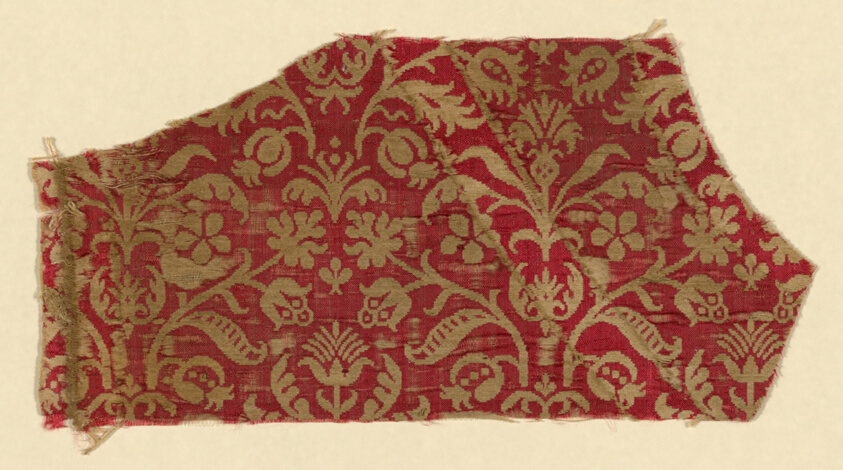
On the Nature of the Fragment: A Disquisition on Material Memory
In the considered estimation of this establishment, true heritage is rarely presented as a complete narrative. It arrives, more often than not, as a fragment—a discreet, eloquent shard bearing the patina of time and the weight of silent testimony. To encounter such an artifact is not to be presented with a solved equation, but rather with a profound and elegant cipher. The specimen under examination—a compound weave of silk and linen—serves as a paramount exemplar of this principle. It does not proclaim; it intimates. It does not overwhelm with scale; it persuades through the integrity of its own compromised existence.
A Constitution of Contradictions: The Compound Weave
The very materiality of the piece is a treatise on balanced opposition. Silk and linen: one the apotheosis of organic luxury, a filament of sheer, proteinaceous brilliance spun by the silkworm; the other, a bast fibre of democratic virtue, derived from the sturdy flax plant, celebrated for its tensile strength and humble coolness. To unite them in a compound weave is an act of sartorial alchemy. It speaks of a craftsman’s intellect, of a deliberate pursuit of a specific, nuanced hand.
This is not a mere blend, but a structured collaboration. The silk, likely employed as the warp or as a supplementary weft, would have bestowed upon the whole a luminous surface, a capacity to capture and refract light with a soft, liquid radiance. The linen, providing the foundational ground, would have imparted body, a dignified drape, and a mitigating crispness—preventing the silk from succumbing to excessive fluidity, from becoming merely languid. The resultant fabric is one of fluid elegance, yes, but an elegance tempered by substance. It suggests a garment designed for movement within rarefied atmospheres—the gentle sweep of a gown through a candlelit salon, the precise, assured gesture of a tailored sleeve. The fragment, in its current state, holds the memory of that kinetic grace within its very threads.
The Patina of Interruption: Reading the Breach
Now, however, we must attend to its condition: fragmented. The edges are raw, severed not by shears but by the unequivocal agency of time. This breach is not a deficit; it is the locus of its most compelling discourse. The frayed termini of linen and silk, once interlocked in their complex dance, now stand exposed. In this exposure, we are granted a privileged view into the fabric’s soul—its internal architecture laid bare. We can observe the density of the weave, the harmony of the thread counts, the quality of the twist in the yarn. The breakage tells a story of stress, of a point of yielding.
Furthermore, the fragment’s silence regarding the whole is its most articulate feature. Was this a portion of a bodice, a cuff, an inset panel? The classic silk craftsmanship evident in the surviving weave hints at an application of significance, not mere trimming. The compound structure was expensive, time-consuming, and demanded a loom of some sophistication. Its use was a statement of intent. The linen’s presence may indicate a garment meant for warmer climates or seasons, or perhaps a deliberate aesthetic choice to mute the silk’s sheen for a more matte, daytime propriety. The fragment, in its reticence, compels us to interrogate, to reconstruct, to engage actively with its history.
Fluid Elegance as a Philosophical Stance
The context provided—classic silk craftsmanship and fluid elegance—transcends mere description. It proposes a philosophy. Classic craftsmanship implies a grammar, a set of rules and techniques honed over centuries, from the mulberry groves of ancient China to the Jacquard looms of Lyon. The weaver of this fragment operated within this venerable continuum. The fluid elegance is the poetic output of that technical mastery. It is not the flamboyant, ostentatious luxury of brocade, but the subtle, sophisticated luxury of supreme suitability—the elegance of a material perfectly fitted to its purpose, moving with the wearer as a second skin.
This extant piece, therefore, becomes a relic of that philosophy. It is a physical manifestation of the belief that true refinement lies in the marriage of opposites: strength with softness, luminosity with restraint, enduring structure with apparent ease. Its fragmented state only heightens this perception. We are left with the essence, the core sample of that ideal, unadulterated by the compromises of a complete garment’s functional necessities.
Conclusion: The Fragment as Legacy
In the final analysis, to possess such a fragment is to be made custodian of a question. It is a more demanding, and thus more rewarding, legacy than a preserved whole. A complete garment speaks of a specific moment, a fixed silhouette. A fragment speaks of process, of material intelligence, and of the beautiful, inevitable decay that attends all mortal things, even those wrought with immortal skill.
This silk and linen artifact, resting now upon the archival cloth, is a testament to the fact that heritage is not a sealed vault, but a conversation. Its frayed edges are an invitation—to consider the hand that wove it, the form it once took, the life it adorned, and the precise quality of its elegance. It reminds us that the most enduring statements are often those made in a whisper, and that from a single, exquisite fragment, an entire world of craftsmanship, taste, and silent history can be, with due respect and scholarly imagination, eloquently reconstructed.