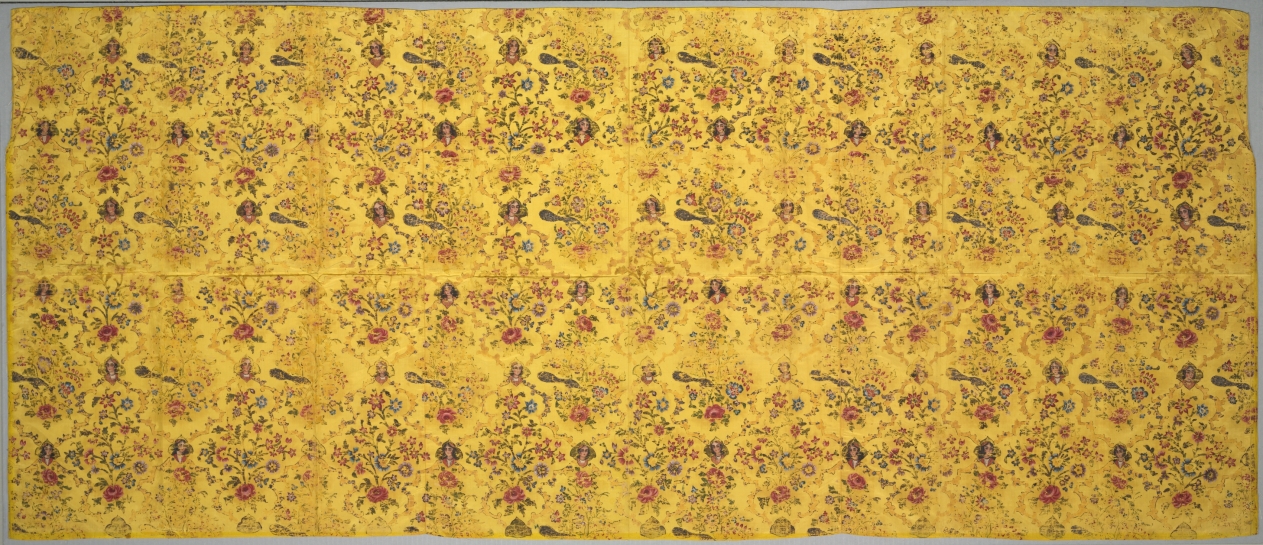
An Exegesis of Imperial Opulence: The Flora, Fauna, and Figure of a Silken Wall Cover
To engage with this artifact is to undertake a sartorial audit of absolute authority. We are not presented with mere furnishing, but with a woven proclamation—a testament to a supply chain of power, taste, and technical supremacy that defined the very notion of luxury for centuries. The medium, as ever, is the message: silk. Not simply a fibre, but the historical currency of empires, the catalyst for transcontinental trade, and the definitive canvas upon which dynastic legacies were embroidered in light and colour. The subject—a wall cover teeming with flora, peacocks, and portrait medallions—transcends decoration. It is a curated ecosystem of symbolism, a boardroom of iconography where nature, sovereignty, and eternity convene.
The Foundation: The Sovereign Thread
Before a single motif can be decoded, one must appreciate the ground upon which it is built. Imperial silk weaving, particularly as perfected in the workshops of China for the Ming and Qing courts, and later emulated in European manufactories like Lyon and Spitalfields, represented the apex of pre-industrial technology. It was a state-controlled enterprise. The cultivation of the mulberry, the rearing of the Bombyx mori silkworm, the reeling of the filament, and the complex operation of the draw-loom were processes guarded with the severity of state secrets. The resultant fabric was a controlled substance, its distribution and use often legislated by sumptuary laws. To drape a wall in such material was, therefore, an act of profound statement. It declared not merely wealth, but sanctioned privilege, a direct lineage to the imperial prerogative. The sheen, the handle, the formidable durability—these were the baseline specifications for a project intended for permanence.
The Arboreal Archive: Flora as Heraldic Device
The flora depicted is never arbitrary horticulture. It is a carefully selected board of directors from the botanical world, each member possessing an impeccable symbolic pedigree. One will likely observe the peony, undisputed sovereign of flowers in the Eastern canon, representing prosperity, honour, and the fullness of spring. The lotus, emerging pristine from murky waters, speaks of purity, spiritual elevation, and cosmic harmony. Intertwining branches of the prunus (plum blossom), which braves the winter frost, signal resilience and scholarly perseverance.
This is not a wild garden, but a planned estate of meaning. The arrangement is rhythmic, symmetrical, and endlessly repeating—a visual manifestation of the eternal order of the natural world under celestial (and by extension, imperial) guidance. The silk thread, with its capacity for gradation of hue, captures the delicate veining of a leaf, the blush on a petal, rendering nature in a state of idealised, perpetual perfection. It is a managed landscape, reflecting the emperor’s role as steward of all under heaven.
The Avian Auditor: The Peacock’s Gaze
Enter the peacock. Its inclusion elevates the composition from the pastoral to the regal. In Western traditions, the bird is associated with Juno, vision, and incorruptibility. In Eastern symbology, it embodies the dignities of beauty, refinement, and the watchful administration of the realm. Its magnificent train, a fan of a hundred eyes, suggests omniscience—a fitting attribute for the imperial purview.
Critically, the peacock is rendered in all its iridescent glory. Here, the silk weaver’s art achieves its most virtuosic pitch. Capturing the “peacock” colour—that shifting interplay of deep blues, greens, and purples—required masterful dye work with precious pigments and complex layering of threads. The bird is not merely depicted; it is re-animated in silk, its plumage a tangible display of the workshop’s ability to command the very physics of light. It stands as a guardian of the scene, its splendour a direct reflection of the splendour of the court it adorns.
The Portrait Medallion: The Anchor of Authority
Amidst this lush, symbolic landscape, we encounter the most direct assertion of power: the portrait medallion. Framed by intricate cartouches, often derived from classical or imperial insignia, these are not mere decorative rondels. They are the keystone of the entire narrative.
In a European context, these might contain the profiles of ruling monarchs or classical deities aligning the dynasty with timeless virtue. In a Chinese context, they may feature the shou character (longevity) or the dragons and phoenixes of the imperial couple. They act as a seal, a stamp of provenance and purpose. The medallion interrupts the organic flow of the flora and fauna to impose a human, or heraldic, order. It states unequivocally that this entire world of woven beauty exists under the aegis of the figure within the frame. It is the corporate logo of empire, woven directly into the fabric of reality.
The Lasting Legacy: A Woven Testament
This wall cover, therefore, is a multidimensional document. It is a technical prospectus of the most advanced textile science of its age. It is a political manifesto written in thread, asserting hierarchy, order, and divine favour. It is a botanical and zoological registry of approved symbols. Finally, it is an exercise in environmental design, intended to transform an interior space into an immersive embodiment of imperial ideology.
To commission it required access to a monopolised supply chain. To display it was to claim a place within that rarefied lineage. Its preservation today allows us to reverse-engineer not just a pattern, but an entire worldview—one where authority was not merely asserted, but woven into the very walls that contained it. The legacy of imperial silk weaving is here made manifest: the transformation of a delicate filament into an enduring language of power, meant to outlast the seasons, the reigns, and the centuries themselves. It is, in the final analysis, the ultimate bespoke creation: a world made to order, from the ground up, in silk.