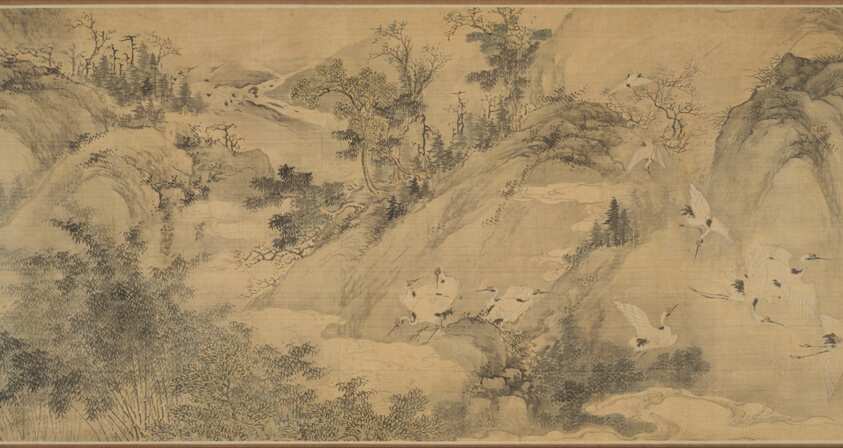
An Examination of Lineage and Line: The One Hundred Cranes Handscroll
To engage with a handscroll of such designation—One Hundred Cranes—is to accept an invitation to a most exacting sartorial atelier, albeit one transposed to the realm of silk and ink. Here, the medium is not merely a support; it is the foundational cloth from which the entire conception is cut. The specific, luminous ground of untreated, natural silk represents the equivalent of a length of the finest, unpadded shantung or a gossamer-weight jacketing cloth. Its subtle tooth and sheen are not accidental qualities but essential, active participants in the final composition. The ink and light colour do not sit opaquely upon this surface; they are absorbed, they bleed along the fibres with a controlled deliberation, the silk itself guiding the diffusion of wash to create soft, feathered edges—an effect no paper could replicate with such aristocratic subtlety. This is the first and most critical point of connoisseurship: the material dictates the manner of execution.
The Discipline of the Draughtsman’s Hand
Consider, if you will, the rendering of the cranes themselves. The depiction of one hundred specimens necessitates a vocabulary of forms that is at once consistent and infinitely varied—a challenge akin to crafting a wardrobe of one hundred bespoke overcoats, each distinct yet unmistakably from the same house cut. The artist’s brushwork here is the equivalent of the tailor’s chalk and scissor. The long, sweeping curves that define the arching necks and trailing secondary feathers demand a single, confident stroke of the brush, charged with ink of precisely the correct dilution. There is no opportunity for correction or over-painting on this silk ground; a hesitant line would be immediately apparent, a fatal flaw in the garment’s construction.
The elegance is in the restraint. The application of light colour—perhaps a whisper of ochre at the crown, a hint of vermilion for the crest—is applied with the discretion of a perfectly chosen pocket square. It does not seek to obscure the underlying ink work, any more than a fine silk lining should contradict the drape of the outer cloth. It serves to accentuate, to highlight, and to provide the most nuanced of tonal separations. The fluidity of the forms, the sense of the cranes in various states of repose, alertness, or preening, speaks to a profound understanding of anatomy, not through laboured detail, but through the masterful suggestion of structure and movement beneath the plumage.
Composition: The Narrative of the Unfolding View
The format of the handscroll is paramount to its intellectual and aesthetic consumption. It is not a static image to be taken in at a glance, like a portrait above a mantel. It is a curated experience, revealed temporally, much as a client is guided through the stages of a commission—from the initial selection of cloth, to the fitting of the basted garment, to the final revelation. The viewer, or more accurately, the operator of the scroll, controls the pace of revelation. One may linger on a group of three cranes, their poses forming a delicate, balanced dialogue. One may scroll slowly to appreciate the ingenious manner in which the artist has avoided monotony, using the reeds, wisps of cloud, or the suggestion of a water’s edge to segment the procession without creating jarring divisions.
This compositional rhythm is the scroll’s narrative. It possesses a quiet, inherent cadence. The placement of each bird, the intervals between them, the clusters and the solitary figures—all are governed by an instinct for visual harmony and spatial tension that feels inevitable. It is the spatial equivalent of the rule that a tie’s dimple should be centred; a small detail, but one upon which the entire impression of considered elegance rests. The emptiness, the strategic use of silk-as-negative-space, is as critical as the inked forms. It is the silence between the notes, the cuff exposed just so from the jacket sleeve.
Heritage and the Permanence of an Ideal
Ultimately, the One Hundred Cranes handscroll transcends its immediate subject matter. It is a testament to a system of values where material integrity, technical mastery, and compositional intelligence are inseparable. The crane, in the cultural lexicon from which this work springs, is a symbol of longevity, nobility, and auspicious grace. The artist, through the disciplined application of ink and light colour upon silk, does not merely depict one hundred birds; he embodies and projects these very qualities through the act of creation itself.
The work stands as a peer to the most revered traditions of bespoke craftsmanship. It asserts that true elegance is never ostentatious. It resides in the perfection of the foundational elements: the quality of the silk, the authority of the line, the intelligence of the design, and the serene confidence to allow these elements to speak for themselves. In the quiet unfurling of this scroll, one encounters not a mere painting, but a permanent manifesto on fluid elegance—a principle as applicable to the cut of a lapel as to the stroke of a brush. It is a heritage artifact that does not simply belong to history, but continues to articulate, with impeccable clarity, a standard against which contemporary expressions of craftsmanship might still be measured.