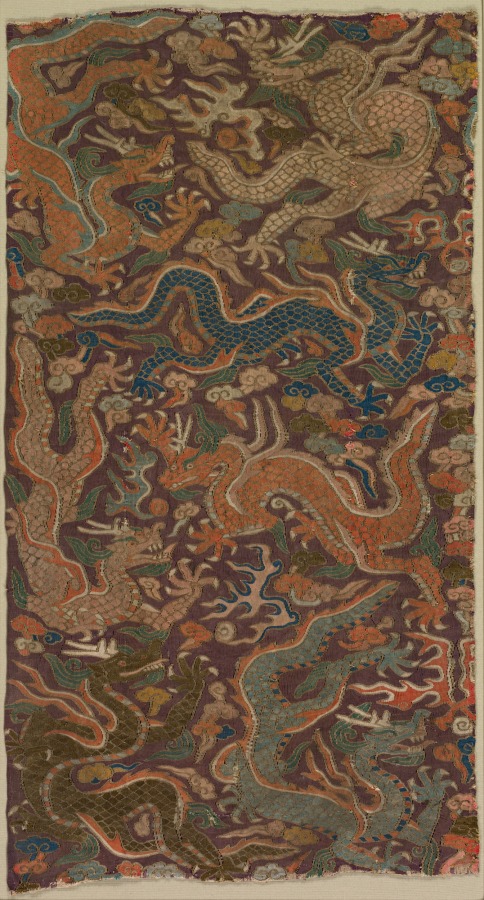
An Inquiry into the Motif: Dragons in Pursuit of the Flaming Pearl
To comprehend the full weight of this artefact—a length of silk brocade depicting the eternal chase of the dragon after the flaming pearl—one must first appreciate the profound materiality of its foundation. Silk is not merely a substrate; it is a testament to imperial authority, technological supremacy, and a cultural lexicon woven with intention. The very fibre, cultivated in secrecy for millennia, established a geopolitical currency more stable than gold. Its production, from sericulture to the monumental draw-looms of imperial workshops, represented a pinnacle of coordinated industry, a pre-industrial complex demanding precision, patience, and immense capital. The fabric, therefore, was never innocent. It was a carrier of meaning, a restricted language of power. To clothe oneself in such silk was to announce one’s position within a celestial-ordained hierarchy. The motif under examination here represents the apogee of that woven language, reserved for the apex of the imperial structure.
The Grammar of Power: Decoding the Motif
The central drama—one or more dragons in dynamic pursuit of a sphere wreathed in flame—operates on multiple symbolic registers. Consider the dragon, or long. Unlike its Western counterpart, it is not a beast to be slain but a benevolent, potent force of nature, embodying cosmic energy (qi), transformative power, and, most critically, imperial authority. The Son of Heaven himself was its living embodiment. The five-clawed dragon, specifically, was a strictly enforced emblem of the emperor, its depiction on silks a sartorial decree of law.
The object of its pursuit, the flaming pearl, completes a dialectic of sovereignty. Scholars posit varied interpretations: it is the pearl of wisdom, the moon, the sun, or the Buddhist cintamani, the wish-fulfilling jewel. In the context of imperial iconography, it is best understood as the representation of perfect truth, luminous knowledge, and the legitimate mandate to rule. The dragon does not merely possess the pearl; it is perpetually engaged in its pursuit. This is the critical nuance. The chase signifies the eternal vigilance, the unceasing endeavour, and the dynamic exertion required of the virtuous ruler. It is a visual metaphor for the pursuit of heavenly perfection and the maintenance of cosmic order, a duty incumbent upon the throne.
Material Execution: Where Allegory Meets Loom
The translation of this potent allegory into silk is where imperial ambition met technical mastery. The complexity of the motif—with its sinuous, scaled bodies, expressive claws, and undulating flames—demanded the most advanced weaving technology of the age: the pattern-making draw-loom. This formidable apparatus, operated by a master weaver and a draw-boy, could manipulate thousands of warp threads to create detailed, polychrome designs. The resulting fabric, often a kesi (silk tapestry weave) or a dense brocade, was characterised by its clarity of design, richness of colour (using mineral and vegetable dyes of the highest order), and a palpable, weighty presence.
The materiality enforced the message. The lustre of the silk caught the light, causing the dragon and pearl to shimmer with an otherworldly vitality, quite literally animating the symbol. The density of the weave conveyed substance and permanence. This was not a hastily printed emblem; it was a labour-intensive, costly investment of time and skill, a physical manifestation of the empire’s resources dedicated to articulating its own legitimacy. The silk ground, therefore, was the silent yet essential partner to the motif, providing the dignifying sheen and tactile authority that elevated the design from mere decoration to a heraldic device of the highest order.
A Legacy Woven in Thread
The legacy of these imperial silks extends far beyond the walls of the Forbidden City. They established an aesthetic and technical canon that influenced every stratum of textile production, albeit with carefully regulated diminutions of the central motif for lesser ranks. The pursuit of the flaming pearl became a foundational grammar in the language of East Asian decorative arts, appearing in ceramics, lacquerware, and architectural details. Its endurance speaks to the profound resonance of its underlying narrative—the noble pursuit of enlightenment and harmonious rule.
In contemporary considerations, this artefact invites reflection on the inseparable union of material, motif, and meaning. The dragon and pearl motif, divorced from its original, rigidly policed context, retains its majestic power but reminds us that true luxury—in the historical sense—was never merely about aesthetic pleasure. It was about the meticulous encoding of world order into tangible form. The silk was the medium; the draw-loom was the technology; but the message, forever chasing its own perfect realisation, was one of sovereignty, perpetuity, and celestial duty. To study this length of silk is to understand that in the ateliers of empire, thread was philosophy, and the loom was its most eloquent orator.