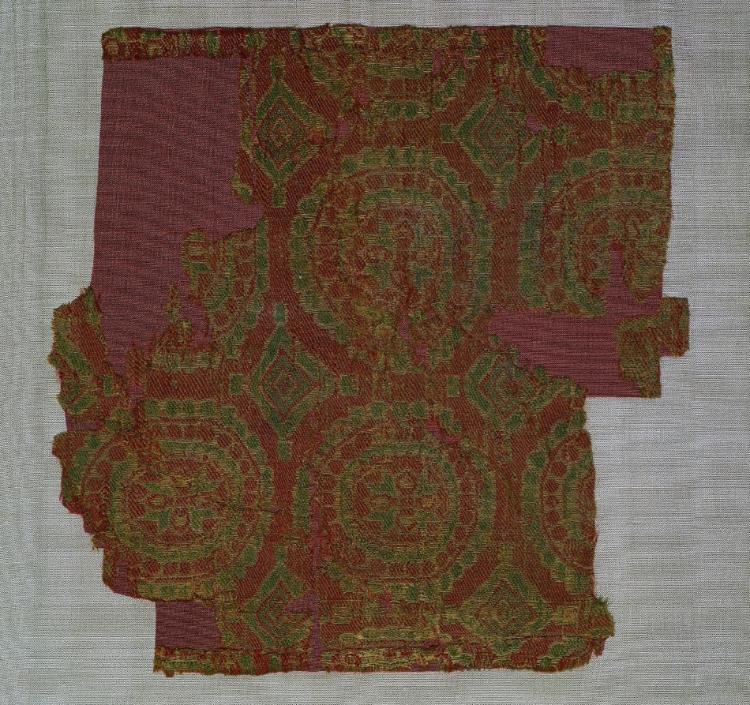
A Consideration of Samite: The Imperial Substrate
To comprehend the legacy of imperial silk weaving, one must first apprehend the foundational cloth: samite. It is not merely a fabric, but the very substrate of power upon which empires articulated their divine and temporal authority. Characterised by a weft-faced compound twill structure, samite possesses a singular density and sheen, a heavy, liquid drape that captures and modulates light with a solemnity unknown to simpler weaves. Its production was, for centuries, a fiercely guarded secret—a state monopoly of the Byzantine gynaecaea and, later, the Islamic caliphates. To clothe oneself in samite was to announce one’s proximity to the innermost sanctums of imperial or ecclesiastical power; it was a wearable cipher of supreme status.
The Grammar of the Roundel: A Heraldry of Botany
The specimen under consideration—a fragment of samite adorned with roundels of rosettes—speaks a sophisticated visual language. The roundel, or clipeus, is not a casual motif. It is a framing device of profound intentionality, a circular boundary that isolates and sanctifies the imagery within from the endless field of the cloth. It declares the contained symbol as worthy of singular attention, transforming the fabric from a mere textile into a sequenced gallery of emblematic thought. The rosette, within this hallowed circle, is far from a simple floral doodle. It is a formalised, radial blossom, a botanical abstraction leaning towards the geometric. Its origins likely trace to the ancient Near Eastern "lotus" or palmette, motifs absorbed and refined through the relentless cultural syncretism of the Silk Roads.
In the hands of Sasanian and then Byzantine weavers, the rosette evolved into a symbol of cosmic order and perennial renewal. Its symmetrical petals radiating from a central point suggest the sun, a wheel of fortune, or the unfolding of divine harmony. When rendered in silk and gold thread upon the imperial purple ground—a colour legislated for sole use of the Basileus—the rosette roundel becomes an article of faith and dominion. It is the natural world, disciplined, perfected, and enlisted into the service of proclaiming an empire’s eternal, cyclical legitimacy.
Material Intelligence: The Loom as Legislative Chamber
The creation of such a textile was an enterprise of staggering complexity, demanding what we might term a material intelligence of the highest order. The drawloom required to weave patterned samite was a monumental machine, operated by a collaborative hierarchy of master weavers and draw-boys. Its configuration was a form of frozen logic, a binary system of heddles and leashes that translated the designer’s cartoon into raised and suppressed warp threads. Each roundel, each precisely curling stem, was encoded into the loom’s setup—a process as arduous as typesetting a folio, but for a medium of thread and light.
This technological marvel was inseparable from political economy. Imperial workshops, such as those in Constantinople or, later, Baghdad and Damascus, were not ateliers in the romantic sense. They were strategic installations, as crucial to statecraft as the mint or the armory. The silks they produced were seldom for open commerce. They were diplomatic currency, bestowed upon allied kings and potentates in carefully measured lengths. A robe of honour (khil'a) made from such cloth did not merely gift a garment; it enveloped the recipient in the very substance of the patron’s authority, binding them in a web of obligation and visible allegiance. The samite with rosette roundels was, therefore, an instrument of soft power long before the term was coined.
Enduring Echoes in the Sartorial Canon
The legacy of this imperial grammar of weave and motif is not confined to museum vitrines. Its echoes resonate in the most refined bastions of modern menswear. Consider the unwavering commitment to proprietary cloths developed by the great houses of Savile Row and their Florentine or Neapolitan counterparts. The quest for a specific twist, weight, and hand-feel in a jacketing flannel or a luxury wool is a direct descendant of the imperial obsession with controlling the material substrate of status.
More pointedly, the language of the roundel finds its subtle expression in the polka dot, the paisley (itself a descendant of the Persian boteh), and in the discreet, repeating patterns of a fine silk tie or a printed lining. The principle remains: a controlled, rhythmic pattern bestows a sense of order, tradition, and coded identity. When a bespoke tailor selects a bold silk for a waistcoat lining, he is engaging in a minor act of heraldry, placing a personal emblem close to the wearer’s heart—a direct, if diminished, inheritance from the emperor whose silken robes declared his god-given right to rule.
In final analysis, this fragment of samite is a testament to a world where textile was theology, politics, and economics woven into one luminous, tangible form. The rosette within its roundel is a silent manifesto of imperial ideology, a declaration that beauty is never innocent, and that the most enduring power is often sheathed in the most exquisite materials. Its study reminds us that in the hierarchy of human expression, the loom, in its time, was as potent as the pen or the sword, and its products were the original broadsheets of the mighty.