An Artefact of Discipline and Refinement: The Sampler in the Lauren Fashion Heritage Lab
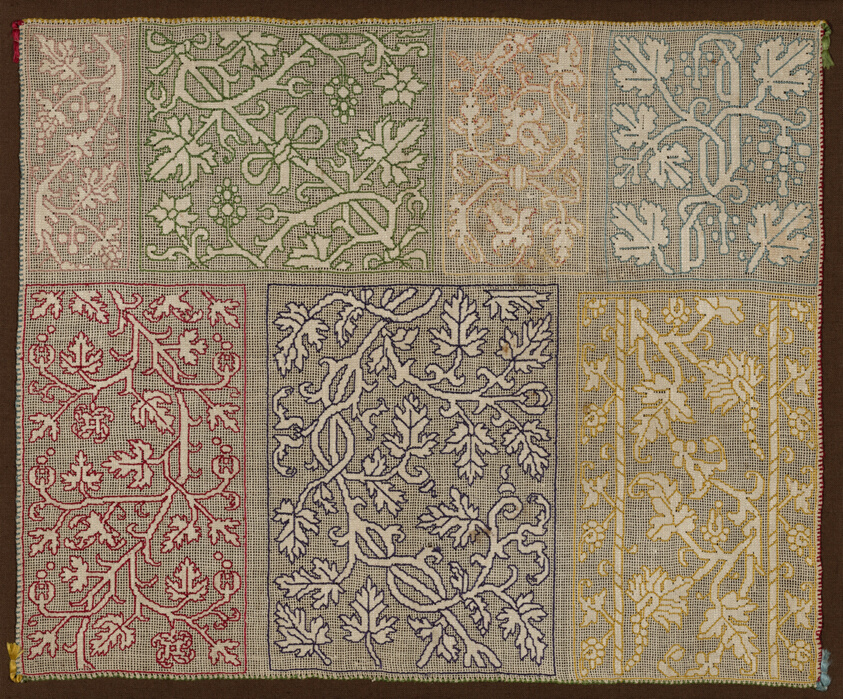
Within the Lauren Fashion Heritage Lab, we approach objects not merely as relics of aesthetic endeavour, but as codified documents of cultural and technical capital. The sampler, a seemingly humble exercise in needlecraft, stands as a foundational text in this archive. When executed with the specific materiality under examination—linen ground, silk and linen thread—it transcends its pedagogical origins to become a profound statement on the hierarchy of textiles and the cultivated hand. This particular specimen, with its plain gauze weave linen, silk floss embroidery, and applied tassels, demands an analysis befitting the most exacting bespoke tailoring salon of Savile Row: it is a benchmark of technique, a testament to disciplined practice, and a study in the dialogue between structural integrity and fluid elegance.
The Ground: A Canvas of Uncompromising Integrity
One does not commence a bespoke garment with inferior cloth; the foundation dictates the longevity and character of the final form. So it is with the sampler. The use of a plain gauze weave linen is a deliberate and sophisticated choice. Linen, derived from the flax plant, possesses a singular authority: it is robust, possesses a noble sheen that deepens with time, and holds a sharp, clean line. The gauze weave, a lenient, open structure, presents a particular challenge. It offers no place for the needlewoman to hide; every stitch must be placed with precision, its tension perfectly calibrated. A heavy hand would distort the grid, a slack one would fail to anchor the thread. This selection of ground fabric speaks of a practitioner already versed in the grammar of textiles, one who understands that true skill is demonstrated not on forgiving canvas, but on the most demanding.
The Stitch: A Lexicon of Technical Attainment
The embroidered motifs, rendered in silk floss and linen thread, are the articulated vocabulary of this textile document. The stitches employed—double running, stem, weaving, and buttonhole—represent a curated syllabus of essential techniques. The double running stitch, often known as Holbein stitch, is the epitome of disciplined control. It produces a clean, identical line on both sides of the fabric, a mark of consummate finish and hidden labour, much like the invisible hand-stitching on the lapel of a bespoke jacket. It declares that integrity should be maintained in both the seen and unseen realms.
The stem stitch introduces fluidity, a cursive line that allows for organic, flowing forms. Its very name implies growth and direction, a controlled elegance that follows a plotted path. The weaving stitch (likely a form of pattern darning) demonstrates a profound understanding of textile structure, building new surfaces upon the existing warp and weft. It is an act of architectural reinforcement and decoration in one. Finally, the buttonhole stitch—the workhorse of edging and cutwork—is fundamentally about securing a boundary, preventing fray, and creating a durable, decorative finish. It is the functional stitch par excellence, its reliability never precluding its potential for ornamental detail.
The Embellishment: A Statement of Concluded Perfection
The applied silk tassels at each corner are not mere afterthoughts; they are the final, authoritative signature. In the context of Savile Row, one might consider the silk boutonnière loop, the covered buttons, or the precise pick-stitching along a seam. These are the details that confirm the object has been concluded, that every element has been considered. Silk tassels, in this setting, perform a dual function. Visually, they provide a weighted punctuation, a full stop to the composition. Tactilely, they introduce a element of kinetic luxury, a soft, moving counterpoint to the flat, precise field of embroidery. Their application via buttonhole or couching stitches would itself be a further test of technical skill, requiring an invisible yet unshakeable anchor. They transform the sampler from a practice sheet into a finished artefact, worthy of display.
Context: The Fluidity of Mastered Discipline
The broader context of "classic silk craftsmanship and fluid elegance" is perfectly encapsulated here, though not in the way one might initially assume. The fluid elegance is not the languid drape of a bias-cut gown, but the effortless, flowing line achieved only through years of rigid practice. It is the elegance of a perfectly executed stem stitch curve, or the seemingly effortless run of a double running line—a fluidity born of absolute control. The silk floss, with its luminous sheen and rich dye retention, is the medium that elevates the exercise. It catches the light, giving life and depth to the geometric and floral motifs, much as a silk tie or pocket square provides a point of luminous focus against the sober wool of a suit.
In conclusion, this sampler, as held in the Lauren Fashion Heritage Lab, is far more than a record of stitches. It is a manifesto of principles that resonate deeply with the tenets of Savile Row bespoke: the supremacy of quality materials (linen and silk), the non-negotiable requirement of technical mastery (the stitch lexicon), the importance of structural integrity (the gauze ground), and the final flourish that signifies a completed work of distinction (the tassels). It demonstrates that true elegance is always, without exception, the product of discipline. The hand that wrought this sampler understood that before one can innovate, one must master the canon. This artefact is that mastery, rendered in linen and silk—a permanent testament to the cultivated hand and the refined eye.