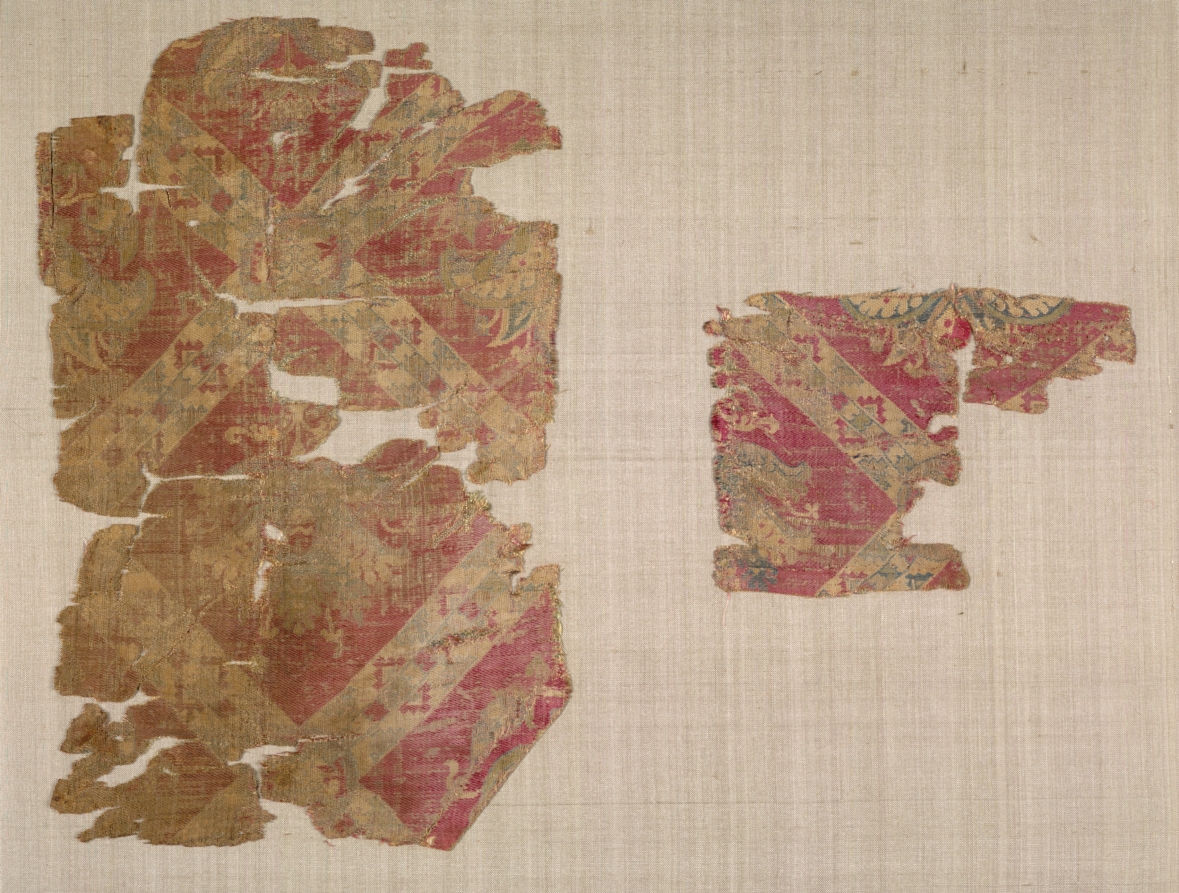
A Considered Examination: Fragments Bearing the Palmette
One approaches these remnants—these Silk Fragments with Palmette Blossoms—not as mere textile, but as a testament to a formidable institutional legacy. Their materiality, pure silk of the most exacting grade, is the foundational premise. This is not a fabric for the tentative or the impecunious. It speaks of a supply chain commanded by imperial prerogative, of mulberry groves cultivated as a matter of state, and of sericulture so closely guarded its secrets were tantamount to treason. The very fibre, before a single thread was thrown on the loom, was already imbued with authority.
The Loom as a Instrument of State
The context, as we must firmly establish, is the legacy of imperial silk weaving. This was never a cottage industry, nor a pursuit of mere aesthetic fancy. It was, in the most calculated sense, soft power rendered in filament and dye. Imperial ateliers were less workshops and more ministries of visual propaganda. The complexity of the weave observable in these fragments—likely a samite or a fine damask—required looms of immense size and sophistication, operated by teams of highly specialised artisans. These were capital investments on a national scale. The loom, in this context, becomes an instrument of state, its rhythmic clatter a sound of sovereign might, producing not just cloth but a portable, wearable manifestation of dominion.
The Grammar of the Palmette: A Heraldic Botanica
Which brings us to the central motif: the palmette blossom. To the untrained eye, a mere decorative floral. To the cognoscenti, a dense lexicon of symbolic intent. The palmette is not a naturally occurring form; it is a stylised, heraldic botanica, a composite of palm frond and lotus bloom, distilled through centuries of cross-cultural exchange along those very trade routes the silk itself travelled. Its presence on imperial silk is a deliberate statement of cultivated, ordered nature. It represents a world brought to heel, its wildness formalised into a perfect, symmetrical, and repeatable emblem of control.
The arrangement of the palmettes across the fragment’s field is crucial. The rhythm is neither haphazard nor strictly regimented into a grid. There is a flowing, scrolling quality, suggesting a luxurious, endless bounty. Yet, upon closer inspection, one discerns the rigorous mathematical underpinning—the precise spacing, the mirrored forms—that prevents the design from descending into mere frivolity. It is, in essence, the visual equivalent of a complex protocol: appearing fluid and natural, while being governed by an unbreakable set of rules. This is the essence of imperial aesthetics: the concealment of immense effort beneath a surface of effortless grandeur.
Colour & Light: The Alchemy of Status
While time has softened the original chromatic vigour, traces in the warp and weft hint at the initial spectacle. The dyes employed would have been of the highest order: cochineal or kermes for reds, lapis lazuli for blues, and perhaps the legendary Tyrian purple, a colour so exclusive its use was codified in sumptuary laws. The silk’s inherent properties—its prism-like ability to refract light—would have been exploited to its fullest. The pattern would not have lain flat; it would have shimmered into view as the wearer moved, a dynamic display of wealth and position. The palmette blossoms would have emerged and receded with each step, a silent, luminous announcement of presence. This was theatre, woven.
The Fragment as Archive
Their current state as fragments is, paradoxically, what elevates their scholarly value. A complete robe can overwhelm; it presents a finished narrative. A fragment, however, invites forensic scrutiny. One examines the selvedge for clues to the loom’s width. The density of the threads per inch speaks to the fineness of the gauge. The back of the weave reveals the technical ingenuity—or occasional shortcut—of the weaver. These are the marginalia of manufacture, the unedited notes that lie behind the polished final product. They tell of a specific workshop, a particular season, perhaps even the hand of a master weaver meeting—or discreetly flouting—the demands of the imperial inspector.
Enduring Legacy: A Continuum of Excellence
The legacy encoded within these silk fragments is not one of mere antiquity. It is a continuing dialogue about the relationship between material, motif, and power. The imperial silk workshops established the non-negotiable principle: that the highest expression of a culture is found in the objects it commits its finest resources to create. The palmette, this hybrid symbol of eternal growth and order, transcends its original context. It whispers of a standard, a benchmark of quality and intentionality that resonates far beyond the palace walls.
To hold such a fragment is to understand that true luxury is never accidental. It is the culmination of controlled supply, technical mastery, and symbolic depth. It is, in the final analysis, a quiet but unassailable assertion of excellence—a principle as vital on the historical Silk Road as it is on a contemporary cutting table. The thread, though severed by time, continues to connect.