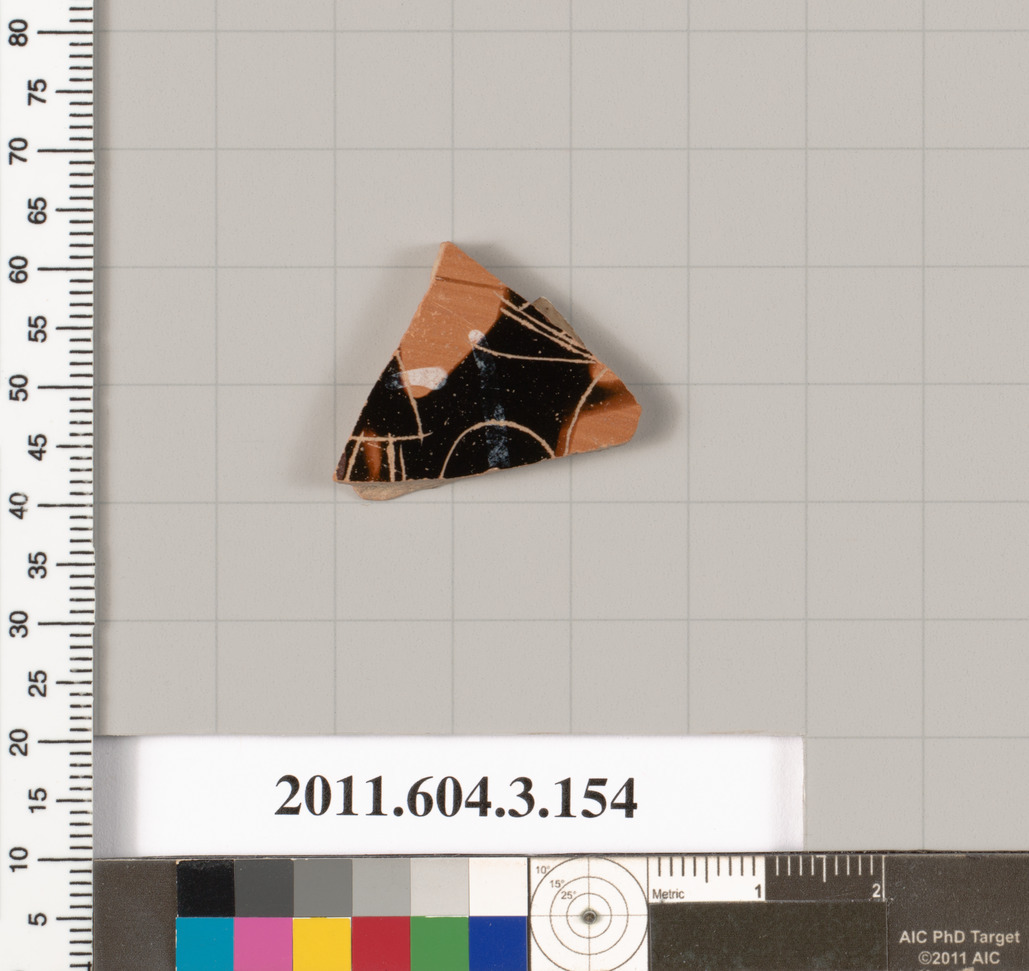
Terracotta and Timelessness: The Attic Fragment as a Genesis for 2026 Old Money Silhouettes
The pursuit of the Old Money aesthetic in fashion is, at its core, a pursuit of legitimacy—a visual language that speaks not of fleeting trends but of enduring values, cultivated taste, and a lineage of quiet authority. For the 2026 iteration, Lauren Fashion Heritage Lab looks beyond the well-trodden archives of twentieth-century prep and into the deeper strata of human craft. Our analysis synthesizes the internal genetic code—the dialectic between the contemplative Pilgrim Sudhana and the dynamic Harpist—with a foundational museum artifact: a Terracotta fragment of an Attic amphora. This shattered vessel, bearing the ghost of a black-figure scene, is not merely an archaeological relic; it is a primal blueprint for the silhouette, texture, and ethos of the coming Old Money paradigm.
The Fragment as Full Form: Archaeology of the Silhouette
The terracotta fragment is, by nature, a study in essentialism and inference. We do not possess the whole jar, yet its curvature tells the story of the complete form. This is the first principle for 2026: the silhouette must be architecturally self-evident. Drawing from the Pilgrim Sudhana’s “stable and inward-gathering” composition, the foundational shapes will be volumetric yet controlled, built from the shoulder and hip like the amphora’s own robust shoulders and tapered base. Think of a woolen overcoat whose cut, from a single angle, implies its perfect drape in the round; or a columnar dress whose seamlessness mirrors the thrown curve of ancient pottery. The silhouette is not worn; it is reconstructed in the mind’s eye from the minimal evidence of a flawless shoulder line or a precise waist suppression, much as the archaeologist intuits the whole from the fragment.
The Black-Figure Dialectic: Graphic Reduction and Ritual Pose
The artifact’s likely black-figure decoration—where silhouetted forms are etched with intricate detail—provides a masterclass in reductive potency. This directly engages the genetic code’s contrast between the Harpist’s “strong, simple contrast” and Sudhana’s “inward convergence.” For 2026, this translates to silhouettes that are defined by graphic, almost hieratic, clarity. The dynamic, S-curve balance of the Harpist is translated not into ornament, but into cut and posture. A tailored jacket will incorporate a subtle, asymmetric drape or a sleeve head set to create an echo of the harpist’s poised arm. The “ritual stillness” of Sudhana manifests in garments that demand and reward a composed posture—a coat that falls perfectly only when standing with quiet assurance, a skirt that moves with a deliberate, unruffled rhythm. The wearer becomes the vessel for this ancient, cross-cultural dialogue between motion and stillness.
Patina as the Ultimate Luxury: The Texture of Time
Terracotta’s materiality is crucial. It is fired earth, possessing a porous, tactile, and unpretentious dignity. Its value is accrued through time, acquiring a patina of micro-fissures and a softened chromatic depth. This informs the 2026 material palette decisively, moving beyond pristine finishes toward the “inward luminescence” prescribed by our genetic code. Heritage-Black, as a category, evolves from a mere color to a textural experience. Imagine cashmere dyed not with flat jet, but with layers of pigment that allow a warm, earthen undertone to emerge under light—a modern analogue to the terracotta’s red-ochre heart. Wool will be brushed to a soft, felt-like nap, recalling the fragment’s eroded surface. Leather will be vegetable-tanned and aniline-dyed to develop a personal patina, its story written in subtle creases and a glow that comes from within, not from surface polish. This is the anti-logo, the luxury of matter that speaks of its own history.
The Poetics of the Broken: Asymmetry and Wholeness
Finally, the very fact of the artifact’s fragmentation is instructive. Old Money 2026 rejects ostentatious perfection. It embraces a poetics of the considered flaw—the elegance of something that has been lived in and possesses an intellectual completeness despite, or because of, its asymmetry. A garment may feature a seam left intentionally visible in a contrasting stitch (echoing the etched lines of the black-figure technique), a closure system that is deliberately archaic yet functional, or a hem that is uneven in a manner that creates a dynamic, harpist-like flow when in motion. This is the “concentrated” state shared by pilgrim and musician, translated into design details that require and reward attention. The silhouette is complete, but its narrative is not seamless; it invites the viewer to piece together its provenance, much like the museum fragment.
In conclusion, the Attic terracotta fragment provides the profound, material anchor for our cross-cultural genetic code. It instructs us that the 2026 Old Money silhouette is an archaeology of form: excavated in line, weathered in texture, and assembled with the silent authority of rediscovered truth. It is not about appearing wealthy, but about embodying the continuity of craft, the dignity of material, and the serene, self-possessed geometry that has, for millennia, separated the eternal from the ephemeral. Lauren’s 2026 collection will thus serve as a curated repository of these principles, offering not just clothing, but wearable heritage—fragments of a timeless aesthetic reconstituted for the modern body and spirit.