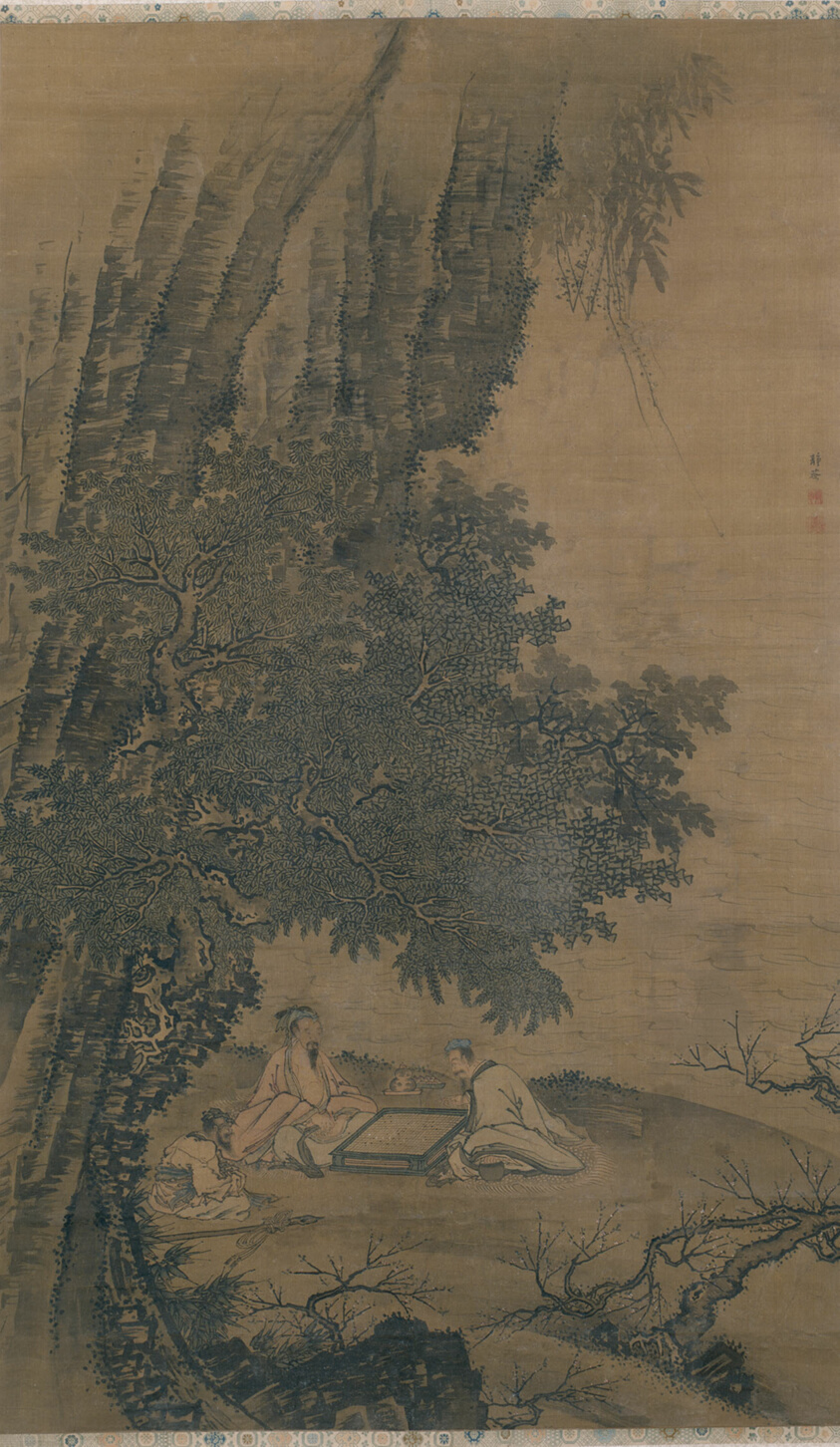
The Enduring Thread: Materiality and Metaphor in *Landscape with Daoist Immortals Playing Weiqi*
Introduction: The Silk as a Testament to Craft
In the hushed, discerning corridors of heritage preservation, where provenance whispers and materiality speaks with a clarity that transcends centuries, the hanging scroll titled *Landscape with Daoist Immortals Playing Weiqi* stands as a paragon of refined artistry. Executed in ink and colors on silk, this artifact is not merely a painting; it is a document of cultural philosophy, a testament to the unbroken lineage of classic silk craftsmanship, and a meditation on the fluid elegance that defines the highest echelons of Chinese aesthetic tradition. For the connoisseur, the silk is not a passive support but an active participant in the narrative—a woven field of potential that the artist has coaxed into dialogue with brush and pigment.
The materiality of this scroll is its first and most profound statement. Silk, cultivated from the cocoon of the *Bombyx mori* moth, has been the chosen medium of Chinese painters for over two millennia. Its production, from the delicate unwinding of filaments to the meticulous weaving on a loom, demands a patience and precision that mirrors the very act of painting. In this scroll, the silk is of a fine, tabby weave, its surface smooth yet possessing a subtle, tactile grain that catches light in a manner akin to a gentle mist. This is not a coarse, utilitarian fabric; it is a luxurious substrate, selected for its ability to absorb and reflect ink with a luminosity that paper cannot replicate. The warp and weft, invisible to the casual eye, create a structural integrity that has allowed the scroll to endure for centuries, a silent testament to the weaver’s art.
The Fluid Elegance of Brush and Silk
The term “fluid elegance” is not a mere poetic flourish; it is a technical description of the interaction between the brush, the ink, and the silk. Unlike paper, which can absorb ink with a certain dryness, silk possesses a natural sizing—a slight sheen derived from sericin, the protein that coats the silk fiber. This sizing resists immediate absorption, allowing the ink to float momentarily on the surface before settling. The artist of this scroll has exploited this property with masterful control. The strokes that delineate the craggy peaks of the landscape are executed with a dry, textured brush, creating a “flying white” effect where the silk’s ground shines through, suggesting the weathered bones of ancient mountains. Conversely, the mists that curl around the immortals are rendered with a wet, diluted wash, the ink bleeding softly into the silk’s weave, creating an ethereal, almost breathable atmosphere.
The colors—subtle mineral pigments of azurite, malachite, and cinnabar—are applied in thin, translucent layers. This technique, known as *gongbi* (meticulous brushwork), requires a steady hand and an intimate understanding of the silk’s capacity. Each layer of pigment must be allowed to dry completely before the next is applied, a process that can take weeks. The result is a depth of hue that seems to emanate from within the silk itself, rather than resting upon its surface. The robes of the Daoist immortals, for instance, are a study in restrained opulence: the azurite blue of one figure’s sash is not a flat field but a mosaic of tiny brushstrokes, each one a deliberate act of devotion to the craft. This is not the garish display of wealth; it is the quiet confidence of a tailor who knows that the finest cloth needs no embellishment beyond its own perfection.
Context: The Weiqi Game as a Metaphor for Craft
The subject of the painting—Daoist immortals playing *weiqi* (the game of Go)—is a profound allegory for the very principles that govern the creation of this scroll. Weiqi is a game of strategic balance, of placing stones on a grid to claim territory, of knowing when to advance and when to withdraw. The artist, in composing the landscape, has engaged in a similar game. The composition is a masterclass in asymmetrical balance: a towering cliff on the left is counterpoised by a void of mist on the right; the immortals, seated at a low table, are a point of stillness amidst the dynamic flow of waterfalls and twisting pines. The silk, with its inherent grid of warp and weft, becomes the board upon which this visual game is played. Every brushstroke is a stone, placed with the same deliberation and foresight that a weiqi master would apply to a critical move.
The immortals themselves are depicted with a serene detachment that echoes the artist’s own relationship to the silk. They are not imposing figures; they are integrated into the landscape, their forms echoing the curves of the rocks and the branches of the trees. This is the Daoist ideal of *wu wei*—effortless action. The artist, through years of discipline, has achieved a state where the brush moves as naturally as the wind through the silk. The painting is not a representation of a landscape; it is the landscape itself, brought into being through the union of human intention and the inherent qualities of the material. The silk, in this context, is not a barrier but a conduit, a medium through which the Dao—the Way—can be expressed.
Preservation and the Legacy of Craft
As a heritage artifact, this scroll demands a reverence that extends beyond its visual appeal. The silk is a living material, susceptible to the ravages of light, humidity, and time. The careful mounting of the scroll—with its silk borders, wooden roller, and jade toggle—is itself a craft tradition that has been refined over centuries. The mounting not only protects the painting but also enhances its presence, framing it within a context of ritual and respect. To handle this scroll is to engage with a lineage of artisans—the weaver, the painter, the mounter—each of whom has contributed to its survival. The fluid elegance of the brushwork is matched only by the fluid elegance of the conservation practices that have preserved it.
In the world of Savile Row, where a bespoke suit is a collaboration between tailor and cloth, the *Landscape with Daoist Immortals Playing Weiqi* stands as a parallel masterpiece. The silk is the cloth; the ink and colors are the stitching; the composition is the cut. And the result, like a perfectly tailored garment, is an object of timeless grace. It is a reminder that true luxury is not in opulence but in the invisible threads of skill, patience, and understanding that bind the maker to the material. This scroll is not merely a painting; it is a philosophy made tangible, a game of weiqi played across the centuries, and a testament to the enduring power of silk as a vessel for the human spirit.