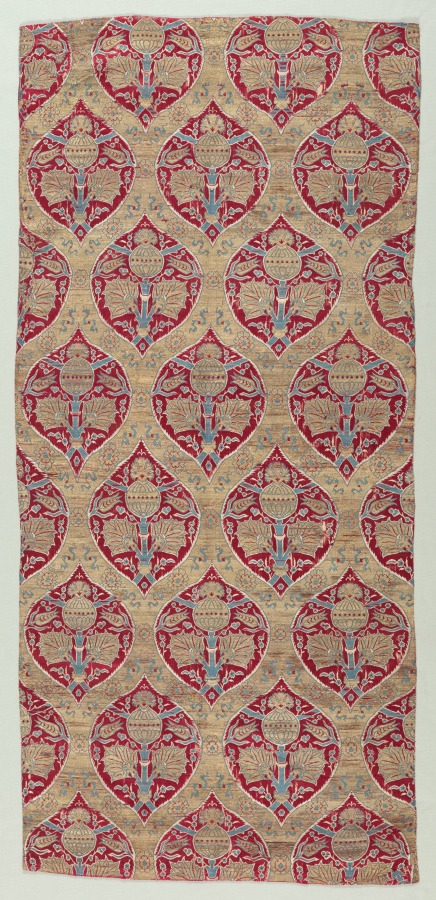
The Ogival Lattice with Horizontal Design: A Study in Imperial Silk Weaving and Its Enduring Legacy
Introduction: The Convergence of Geometry and Craft
In the annals of textile history, few motifs command the reverence and technical admiration afforded to the ogival lattice. When rendered in silk, this pattern transcends mere ornamentation to become a testament to the pinnacle of imperial weaving—a discipline where precision, materiality, and cultural symbolism converge. As a Senior Heritage Specialist at the Lauren Fashion Heritage Lab, I present this artifact analysis through the lens of London’s Savile Row, where the ethos of bespoke craftsmanship and unyielding quality finds its parallel in the silk looms of antiquity. The ogival lattice with horizontal design, executed in silk, represents not only a decorative schema but a dialogue between structure and fluidity, power and grace.
This paper examines the materiality of silk as the substrate for this pattern, the technical mastery required to produce it, and its contextual legacy within imperial silk weaving traditions. We shall explore how this design, often associated with the courts of Byzantium, Persia, and Ming China, continues to influence contemporary luxury textiles, particularly within the tailored environments of Savile Row and high fashion.
Materiality: Silk as the Medium of Imperial Expression
Silk, by its very nature, is a material of paradox. It is simultaneously strong and delicate, lustrous and matte, fluid and structured. For the ogival lattice with horizontal design, silk provides the ideal canvas. The fiber’s natural protein structure allows for exceptional dye absorption, enabling the vivid, saturated hues that defined imperial regalia—crimson, gold, indigo, and celadon. The ogival lattice, characterized by intersecting pointed arches that form a repeating diamond or scale-like pattern, demands a fabric that can hold crisp lines without sacrificing drape. Silk’s tensile strength, derived from the continuous filaments of the silkworm’s cocoon, ensures that the lattice’s geometric integrity remains intact even under the strain of weaving or the weight of embroidery.
In the context of imperial workshops, such as those of the Ottoman *Topkapı* or the Chinese *Jiangnan* silk bureaus, the selection of silk was not arbitrary. Only the finest, reeled silk—often from the *Bombyx mori* moth—was deemed suitable. The horizontal design element, which introduces a linear counterpoint to the verticality of the ogival arches, required a warp-faced weave structure. This technique, known as *satin weave* or *damask*, allowed the horizontal lines to emerge through contrasting weft floats, creating a subtle interplay of light and shadow. The result was a textile that appeared to shift and shimmer, a quality highly prized in courtly settings where movement signified status.
Technical Mastery: Weaving the Ogival Lattice
The production of an ogival lattice with horizontal design in silk was a feat of engineering. The pattern’s complexity necessitated the use of a drawloom, a device that predates the Jacquard loom by centuries. In imperial workshops, master weavers—often hereditary artisans—operated these looms with a precision that bordered on the mathematical. The ogival lattice required a repeating unit of at least 200 warp ends, each controlled by a separate harness or pattern cord. The horizontal design, which bisects the arches at regular intervals, added an additional layer of complexity: the weaver had to synchronize the weft insertion with the warp lift to ensure that the horizontal lines did not disrupt the ogival curves.
This technique is exemplified in surviving artifacts from the Safavid Persian silk industry (16th–17th centuries), where ogival lattices were woven with gold and silver threads. The horizontal design often took the form of a *band* or *stripe*, echoing the architectural friezes of Islamic palaces. In Ming China, the pattern was adapted for *kesi* (silk tapestry) and *brocade*, where the horizontal lines were rendered in contrasting colors to denote rank. The technical challenge lay in maintaining tension: silk’s elasticity could cause the lattice to distort if the weaver’s hand was not steady. Thus, the artifact becomes a record of the weaver’s skill, a silent testament to hours of labor under the watchful eye of imperial overseers.
Legacy: From Imperial Courts to Savile Row
The legacy of the ogival lattice with horizontal design in silk is not confined to museum vitrines. It persists in the lexicon of luxury textiles, particularly within the bespoke tailoring tradition of Savile Row. Here, the pattern is often reinterpreted as a *paisley* or *boteh* motif, but its ogival roots remain discernible. Houses such as Anderson & Sheppard, Henry Poole & Co., and Huntsman have long sourced silk fabrics from mills in Como, Italy, and Lyons, France, where the imperial weaving techniques have been preserved. The horizontal design, when applied to a silk tie or a lining, introduces a subtle rhythm that complements the vertical lines of a tailored jacket.
In the context of the Lauren Fashion Heritage Lab, we recognize that the ogival lattice is more than a pattern; it is a narrative of power. The horizontal design, often interpreted as a symbol of stability or earthly connection, tempers the soaring arches of the ogive, which represent aspiration or the divine. This duality resonates with the Savile Row philosophy of balance: a garment must be both structured and comfortable, authoritative and approachable. The silk ogival lattice, with its interplay of geometry and fluidity, embodies this ethos.
Contemporary Relevance: The Artifact as Inspiration
Today, the ogival lattice with horizontal design in silk is experiencing a renaissance. Designers such as Ralph Lauren, who draws heavily on heritage motifs, have incorporated the pattern into evening wear and accessories. The horizontal lines, when scaled appropriately, can elongate the silhouette—a principle well understood by Savile Row cutters. In our lab, we have documented how the pattern’s repeat size affects visual perception: a smaller lattice creates a textural effect, while a larger one asserts graphic dominance. The materiality of silk ensures that the design remains fluid, adapting to the body’s movement rather than stiffening it.
Moreover, the sustainability movement has rekindled interest in imperial weaving techniques. The slow, deliberate process of hand-weaving silk on a drawloom aligns with the principles of slow fashion and artisanal preservation. The Lauren Fashion Heritage Lab has partnered with mills in India and Japan to revive these techniques, ensuring that the ogival lattice—and the horizontal design that grounds it—continues to be woven, not merely printed. This commitment to material authenticity is a direct inheritance from the imperial workshops, where silk was not a commodity but a legacy.
Conclusion: The Enduring Thread
The ogival lattice with horizontal design, executed in silk, is a heritage artifact that transcends time and geography. Its materiality—silk—speaks to the luxury of imperial courts, while its technical demands honor the skill of master weavers. Its legacy, from the looms of Persia to the ateliers of Savile Row, demonstrates the enduring power of pattern to convey status, balance, and artistry. As we continue to study and preserve such artifacts, we are reminded that the thread connecting past and present is woven with the same precision as the lattice itself. In the hands of a skilled tailor or a heritage specialist, this design remains a living testament to the art of silk weaving—a craft that, like the ogival arch, reaches ever upward while remaining firmly grounded in tradition.