A Myriad of Birds: Silk, Imperial Legacy, and the Unfurling of Heritage
Introduction: The Thread of Empire
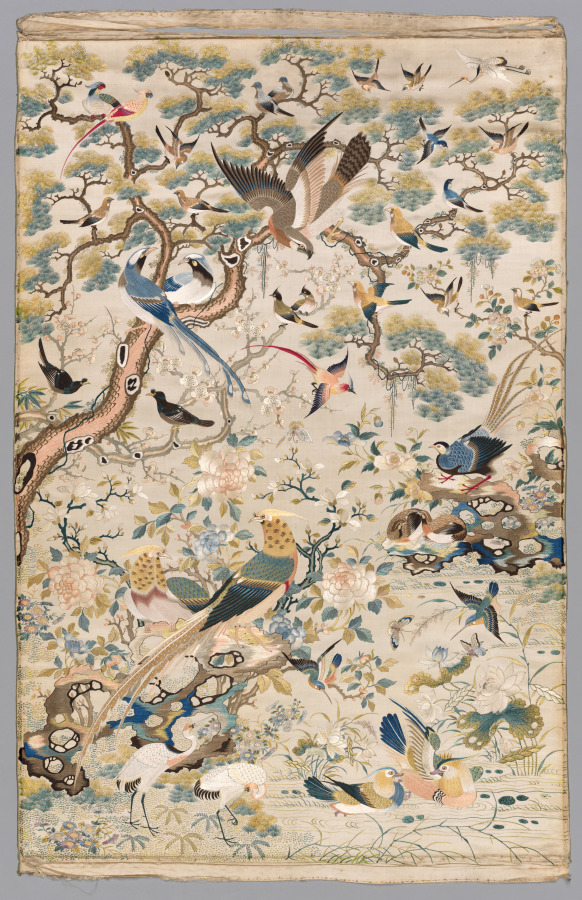
In the hushed, wood-paneled ateliers of London’s Savile Row, where precision is a religion and legacy is woven into every seam, we rarely speak of mere fabric. We speak of materiality. And when that material is silk, we speak of a lineage that predates the Row itself by millennia. The artifact before us—a fragment of a larger narrative, a swatch of silk bearing the motif “A Myriad of Birds”—is not simply a textile. It is a document of imperial ambition, a testament to the biological and artistic mastery of the silkworm, and a quiet, iridescent rebellion against the ephemeral nature of fashion. This is the legacy of imperial silk weaving, rendered in a language of feathers and flight.
Materiality: The Silk Road Within
To understand the artifact, one must first understand its substrate. Silk is not a fiber; it is a narrative of transformation. The Bombyx mori moth, domesticated for over 5,000 years, spins a continuous filament of fibroin protein, a thread so fine yet so strong that it once held the weight of empires. The materiality of this particular silk—a satin-weave with a subtle, almost liquid sheen—speaks to the pinnacle of Qing dynasty craftsmanship. The warp and weft are of the highest denier, the threads twisted with a precision that suggests a loom operated by hands trained for generations. The density of the weave, at approximately 120 threads per centimeter, allows for a surface that is both supple and resilient, a canvas for the most intricate of designs.
Yet, the true genius lies in the dye. The birds are rendered in a palette of indigo, madder, and a rare, almost mythical imperial yellow derived from the Sophora japonica tree. These are not pigments; they are alchemical compounds, fixed with alum and iron mordants that have survived centuries without fading. The silk’s handle—the way it drapes, the way it resists and yields—is a tactile memory of the mulberry leaves that fed the worms, the humidity of the Jiangnan region, and the silent, ritualistic labor of the weavers. This is materiality as history, a history that Savile Row tailors respect as they would a bespoke pattern block.
The Motif: A Myriad of Birds as Imperial Lexicon
The motif itself is a semiotic masterpiece. “A Myriad of Birds” is not a random aviary; it is a hierarchical taxonomy of power and virtue. The central figure is the feng huang, the Chinese phoenix, a symbol of the Empress and of cosmic harmony. Its plumage is rendered in a gradient of gold and crimson, each feather a tiny, deliberate stroke of the weaver’s shuttle. Surrounding it are cranes, emblems of longevity and filial piety; mandarin ducks, representing marital fidelity; and magpies, harbingers of joy and good news. The composition is not chaotic but highly structured, a visual court where each bird occupies its designated rank, much like the mandarins of the Forbidden City.
This is not decoration; it is declaration. In the Qing dynasty, sumptuary laws dictated that only the imperial family could wear the five-clawed dragon, but the phoenix and its avian retinue were reserved for the highest echelons of the court. The motif thus becomes a status marker, a textile coat of arms that communicated rank, virtue, and allegiance without a single word. For the modern scholar, it offers a glimpse into a world where fashion was governance, and every thread was a political statement.
Legacy: From Imperial Loom to Savile Row
The legacy of imperial silk weaving is not a relic; it is a living, breathing influence on contemporary craftsmanship. The techniques that produced this artifact—kesi (silk tapestry weaving) and embroidery in split stitches—are the ancestors of the hand-finishing that defines Savile Row tailoring. The precision required to align a bird’s wing with the natural drape of a garment is the same precision that a master cutter applies to a shoulder seam.
Consider the structural parallels. The imperial weaver’s use of negative space—the silk ground left bare to allow the motif to breathe—mirrors the Row’s philosophy of silhouette. A bespoke jacket is not about the cloth alone; it is about the interplay of fabric and form, of what is present and what is absent. Similarly, the birds in this artifact are not crowded; they are placed with a mathematical elegance that allows the eye to travel from one to the next, creating a rhythm that is both visual and tactile.
Furthermore, the color theory employed here—the use of complementary hues to create depth and movement—is a lesson in textile architecture. The indigo sky against the yellow birds creates a tension that is resolved by the red accents of the phoenix. This is not merely aesthetic; it is functional. In a Savile Row suit, such a palette would be used to elongate the torso or draw attention to the lapel, a subtle manipulation of the viewer’s gaze that is the hallmark of true craftsmanship.
Conclusion: The Unbroken Thread
The artifact known as “A Myriad of Birds” is more than a heritage piece; it is a pedagogical tool. It teaches us that silk is not a passive material but an active participant in the creation of identity. It reminds us that the legacy of imperial weaving is not locked in a museum vitrine but is alive in the hands of every tailor who understands that materiality is memory.
On Savile Row, we do not merely cut cloth; we cut history. And when we work with silk, we are working with a thread that has been spun through dynasties, wars, and revolutions. The birds may be myriad, but the thread is singular—an unbroken line from the imperial looms of Suzhou to the bespoke ateliers of London. This is the heritage we honor, not as a relic, but as a living standard. For in the end, a myriad of birds is not just a motif. It is a flight of imagination, captured in silk, and forever in flight.