The Terracotta Fragment and the Architecture of Restraint: Recasting Attic Elegance for the 2026 Old Money Silhouette
Introduction: The Fragment as a Genealogical Lens
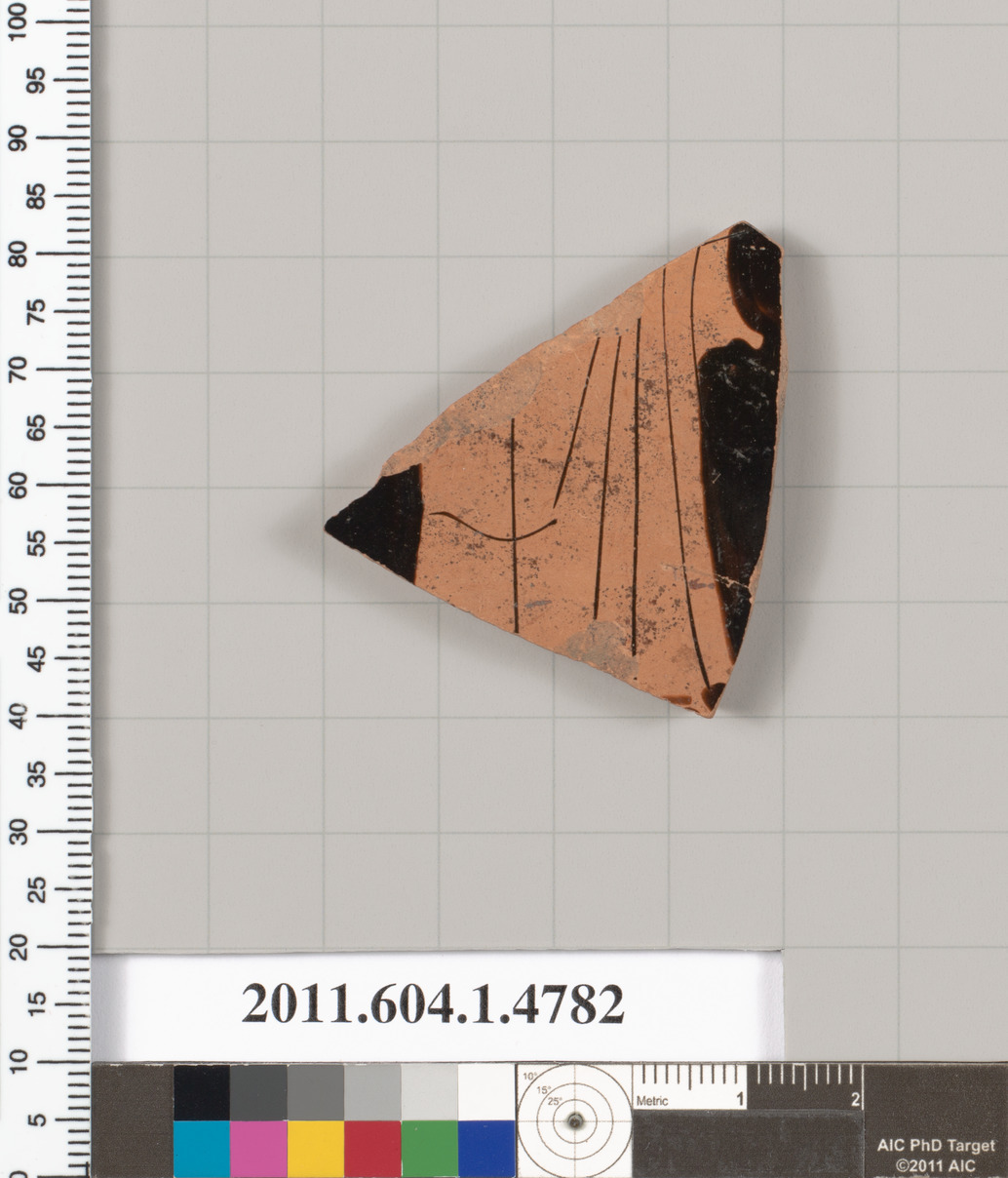
The museum artifact under consideration—a terracotta fragment of an Attic kylix, or drinking cup—presents an ostensibly remote point of departure for a heritage fashion analysis. Yet, within the Lauren Fashion Heritage Lab, we recognize that the most profound design genealogies often emerge from the most fragmented of sources. This shard of fired clay, bearing the residual traces of black-figure or red-figure technique, is not merely a relic of sympotic leisure in classical Athens. It is a material manifesto of proportion, negative space, and the disciplined surface—principles that directly inform the 2026 Old Money silhouette. The kylix, with its shallow bowl, delicate stem, and dual handles, embodies a philosophy of poised containment. Its terracotta base, unglazed and tactile, speaks to a luxury that does not announce itself but is felt through weight, texture, and the quiet authority of form. This paper argues that the terracotta fragment provides a critical counterpoint to the “layer of plenitude” observed in the Damascus Room and the “ascending base” of He Xiangu’s pedestal, translating their Eastern metaphysics of layered infinity into a Western lexicon of structural clarity and material honesty—the very essence of Old Money’s 2026 evolution.
From Sympotic Vessel to Sartorial Structure: The Kylix as Silhouette Blueprint
The kylix’s architecture is one of deliberate tension. Its broad, shallow bowl rests upon a slender, fluted stem, which in turn anchors to a flat, circular base. This tripartite division—bowl, stem, base—offers a direct analog to the 2026 Old Money silhouette. The bowl corresponds to the upper torso: a broad, relaxed shoulder line achieved through a softly tailored jacket or a cashmere overcoat with a gentle drape. The stem translates to the waist and hip: a cinched, elongated line that creates a vertical axis of gravity. The base becomes the lower silhouette: a wide, fluid trouser or a column skirt that grounds the figure with a sense of planted stability. The kylix teaches us that volume must be balanced by restraint. The bowl’s generous spread is only permissible because the stem is so precisely narrow. In 2026, this manifests as a jacket with a broader shoulder (inspired by the kylix’s rim) paired with a high-waisted, straight-leg trouser that tapers subtly—never flaring—to the ankle. The silhouette is not about excess but about controlled expansion and contraction, a rhythmic modulation of form that echoes the kylix’s own visual cadence.
The Terracotta Surface: A Lesson in Material Honesty and Patina
Unlike the Damascus Room’s exuberant layering of tile, plaster, and gold, or the He Xiangu pedestal’s intricate cloud and lotus carving, the terracotta fragment celebrates the unadorned surface. Its beauty lies in its material truth: the warm, earthy orange of fired clay, the subtle variations in texture from the potter’s wheel, the faint scratches of use, and the uneven darkening from centuries of burial. This is a luxury of authenticity, not ornament. For the 2026 Old Money silhouette, this translates into a renewed emphasis on heritage fabrics in their purest state. We are not speaking of printed silks or embroidered brocades, but of heavy, unbleached linen, raw silk with its natural slubs, and worsted wool in undyed charcoal or oatmeal. The terracotta fragment teaches us that the most powerful statement is often the quietest. A jacket cut from a single piece of cashmere, with no lining, no pocket flaps, no visible branding—its sole ornament the subtle sheen of the fiber itself—is the direct sartorial descendant of this Attic shard. The patina of wear, the slight fading at the elbows, the soft creasing at the knee: these become the marks of a life well-lived, the equivalent of the kylix’s archaeological scars, which speak not of decay but of enduring presence.
Negative Space and the Art of the Unseen
The kylix’s most profound contribution to the 2026 silhouette may be its use of negative space. The shallow bowl creates a void—a hollow that defines the vessel’s function. The handles create loops of empty air. The stem elevates the bowl, creating a shadowed gap between the cup and the table. This is not absence; it is articulated emptiness. In fashion, this translates to the strategic use of unconstructed areas: a jacket that falls away from the body at the back, creating a breath of air between fabric and spine; a trouser that breaks just above the shoe, revealing a sliver of ankle; a neckline that scoops low, exposing the clavicle and the hollow of the throat. The 2026 Old Money silhouette will not be a second skin. It will be a sculptural envelope that defines the body through the spaces it leaves untouched. This is the antithesis of the “fast fashion” body-con—it is a luxury of distance and discretion. The wearer is not displayed; she is framed, much as the kylix’s bowl frames the wine it holds.
Conclusion: The Fragment as a Foundation for Future Heritage
The terracotta kylix fragment, the Damascus Room, and the He Xiangu pedestal—three artifacts, three civilizations, three materials—converge on a single, timeless principle: true luxury is the mastery of form in service of spirit. The Damascus Room layers to create a sacred void. The pedestal ascends to support a transcendent figure. The kylix balances volume with emptiness to hold a libation. For the 2026 Old Money silhouette, this synthesis demands a return to architectural precision: a jacket that is not merely worn but inhabited; a trouser that is not merely cut but proportioned; a fabric that is not merely dyed but allowed to speak. The terracotta fragment reminds us that the most enduring forms are those that embrace their own limitations. In an era of digital excess and algorithmic novelty, the 2026 Old Money silhouette will find its power in restraint, material truth, and the eloquent silence of negative space. It will be a silhouette that, like the kylix, holds its contents with grace, and in doing so, reveals the character of the one who holds it.