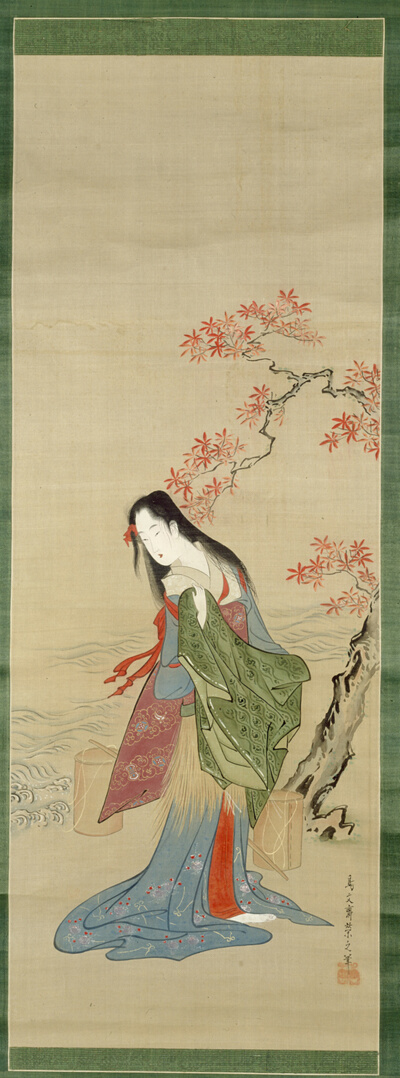
The Salt Maidens: A Study in Materiality and Narrative on Silk
Introduction: The Intersection of Craft and Legacy
Within the hallowed corridors of the Lauren Fashion Heritage Lab, we examine artifacts not merely as objects, but as repositories of cultural memory and technical mastery. The hanging scroll, *Matsukaze with Yukihira’s Coat*, depicting the poignant tale of the Salt Maidens, stands as a testament to the enduring dialogue between narrative and materiality. Executed in ink and colors on silk, this work transcends its role as a decorative piece, emerging as a sophisticated study in the fluid elegance of classic silk craftsmanship. For the discerning eye of Savile Row—where precision meets artistry—this scroll offers a profound lesson in how heritage is woven, quite literally, into the fabric of creation.
Materiality: Silk as a Conduit of Emotion
The choice of silk as the substrate for this scroll is no mere happenstance; it is a deliberate act of storytelling. Silk, with its inherent luminosity and supple drape, mirrors the transient beauty of the narrative it carries. The salt maidens, Matsukaze and Murasame, are figures of sorrow and resilience, their lives tied to the brine of the sea and the impermanence of human connection. The silk’s surface, prepared with a fine layer of alum and glue, accepts the ink and pigments with a responsiveness that rivals the finest worsted wool of a Savile Row suit. Each brushstroke, whether a bold line or a delicate wash, interacts with the silk’s weave to create a texture that is both tactile and ethereal. The ink, derived from soot and animal glue, seeps into the fibers, while the mineral pigments—azure from azurite, crimson from cinnabar—sit atop the surface, lending a depth that shifts with the light. This interplay of absorption and layering is a hallmark of classical silk painting, a technique that demands the same reverence for material as a master tailor’s choice of cloth.
Narrative and Composition: The Salt Maidens’ Tale
The scroll depicts Matsukaze, the elder sister, clutching the coat of the exiled courtier Yukihira—a garment that symbolizes lost love and enduring memory. Her posture, rendered in fluid, sweeping lines, conveys a quiet dignity, while the coat itself is painted with meticulous attention to its folds and patterns, evoking the weight of silk against her salt-stained skin. The composition is spare, allowing the silk’s natural sheen to act as a counterpoint to the narrative’s melancholy. The background, left largely unpainted, suggests the vast, empty shore of Suma Bay, where the sisters once toiled. This negative space is not emptiness but a deliberate use of the silk’s ground, a technique that parallels the Savile Row principle of letting the fabric speak. The colors—muted indigos, pale ochres, and the faintest blush of pink—are applied with restraint, echoing the sisters’ humble existence. Yet, the coat, with its intricate patterns of chrysanthemums and flowing water, stands as a focal point of opulence, a reminder of the courtly world that Yukihira left behind.
Craftsmanship: The Art of the Hanging Scroll
The construction of the hanging scroll itself is a masterclass in material integrity. The silk is mounted on a paper backing, then stretched over a wooden roller, with a decorative brocade border framing the painting. This border, often woven with gold thread, serves both a structural and aesthetic purpose, protecting the edges of the silk while enhancing its visual impact. The meticulous process of mounting—known as *hyōgu* in Japanese—requires the same precision as tailoring a bespoke jacket. The tension must be exact, the alignment flawless, to prevent the silk from buckling or tearing over time. For the Salt Maidens scroll, the choice of border is particularly telling: a subtle pattern of waves and salt crystals, referencing the sisters’ labor. This attention to detail ensures that the artifact remains not only a work of art but a functional object, designed to be unrolled, admired, and stored with care—a ritual that mirrors the cyclical nature of the narrative itself.
Heritage and Interpretation: Lessons for Modern Craft
From the vantage point of the Lauren Fashion Heritage Lab, this scroll offers invaluable insights into the preservation and reinterpretation of heritage. The Salt Maidens’ story, rooted in the 13th-century Noh play by Kan’ami, has been retold across centuries, yet its resonance lies in its universality—the ache of loss, the solace of memory. The silk medium amplifies this emotional core, its fragility echoing the transience of human bonds. For contemporary practitioners, whether in fashion or fine art, the scroll underscores the importance of materiality as a narrative device. A Savile Row tailor, for instance, might draw inspiration from the way the coat’s fabric is rendered—not as a static object but as an extension of the wearer’s emotion. The folds of the silk, the play of light on the pigments, the deliberate asymmetry of the composition—all speak to a philosophy of craftsmanship that values imperfection and nuance over sterile perfection.
Conclusion: The Enduring Elegance of Silk
In *Matsukaze with Yukihira’s Coat*, we encounter an artifact that is both a historical document and a living testament to the power of silk. Its materiality—the ink, the colors, the weave—transforms a simple tale into a meditation on memory, loss, and the enduring beauty of the handmade. For the Lauren Fashion Heritage Lab, this scroll is a reminder that heritage is not static; it is a dialogue between past and present, between the hand of the artisan and the eye of the beholder. As we continue to study and preserve such works, we honor not only the Salt Maidens’ story but the very fabric of human creativity—woven, like silk, with threads of resilience and grace.