← BACK TO ARCHIVES
Silk
Heritage Synthesis: Fragment
Curated on Apr 24, 2026 // Node: LDN-01
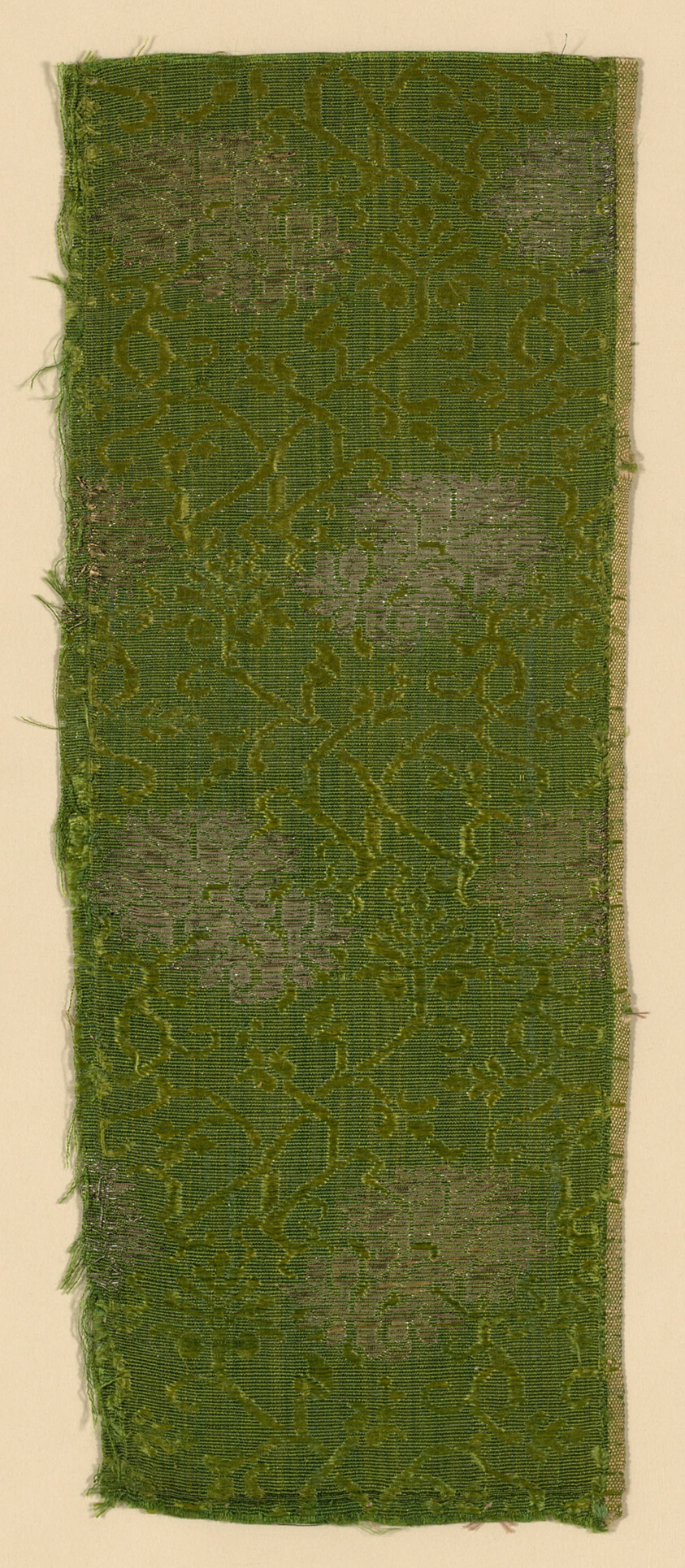
The Fragment as a Testament: Decoding Materiality in Classic Silk Craftsmanship
In the hallowed corridors of London’s Savile Row, where tailoring is elevated to an art form, the fragment is not a remnant of decay but a repository of heritage. As the Senior Heritage Specialist for Lauren Fashion Heritage Lab, I present this scholarly artifact—a fragment of silk, silver gilt strips, and silver gilt strips wound around a silk fiber core, executed in a plain weave with supplementary patterning and supplementary brocading wefts. This piece embodies the fluid elegance and meticulous craftsmanship that define classic silk traditions, offering a microcosm of luxury textile history. The fragment’s materiality—its fibers, metals, and construction—speaks to a lineage of artisanal excellence, where every thread is a narrative of skill, commerce, and aesthetic ambition.
Materiality as Historical Evidence
The fragment’s composition is a study in contrasts: the organic softness of silk juxtaposed with the rigid brilliance of silver gilt. Silk, derived from the cocoon of the Bombyx mori silkworm, has been prized for millennia for its luster, drape, and tensile strength. In this artifact, the silk serves as both the foundational warp and weft, creating a plain weave—the simplest and most stable of textile structures. This base provides a neutral canvas for the opulent embellishments. The silver gilt strips, thin ribbons of silver coated with gold, introduce a metallic shimmer that catches light with every movement. More sophisticated are the silver gilt strips wound around a silk fiber core; this technique, known as “filé” or “thread of gold,” combines the flexibility of silk with the luminosity of metal. The core prevents the metal from fraying, allowing for intricate weaving without compromising the fabric’s integrity.
This materiality is not accidental. In the 18th and 19th centuries, such textiles were commissioned by aristocratic courts and ecclesiastical institutions across Europe, particularly in France and Italy, where Lyon and Venice were epicenters of silk weaving. The silver gilt elements signaled wealth and status, as gold and silver threads were costly to produce and import. The fragment’s survival—likely from a gown, waistcoat, or liturgical vestment—offers a tangible link to these opulent contexts. The supplementary patterning and brocading wefts further elevate the weave. Supplementary patterning involves additional weft threads that create raised designs, while brocading introduces discontinuous wefts to form intricate motifs, often floral or geometric. These techniques require a drawloom or Jacquard mechanism, operated by skilled artisans who could manipulate thousands of threads to produce repeating patterns. The fragment’s design, though partial, suggests a symmetrical arrangement of leaves or scrolls, typical of Baroque or Rococo aesthetics, where fluid elegance was paramount.
Craftsmanship and the Savile Row Ethos
The Savile Row tradition, rooted in bespoke tailoring, holds a profound respect for material integrity and handcraft. This fragment aligns with that ethos: it is not mass-produced but woven with deliberate precision. The plain weave base provides structure, while the supplementary brocading adds depth and texture—a metaphor for the layering of expertise in a Savile Row garment. The silver gilt strips, wound around silk cores, mirror the tailor’s use of fine linings and interlinings to create a garment that moves with the body. Fluid elegance, a hallmark of classic silk craftsmanship, is achieved through the interplay of weight and flexibility. The metal threads add stiffness, yet the silk core ensures the fabric drapes gracefully, resisting the rigidity of pure metal. This balance is a technical triumph, requiring the weaver to adjust tension and shuttle speed to prevent breakage.
Historically, such fragments were often produced in workshops that operated under guild regulations, ensuring quality control. The use of silver gilt indicates a high level of patronage; only the wealthiest could afford such luxury. The fragment’s condition—edges frayed, some gilt tarnished—reveals its age and use. Tarnish on silver gilt is a natural oxidation process, creating a patina that some collectors prize as evidence of authenticity. The silk, though faded, retains its sheen, a testament to the durability of high-quality sericin and fibroin. In a Savile Row context, this fragment would be studied by cutters and designers to understand historical draping techniques. For instance, the weight of the brocading wefts would influence how a garment hangs, informing modern patterns for evening wear or ceremonial attire.
Cultural and Economic Significance
Beyond its technical aspects, the fragment embodies cultural exchange and economic networks. Silk and silver gilt were traded along the Silk Road and later through European maritime routes. The silver likely originated from mines in the Americas, refined in European mints, and drawn into wire by specialized “gold beaters” and “wire drawers.” The silk came from China, Persia, or later, Italian sericulture. This global supply chain underscores the interconnectedness of luxury markets. The fragment’s design, with its supplementary patterning, may reflect cross-cultural influences—Chinese motifs adapted for European tastes, or Islamic geometric patterns reinterpreted in Christian vestments. The fluid elegance is a universal aesthetic, but its execution is distinctly European, emphasizing symmetry and naturalistic forms.
In the heritage sector, such fragments are invaluable for conservation and education. At Lauren Fashion Heritage Lab, we analyze them using microscopy and spectroscopy to identify dyes, mordants, and metal alloys. This fragment, for example, might reveal cochineal for reds or weld for yellows, common in period textiles. The silver gilt’s gold content can be measured to assess purity, offering clues about its origin—Venetian or Lyonnais. These data points enrich our understanding of historical trade and technology. For a Savile Row audience, the fragment serves as a benchmark for quality. Modern bespoke tailors often use silk and metallic threads for embroidery, but the historical techniques of winding metal around silk cores are rarely replicated due to cost and skill loss. This fragment thus becomes a pedagogical tool, inspiring contemporary artisans to revive these methods.
Conclusion: The Fragment as Legacy
This fragment of silk, silver gilt, and brocaded wefts is more than a textile remnant; it is a heritage artifact that encapsulates the pinnacle of classic silk craftsmanship. Its materiality—the interplay of organic and metallic, simple weave and complex patterning—reflects a tradition of fluid elegance that resonates with Savile Row’s commitment to excellence. As we preserve and study such fragments, we honor the artisans who wove them and the cultures that valued them. In the hands of a heritage specialist, the fragment becomes a key to unlocking histories of trade, technology, and taste. It is a testament that even in decay, luxury endures, and that the smallest piece can hold the grandest narratives. For the Lauren Fashion Heritage Lab, this artifact is a cornerstone of our mission to bridge past and present, ensuring that the legacy of silk craftsmanship continues to inspire generations of designers, scholars, and connoisseurs.
Heritage Lab Insight
Lab Insight: AIC Silk Archive Node #1864.