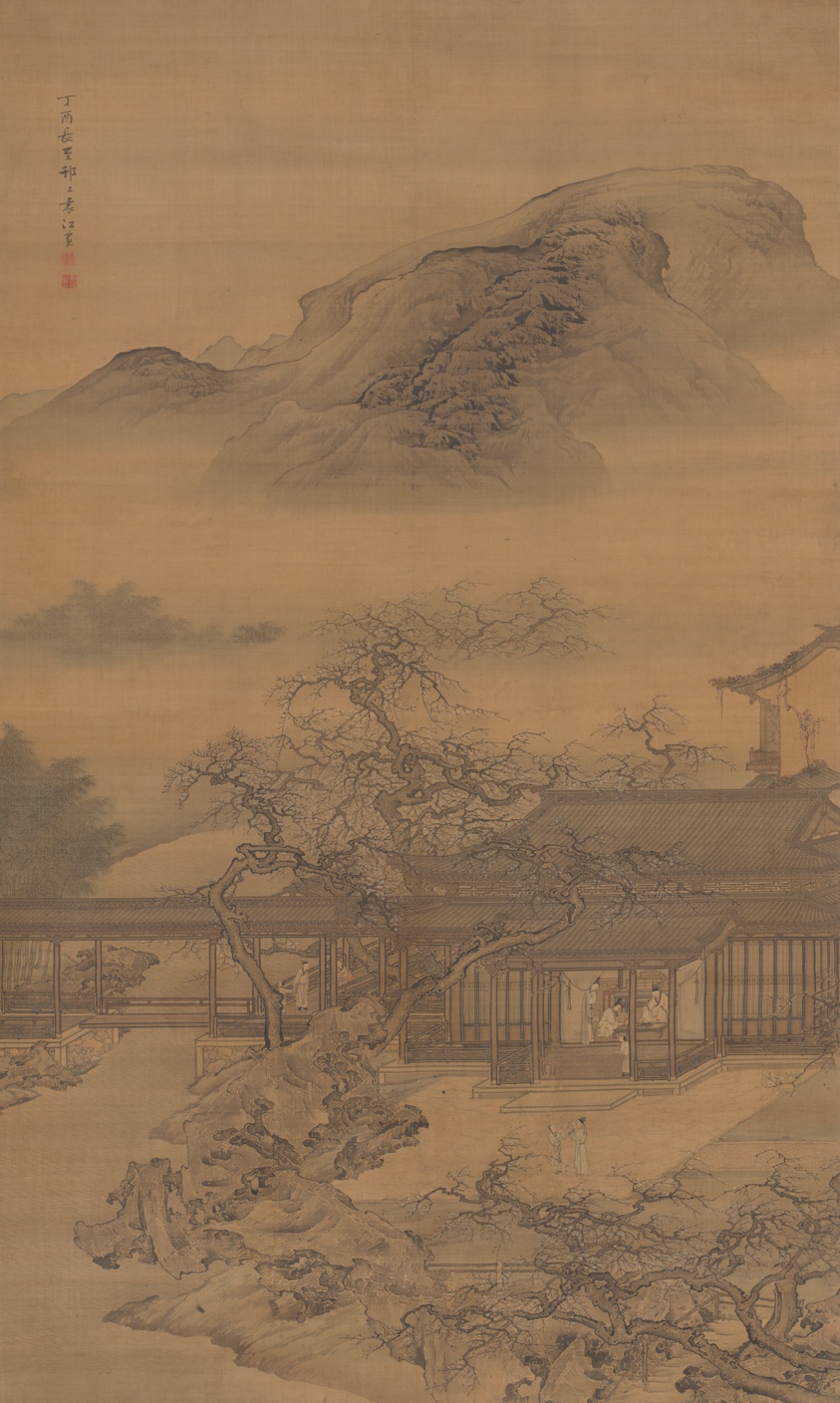
Materiality and the Art of Imperial Elegance: A Study of *Spring Arriving in the Han Palace*
In the hallowed corridors of heritage preservation, where the tactile memory of fabric meets the visual poetry of brushwork, few artifacts command the reverence of *Spring Arriving in the Han Palace* (漢宮春曉圖). This hanging scroll, executed in ink and slight color on silk, is not merely a painting; it is a testament to the symbiotic relationship between materiality and artistic expression—a dialogue that resonates with the precision and discernment of London’s Savile Row, where cloth is never passive but an active participant in the narrative of form. As Senior Heritage Specialist for the Lauren Fashion Heritage Lab, I present this artifact as a study in the confluence of classic silk craftsmanship and fluid elegance, examining how the medium of silk elevates the scroll from a historical document to a living artifact of cultural and aesthetic significance.
The Silk as Substrate: A Foundation of Craftsmanship
Silk, the chosen material for this scroll, is not a neutral ground. In the context of Chinese imperial art, silk was a luxury commodity, reserved for the highest echelons of society—much like the finest worsted wool or cashmere in a Savile Row bespoke suit. The production of silk for painting required meticulous care: the threads were woven into a fine, even weave, often with a slight sheen that catches light in a manner akin to a well-tailored lapel. For *Spring Arriving in the Han Palace*, the silk’s texture is integral to the composition. The ink and slight color—subtle washes of mineral pigments—do not sit atop the fabric as they might on paper; instead, they are absorbed into the silk’s fibers, creating a diffusion that softens lines and imbues the scene with a dreamlike quality. This is not a flaw but a deliberate choice, reflecting the Chinese aesthetic principle of *qiyun* (氣韻), or “spirit resonance,” where the medium breathes life into the subject.
The materiality of the silk also dictates the scroll’s physical behavior. As a hanging scroll, it is designed to be unrolled vertically, revealing the narrative in a controlled, intimate manner—a ritual of unveiling that parallels the slow, deliberate appreciation of a bespoke garment’s drape. The slight color, typically derived from azurite, malachite, or cinnabar, is applied in thin layers, allowing the silk’s natural luminosity to shine through. This technique, known as *gongbi* (工筆), or “meticulous brushwork,” demands a steady hand and an understanding of how the silk will respond to moisture and pressure. In this, the artist acts as a tailor, cutting and stitching with brush and pigment, ensuring that every stroke honors the integrity of the fabric.
Fluid Elegance: The Visual Narrative of Spring
The subject of *Spring Arriving in the Han Palace* is a celebration of renewal, set within the confines of a Han dynasty imperial court. The composition is a tapestry of life: courtiers stroll through gardens, women tend to blossoms, and children play beneath willow trees. Yet, it is the fluidity of the silk that transforms this scene into a meditation on transience. The slight color—pale greens, soft pinks, and muted blues—suggests the ephemeral nature of spring, a season that, like silk, is delicate and fleeting. The ink outlines are graceful, almost calligraphic, echoing the rhythm of the silk’s weave. This is elegance without rigidity, a quality that Savile Row tailors understand intimately: a garment must move with the body, not constrain it. Here, the silk moves with the narrative, allowing the figures to breathe within the frame.
The scroll’s format further enhances this fluidity. Unlike a framed painting, which imposes a static boundary, a hanging scroll is a dynamic object. It can be rolled and unrolled, stored and displayed, its materiality adapting to the viewer’s context. The silk’s flexibility ensures that the scroll does not crack or warp over centuries, provided it is handled with care—a lesson in preservation that mirrors the maintenance of a fine wool suit. The slight color, too, is stable, but only if the silk is kept away from light and humidity. This fragility is not a weakness but a marker of authenticity; it demands respect and knowledge, much like the stewardship of a heritage textile.
Heritage and the Language of Craft
From a heritage perspective, *Spring Arriving in the Han Palace* embodies the convergence of artistic and material traditions. The silk itself is a product of centuries of sericulture, a practice that originated in China and was guarded as a state secret. The weaving techniques, often involving multiple harnesses to create patterns, are a precursor to the jacquard looms that revolutionized European textiles. In this scroll, the silk is not merely a support but a statement of cultural identity. The slight color, applied with brushes made from animal hair, reflects a palette that is both natural and symbolic: green for growth, pink for romance, blue for the heavens. These colors, when absorbed into the silk, create a harmony that is both visual and tactile—a sensation that a Savile Row tailor would recognize as the “hand” of a fabric.
The scroll’s provenance also speaks to its heritage value. It is believed to have been created during the Ming dynasty (1368–1644), a period when silk painting reached its zenith. The artist, likely a court painter, would have been trained in the traditions of the Song dynasty, where silk was the preferred medium for landscape and figure painting. The scroll’s survival is a testament to the care of generations of collectors, who understood that silk requires a stable environment—neither too dry nor too humid—to prevent deterioration. This is a lesson in material stewardship that resonates with the Lauren Fashion Heritage Lab’s mission to preserve and interpret the stories embedded in textiles.
Conclusion: The Scroll as a Living Artifact
In conclusion, *Spring Arriving in the Han Palace* is more than a painting; it is a dialogue between materiality and meaning. The silk, with its luminous weave and responsive texture, is the silent partner in this conversation, elevating the ink and slight color into a realm of fluid elegance. For the heritage specialist, this scroll offers a case study in how craftsmanship—whether in Chinese silk painting or Savile Row tailoring—is never merely technical but deeply cultural. The scroll’s ability to evoke the ephemeral beauty of spring, while enduring through centuries, is a reminder that true elegance lies in the harmony between material and form. As we preserve and study such artifacts, we honor not only the artist’s hand but also the silk that gave it life.