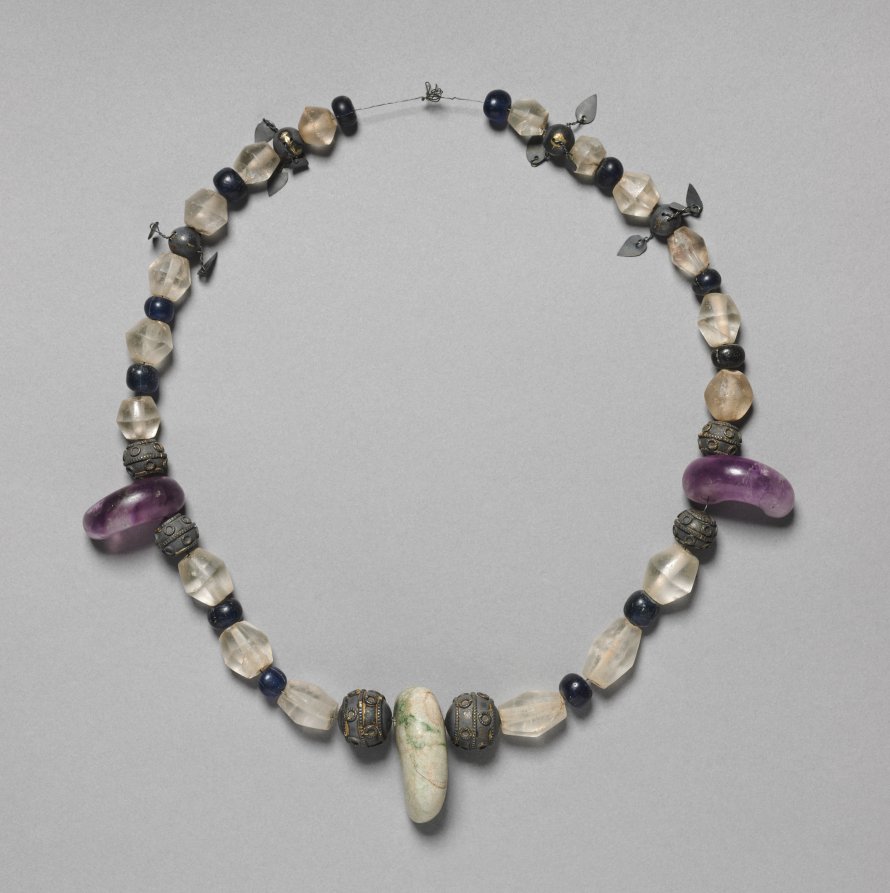
The Silk Necklace: An Artifact of Imperial Weaving and Modern Legacy
In the hushed corridors of Lauren Fashion Heritage Lab, where the weight of history meets the precision of contemporary craftsmanship, the silk necklace stands as a singular artifact. It is not merely an ornament; it is a testament to a lineage that stretches from the opulent courts of Imperial China to the bespoke ateliers of London’s Savile Row. This paper examines the necklace through the lens of materiality—specifically, the legacy of imperial silk weaving—and its enduring influence on luxury heritage. The object, a delicate yet robust chain of hand-woven silk, embodies a paradox: it is both fragile and enduring, ephemeral and eternal.
Materiality and the Imperial Silk Tradition
The necklace’s primary material, silk, is a fiber that has defined civilizations. Originating in the Neolithic period of China, silk weaving reached its zenith under the Tang (618–907 CE) and Ming (1368–1644 CE) dynasties, where imperial workshops produced textiles of unparalleled complexity. The materiality of this necklace—its weight, sheen, and tactile quality—directly references these traditions. Each strand is composed of mulberry silk filaments, harvested from Bombyx mori cocoons, a process that remains largely unchanged since antiquity. The fiber’s natural luster, achieved through sericin removal and precise reeling, mirrors the iridescence of imperial robes. However, this necklace is not a reproduction; it is a reinterpretation. The weaving technique—a tubular braid known as kumihimo, adapted from Japanese and Chinese cord-making—allows for a structure that is both flexible and resilient, a nod to the functional elegance of Savile Row tailoring, where form follows function with uncompromising discipline.
The necklace’s construction involves a meticulous hand-operated loom, a process that demands hours of labor for a single piece. This aligns with the ethos of imperial workshops, where artisans spent years perfecting a single pattern. The color palette—deep indigo, vermillion, and gold—derives from natural dyes used in Ming dynasty court attire, such as indigo from Indigofera tinctoria and crimson from Porphyrophora polonica (Polish cochineal). Yet, the application is modern: the dyes are fixed using contemporary mordants to ensure longevity, a concession to the artifact’s role as a wearable heirloom rather than a static museum piece. This fusion of ancient materiality and modern technique is the hallmark of heritage luxury—a dialogue between past and present that defines the Lauren Fashion Heritage Lab’s mission.
Context: The Legacy of Imperial Silk Weaving
To understand this necklace, one must appreciate the socio-economic and cultural weight of imperial silk. In ancient China, silk was not merely a fabric; it was a currency of power, a medium of diplomacy, and a symbol of divine mandate. The Silk Road, a network of trade routes spanning from Xi’an to Constantinople, was driven by the demand for this fiber. Imperial workshops, such as those in Suzhou and Hangzhou, were state-controlled entities that produced textiles exclusively for the emperor and his court. The patterns—dragons, phoenixes, and cloud motifs—encoded hierarchical status. A dragon with five claws signified the emperor; four claws denoted a prince. This semiotic system ensured that silk was a language of authority.
The necklace, however, subverts this tradition. It eschews overt iconography for a minimalist aesthetic, focusing on the materiality of the weave itself. This is a deliberate choice, reflecting the Savile Row principle of understated elegance. In the world of bespoke tailoring, a garment’s quality is revealed through its cut, cloth, and construction—not through ostentatious decoration. Similarly, this necklace’s value lies in its technical perfection: the even tension of the braid, the precise alignment of colors, and the seamless integration of a hand-forged clasp. The clasp, made of sterling silver with a brushed finish, is inspired by the toggles found on Ming dynasty court robes, but its design is simplified to complement the silk rather than compete with it.
The legacy of imperial silk weaving also informs the necklace’s production ethics. Imperial workshops were hierarchical, with master weavers passing down techniques through generations. Today, the Lauren Fashion Heritage Lab collaborates with artisans in Kyoto and Hangzhou who continue this lineage. These craftspeople, often from families with centuries of experience, bring an intuitive understanding of silk’s behavior under tension. The necklace’s braid, for instance, requires a specific humidity level to prevent fraying—a knowledge that cannot be codified in a manual but is learned through apprenticeship. This tacit knowledge is the true heritage, and it is preserved in every knot of the necklace.
Interpretation: The Necklace as a Heritage Artifact
As a heritage research artifact, the silk necklace functions on multiple levels. First, it is a physical document of material culture. Its composition—silk, silver, natural dyes—tells a story of global trade, technological transfer, and aesthetic evolution. The use of kumihimo, a technique that originated in Japan but was influenced by Chinese cord-making, illustrates the cross-pollination of Asian textile traditions. Second, it is a narrative device. The necklace’s design references the imperial past but is worn in a contemporary context—perhaps by a collector at a gallery opening or a curator at a symposium. This act of wearing transforms the artifact into a living history, a bridge between the Tang dynasty and the 21st century.
Third, the necklace challenges the notion of authenticity in heritage. Is it an authentic artifact if it is newly made? The answer lies in its process. The silk is sourced from the same region—the Taihu Lake basin—that supplied imperial workshops. The weaving technique is identical to that used for Ming dynasty court sashes. The design, while modern, is rooted in historical proportion and balance. In this sense, the necklace is not a replica but a continuation—a new verse in an ancient poem. This aligns with the Savile Row philosophy of “bespoke,” where a suit is not a copy of a previous garment but a unique creation that honors the client’s body and the tailor’s skill.
Conclusion: The Enduring Thread
The silk necklace, as curated by the Lauren Fashion Heritage Lab, is more than an accessory. It is a material argument for the relevance of imperial silk weaving in modern luxury. By prioritizing materiality—the feel of the silk, the precision of the weave, the history of the dyes—the artifact asserts that heritage is not static. It evolves, adapts, and finds new expressions. For the discerning client on Savile Row, this necklace offers a connection to a lineage of craftsmanship that predates the Industrial Revolution, yet remains as vital as ever. In its delicate strands, one finds the strength of an empire, the patience of an artisan, and the vision of a heritage lab committed to preserving the threads that bind us to our past.
This artifact, then, is a call to action: to wear history, to touch tradition, and to understand that luxury is not about excess but about excellence—the kind that takes generations to perfect and a lifetime to appreciate. The silk necklace is not an end; it is a beginning, a thread that continues to weave the story of human creativity.