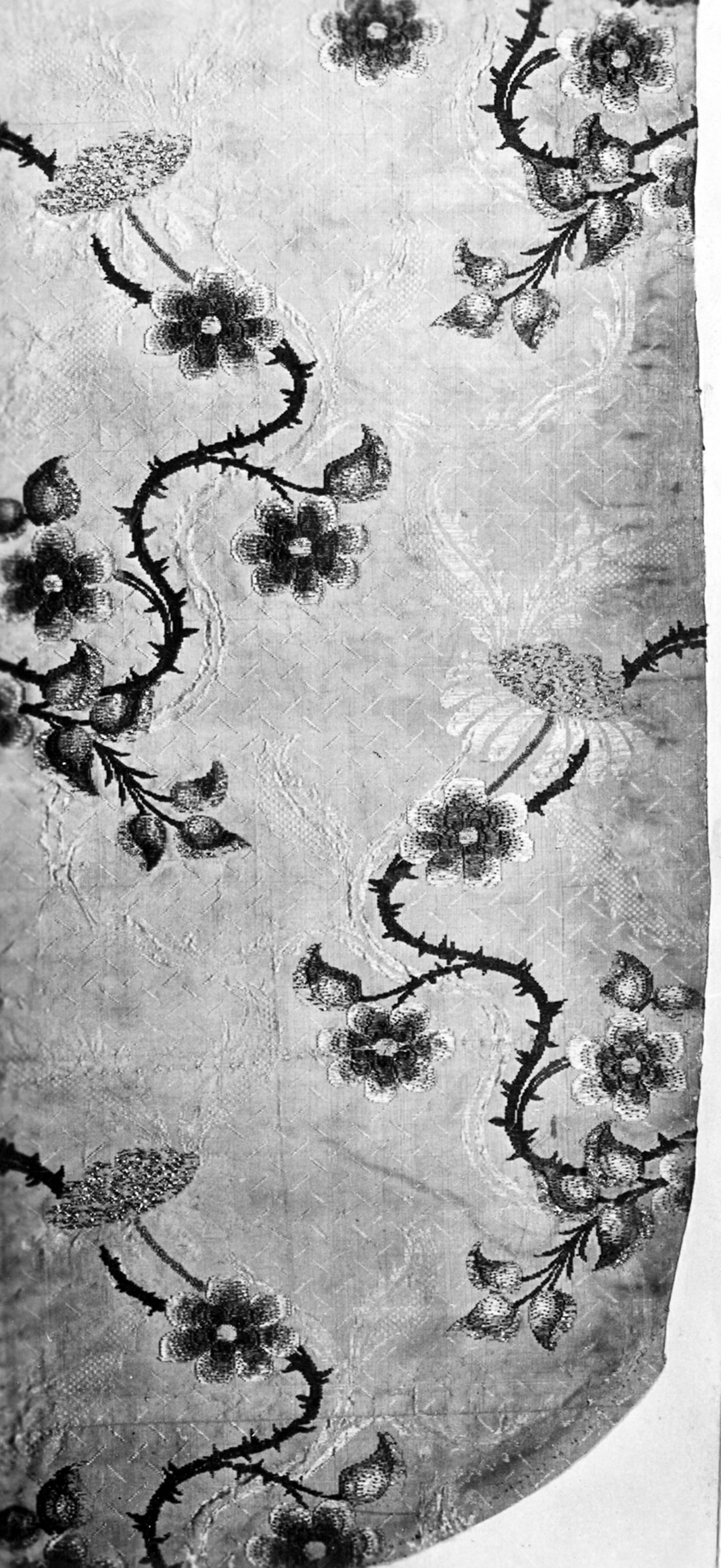
On the Nature of the Fragment: A Disquisition on Material Permanence and Ephemeral Grace
In the considered appraisal of any heritage, one must first reconcile oneself to the fundamental truth of the fragment. The whole, in its pristine and unassailable completion, is often the province of myth. It is the fragment—the severed swatch, the isolated panel, the carefully excised sample—that presents itself for forensic and aesthetic contemplation. This particular artefact, a brocaded plain compound cloth of silk, stands as a testament to that very principle. It does not proclaim its origins as a gown or a robe; it asserts, instead, its own sovereign integrity as a repository of technique, a lexicon of taste, and a silent narrative of fluid elegance interrupted.
Material Testimony: The Architecture of Compound Cloth
The foundation of our analysis rests, as it must, upon the material fact. "Plain compound cloth" denotes a structure of deliberate complexity and understated ambition. It is a fabric of two discrete warps—one ground, one binding—working in concert with a weft to produce a textile of inherent substance and stability. This is not the simple, single-layer gauze of casual drapery; this is architecture. The ground warp provides the foundational scaffold, the unseen but essential infrastructure. The binding warp, in its measured interlacings, consolidates the form, granting the cloth its body, its dignified weight, and its resistance to the vulgarities of distortion.
Upon this engineered ground, the brocade is applied. Not as a mere surface embellishment, but as an integrated, inwoven narrative. The brocading weft, often of a different hue or a superior lustre, is introduced with surgical precision, floating over prescribed areas to manifest its pattern before being bound back into the fabric's matrix. The result is a design that is of the cloth, not on it. To run a discerning thumb across its surface is to read a topography of supreme control: the subdued, tactile grain of the ground giving way to the raised, silken cartography of the brocaded motif. The contrast is not stark, but subtle—a matter of texture and reflectivity, a dialogue between matte and sheen conducted in whispers.
The Philosophy of Fluid Elegance: Drape as Destiny
The stated context, "fluid elegance," is not a mere decorative phrase; it is the raison d'être encoded within the weave. The compound structure, for all its inherent strength, is engineered towards a paradox: resilient pliancy. The silk fibres, possessing a natural tensile strength married to a singular fineness, allow for a density of threads per inch that would coarsen lesser materials. This density, governed by the compound weave's rules, creates a cloth that falls—no, that flows—with a specific, gravitational intelligence.
This fragment, in its current stillness, yet speaks of motion. One deduces its behaviour not from a catwalk's theatrics, but from the way it yields to its own weight on the examining table, forming soft, coherent folds that speak of memory and obedience. The "elegance" herein is classical: it is the elegance of exact proportion, of a drape that conceals its own arithmetic, of a movement that appears effortless precisely because its foundation is ruthlessly calculated. It does not cling; it describes. It does not flutter; it cascades. This is the elegance of the Savile Row silhouette translated into the feminine sphere—a mastery of cut and cloth that creates an aura of authority through sublime simplicity and impeccable line.
The Fragment as Final Arbiter: Patina, Loss, and Legacy
And so we return to the existential condition of the fragment itself. Its edges are raw, a frank admission of separation. The pattern is cut mid-motif, a visual haiku where once there was an epic. This state of incompletion, however, is not a diminishment but a concentration. All that remains is the essential truth of the cloth. We are spared the distractions of fastenings, of linings, of the compromises of fit. We are presented instead with the core proposition.
Here, in this silence, we may observe the patina—the gentle attenuation of colour at a fold line, the slight mellowness of the silk's ivory ground from its conversation with light and air. This is the heritage not of the museum's vacuum, but of use, of careful preservation, of a life lived. The fragment becomes a more honest witness than the purported "garment in perfect condition," for it bears the dignified marks of its passage through time.
In conclusion, this artefact—this brocaded, plain compound silk fragment—serves as the ultimate reference for the cutter, the historian, and the connoisseur. It dispenses with the superfluous and presents the immutable principles: the structural genius of the compound weave, the integrated artistry of the brocade, and the philosophical pursuit of fluid elegance through material excellence. It stands as a silent, eloquent rebuke to the transient and the ill-considered, a permanent manifesto in cloth for the virtues of depth, integrity, and a grace that is woven into the very being of the thing. It is not a remnant of history; it is history, distilled to its most potent and enduring form.