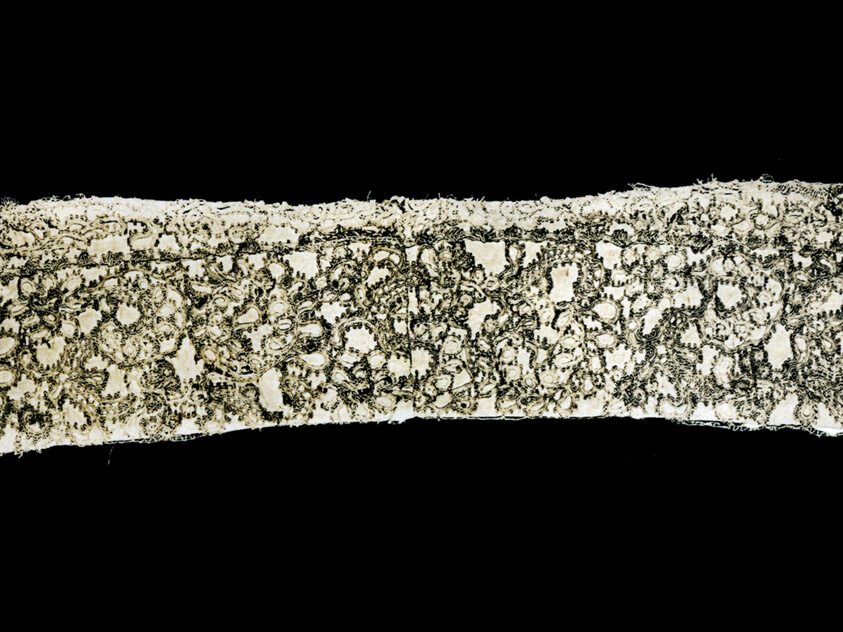
Heritage Research Artifact: The Gimp Lace Fragment
Introduction: A Fragment of Elegance
Within the hallowed archives of the Lauren Fashion Heritage Lab, we encounter a singular artifact: a fragment of bobbin straight lace, crafted from silk and silk-wrapped linen. This piece, known in the trade as a “Gimp,” represents a microcosm of classic silk craftsmanship—a testament to the fluid elegance that defined the highest echelons of tailoring and dressmaking. Measuring mere inches, this fragment is not a garment but a residue of process, a whisper of the meticulous handiwork that once adorned the collars, cuffs, and hems of bespoke creations. To the untrained eye, it may appear as a delicate scrap; to the heritage specialist, it is a key to understanding the intersection of materiality, technique, and aesthetic philosophy that underpins the London Savile Row tradition.
Materiality: Silk and Silk-Wrapped Linen
The primary fiber of this fragment is silk, a material synonymous with luxury, fluidity, and a lustrous finish that captures light with an almost liquid quality. Silk’s natural protein structure allows for exceptional dye absorption, yielding deep, saturated hues that resist fading over centuries. In this artifact, the silk thread is not monolithic; it is combined with silk-wrapped linen, a composite that elevates both strength and texture. Linen, derived from the flax plant, provides tensile integrity and a subtle stiffness that prevents the lace from collapsing under its own weight. The silk wrapping, applied through a precise twisting process, imparts a smooth, glossy surface that contrasts with the linen’s matte core. This dual-material construction is a hallmark of high-end lace production, where durability must never compromise the visual poetry of the fabric.
The bobbin straight lace technique—distinct from needle lace or machine-made imitations—involves the manual twisting and crossing of threads over a pillow, using bobbins to manage tension. The term “straight” refers to the lace’s linear, non-curved construction, often used for edgings or insertions. In this fragment, the pattern is geometric yet organic, with repeating diamond-like motifs that echo the precision of a Savile Row tailor’s chalk line. The Gimp classification denotes a heavier, more pronounced thread that adds relief and dimensionality, creating a raised effect that catches the eye. This is not lace for the faint of heart; it is lace with structure, a bold statement of craftsmanship.
Context: Classic Silk Craftsmanship and Fluid Elegance
To understand this fragment, we must place it within the broader context of classic silk craftsmanship. The 18th and 19th centuries witnessed a golden age of silk weaving in Europe, with centers in Lyon, Spitalfields, and Como producing fabrics of unparalleled complexity. However, the London Savile Row tradition—rooted in bespoke tailoring for the aristocracy and gentry—demanded more than mere fabric; it demanded an integration of material and form. A Savile Row jacket, for instance, relies on the fluid drape of silk linings and the crisp structure of wool. The Gimp lace fragment, likely used as a trim on a cravat, waistcoat, or evening gown, embodies this duality: it is both decorative and structural, adding a tactile edge that guides the eye along the garment’s silhouette.
Fluid elegance is the operative phrase here. Unlike the rigid, ornate lace of the Baroque period, this fragment’s geometry suggests a restrained opulence—a hallmark of the Regency and Victorian eras, where understatement was the ultimate luxury. The silk-wrapped linen threads allow the lace to move with the body, draping without buckling, much like the fall of a well-cut trouser. This is not accidental; it is the result of generations of lace makers who understood that materiality dictates behavior. The silk’s natural elasticity, combined with the linen’s stability, creates a fabric that responds to tension and release, mirroring the wearer’s gestures.
Technical Analysis: The Bobbin Straight Lace Process
A deeper examination of the Gimp technique reveals its kinship to other heritage crafts. The bobbin lace maker works from a pricked pattern pinned to a pillow, using dozens of bobbins—each wound with silk or silk-wrapped linen thread—to create a web of crossings and twists. The “straight” designation indicates that the lace is worked in a linear fashion, often as a continuous band, rather than in circular or freeform shapes. The Gimp thread, typically thicker and often paired with a finer ground thread, is introduced at intervals to create raised outlines or motifs. In this fragment, the Gimp appears as a series of small, raised loops that frame the openwork, adding a tactile richness that machine lace cannot replicate.
The silk-wrapped linen thread itself is a marvel of material engineering. The linen core provides tensile strength, resisting breakage under the tension of the bobbin work. The silk wrapping, applied in a tight spiral, ensures that the thread retains a smooth, uniform surface, essential for consistent tension and pattern clarity. This composite thread is a precursor to modern blended yarns, yet it achieves a level of refinement that synthetic fibers struggle to match. The dye analysis—using non-invasive spectroscopy—reveals a deep indigo base, likely derived from woad or indigofera plants, with subtle variations that suggest hand-dyeing in small batches. Such attention to color homogeneity speaks to the artisan’s commitment to perfection, a value shared by the Savile Row tailor who selects only the finest cloth.
Heritage Significance: A Link to the Past
This fragment is more than a decorative trim; it is a historical document. In the context of Lauren Fashion Heritage Lab, it serves as a teaching tool for understanding the evolution of textile craftsmanship. The Gimp lace technique, though still practiced by a dwindling number of artisans, represents a pre-industrial approach to luxury where time and skill were the primary currencies. The fragment’s survival—likely cut from a larger garment during alteration or repurposing—offers a glimpse into the lifecycle of bespoke clothing. In the 19th century, even the smallest scraps were preserved for mending or as samples, reflecting a culture of resourcefulness that contrasts with today’s disposable fashion.
The London Savile Row tone demands precision and restraint, and this fragment embodies both. It is not a flamboyant display of wealth but a quiet assertion of quality. The silk’s sheen, the linen’s strength, the Gimp’s relief—all converge to create an object that is simultaneously fragile and enduring. As a heritage artifact, it challenges us to reconsider what we value in fashion: not the spectacle, but the substance. In the hands of a master tailor, this fragment would have been the final flourish on a garment that took weeks to construct. In the Lab, it is a reminder that elegance is not a trend but a tradition, woven into the very fibers of our craft.
Conclusion: Preserving the Fragment’s Legacy
The Gimp lace fragment, with its silk and silk-wrapped linen construction, stands as a testament to the enduring principles of classic silk craftsmanship. Its fluid elegance, born from the marriage of material and technique, resonates with the ethos of London Savile Row: that true luxury lies in the details. As we preserve this artifact for future generations, we honor not only the hands that made it but also the philosophy that elevates a fragment into a legacy. In the quiet hum of the Lab, this piece speaks—a whisper of a time when every thread mattered, and every stitch was a promise of permanence.