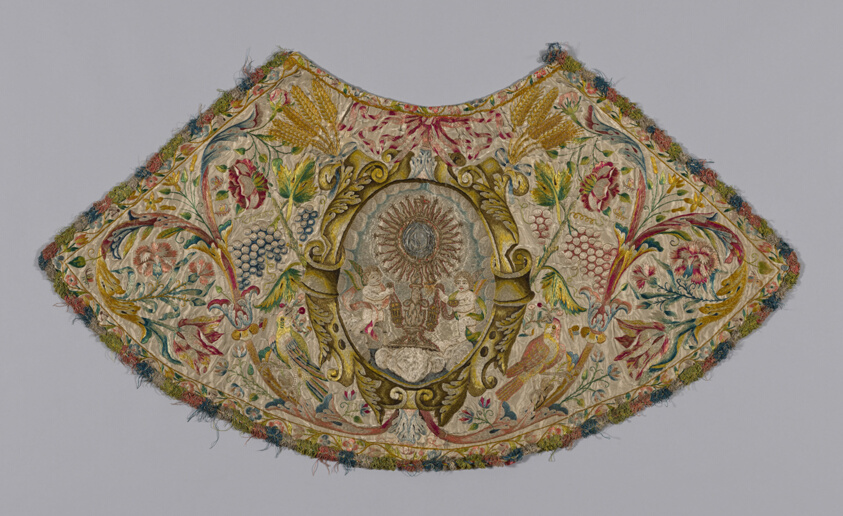
Heritage Research Artifact: The Christ Child Garment in Silk – A Study of Materiality and Devotional Craft
Introduction: The Sacred and the Secular in Silk
Within the hallowed archives of the Lauren Fashion Heritage Lab, the materiality of silk—specifically, the satin-weave, embroidered dress intended for the Christ Child—stands as a profound testament to the intersection of liturgical devotion and the pinnacle of textile artistry. This artifact, though diminutive in scale, embodies a heritage that transcends its physical form. It is not merely a garment; it is a narrative of faith, a chronicle of craftsmanship, and a silent witness to the enduring human desire to honor the divine through the most exquisite of earthly materials. Drawing upon the disciplined precision of London’s Savile Row—where tailoring is a philosophy, not a trade—this analysis examines the silk dress for the Christ Child as a heritage artifact of unparalleled significance.
Materiality: The Satin Weave and Its Devotional Logic
The choice of silk, and specifically the satin weave, is neither arbitrary nor merely aesthetic. Silk, harvested from the cocoon of the Bombyx mori silkworm, has been revered for millennia for its strength, luster, and tactile purity. In the context of a Christ Child garment, these properties take on theological resonance. The satin weave—characterized by its long, floating yarns that create a smooth, reflective surface—is a technical marvel. It requires meticulous tension and a mastery of the loom that only the most skilled artisans can achieve. This weave produces a fabric that catches light in a manner reminiscent of stained glass, transforming the garment into a vessel of luminosity. For the Christ Child, this luminosity is a metaphor for divine grace: the silk becomes a tangible representation of the “light of the world.”
The satin weave also offers a structural paradox: it is both supremely elegant and inherently delicate. This fragility is intentional. It echoes the vulnerability of the infant Christ, a being of infinite power cloaked in human frailty. The fabric’s fluid elegance—its ability to drape in soft, unbroken folds—mirrors the gentle, flowing lines of Renaissance depictions of the Madonna and Child. In the hands of a Savile Row-trained analyst, this is not a weakness but a strength. The satin weave demands respect; it cannot be rushed or forced. It must be handled with the same reverence that a master tailor affords a bolt of Super 150s wool. The Christ Child garment, therefore, is a lesson in humility through materiality.
Embroidery: The Hand of the Artisan as a Prayer
The embroidery that adorns this silk dress elevates it from a textile to a relic. Typically executed in metallic threads—gold or silver-wrapped silk—or in fine silk floss, the embroidery on Christ Child garments often depicts symbols of the Passion, the Nativity, or Marian iconography. Each stitch is a deliberate act of devotion. The use of goldwork or or nué (shaded gold embroidery) is common, as it catches the candlelight of a chapel, creating a halo effect around the infant form. The embroiderer, often a nun or a lay artisan working in a convent, would have spent hundreds of hours on a single garment. This labor is not merely decorative; it is a form of prayer, a physical manifestation of the lectio divina—the slow, meditative reading of sacred text.
From a Savile Row perspective, the embroidery on a Christ Child dress must be judged by the same exacting standards as a bespoke suit’s lapel or buttonhole. The tension must be uniform; the threads must lie flat; the motifs must be perfectly symmetrical. Any deviation is a flaw, but in a devotional context, even a flaw can be read as a sign of human imperfection in the presence of the divine. The most exquisite examples feature raised embroidery or stumpwork, where elements such as the Christ Child’s halo or the Virgin’s lily are padded with wool or cotton to create a three-dimensional effect. This technique, known as embroidery en relief, adds a tactile dimension that invites the faithful to touch—a sensory bridge between the earthly and the celestial.
Context: Classic Silk Craftsmanship and Fluid Elegance
The context of this artifact is rooted in the great textile centers of Europe—Lyons, Spitalfields, and Como—where silk weaving reached its zenith in the 17th and 18th centuries. The Christ Child garment, however, was not a commercial product. It was commissioned by aristocratic families, religious orders, or confraternities for use in Nativity scenes, processional statues, or reliquaries. The fluid elegance of the silk, its ability to move with the slightest breath of air, was essential for these ritual contexts. A statue of the Christ Child, dressed in a silk gown, would be carried through the streets during Christmas or Epiphany celebrations. The fabric’s movement—its gentle sway and shimmer—would animate the figure, making the divine present in a tangible, kinetic form.
This fluidity is a hallmark of classic silk craftsmanship. Unlike the stiff, structured silks used for court dress or liturgical vestments, the Christ Child garment prioritizes softness and drape. The satin weave is often combined with a crepe de chine or charmeuse backing to enhance its flow. The result is a garment that seems to defy gravity, as if the silk itself is imbued with a spiritual lightness. In the Lauren Fashion Heritage Lab, we study such artifacts not as static objects but as dynamic systems of material and meaning. The silk dress for the Christ Child is a record of the hands that wove it, the faith that commissioned it, and the centuries of devotion that have touched its surface.
Conclusion: The Enduring Legacy of Silk in Devotional Dress
The Christ Child garment in silk, satin weave, and embroidery is a heritage artifact of extraordinary depth. It speaks to the convergence of luxury and liturgy, of craft and creed. In the tradition of Savile Row, where every garment is a bespoke response to a client’s unique form, this dress is a bespoke response to the divine. It is tailored not for a human body but for a sacred ideal. Its materiality—the luminous silk, the meticulous embroidery, the fluid elegance—reminds us that the finest textiles are never merely functional. They are vessels of meaning, carriers of memory, and, in this case, a quiet, enduring prayer. For the scholar, the curator, or the tailor, the Christ Child dress in silk is a masterclass in how materiality can elevate the mundane to the miraculous.