Silk as Vessel: A Material Deconstruction of the 1650/75 Braid and Its Legacy in the Old Money Silhouette
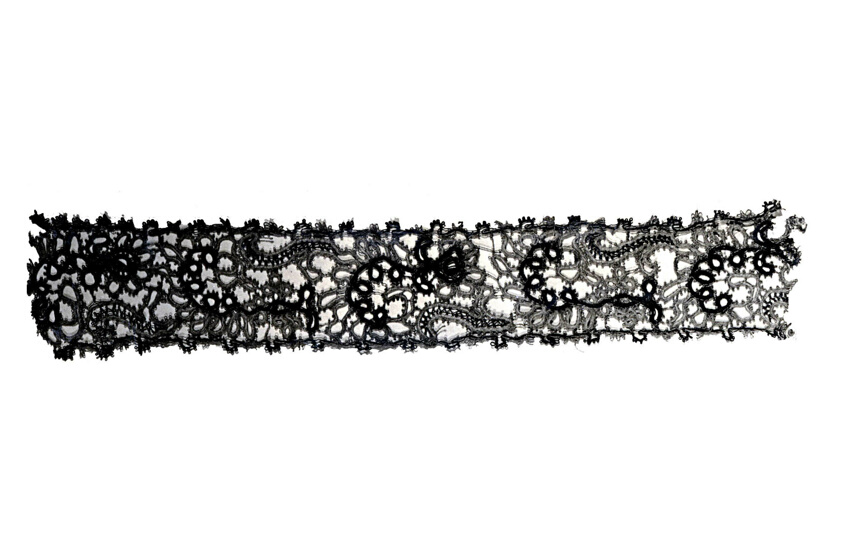
The Lauren Fashion Heritage Lab, through the lens of the Liru Mother Archive, posits that materiality is not merely a component of design but the very genetic code of sartorial legacy. The analysis of historical artifacts, therefore, is an exercise in deep archaeological excavation, seeking the foundational principles encoded within thread and weave. The artifact in question—a Braid (1650/75) from the Art Institute of Chicago, constructed from silk and silk-wrapped linen cords using bobbin straight lace techniques—serves as a profound case study. It embodies the core dialogue presented in our internal genetic code: the concept of the container. Here, silk transcends its role as a decorative filament to become a vessel of social order, restrained power, and inherited aesthetic philosophy, principles that directly inform the architectural ethos of the 2026 ‘Old Money’ silhouette.
Structural Deconstruction: The Anatomy of Restrained Opulence
A technical deconstruction of the AIC braid reveals a hierarchical material system. The core employs linen cords, a material of enduring, understated strength. These are then meticulously sheathed in silk, a transformative act that converts robust foundation into a surface of luminous, tactile refinement. This is not a mere veneer; it is a deliberate alchemy. The bobbin straight lace technique further imposes a discipline of geometry and repetition upon the fluidity of silk. The resulting structure is one of internal tension: the linen provides the unyielding, vertical integrity (the sinew), while the silk provides the horizontal language of light-catching subtlety and complex, ordered texture (the skin). This duality mirrors the "spiritual dialectic" observed in the portrait of Saint Philip Neri, where the heavy, earthly garment contains and contrasts with the suggested luminosity of the spirit. The braid’s beauty is not in flamboyant release but in controlled manifestation, where opulence is defined by its density, its integrity, and its reserved complexity.
The Hermeneutics of the Braid: Encoding Social Grammar
This artifact functions as a microcosm of 17th-century social order, a "civilizational vessel" akin to the Shang-Zhou bronze hu. Its purpose was likely to delineate status—to trim a garment, secure a closure, or adorn an accessory in a manner that communicated belonging to a refined, established hierarchy. The braid does not shout; it insinuates. Its value is legible only through proximity and understanding, a language of nuance rather than declaration. The silk-wrapped construction is key: it speaks of surplus (the luxury of sheathing a functional cord in precious fiber) and of expertise (the labor-intensive craft required to achieve such uniform perfection). Like the taotie motifs on the ritual bronze, the braid’s repeated pattern is a code, signifying membership within a structured, self-perpetuating system of taste. Its aesthetic is one of externalized authority, where personal adornment reflects and reinforces a stable, vertical social architecture.
From Artifact to Architecture: Defining the 2026 ‘Old Money’ Silhouette
The translation of this material hermeneutics into the 2026 ‘Old Money’ silhouette is not one of literal reproduction, but of philosophical inheritance. The silhouette is constructed upon the same principles of internal tension and encoded restraint deconstructed from the braid.
The Silhouette as Vessel: The 2026 form operates as a container for the modern aristocratic body—not for ritual wine or explicit sacredness, but for cultivated character. It favors architectural integrity over transient shape. Tailoring becomes the contemporary equivalent of the linen core: a rigorous, unseen foundation of canvas, interfacing, and precise darting that creates an unshakeable, vertical form. This is the "civilizational" framework, the modern li (ritual propriety) expressed through cut.
Materiality as Hierophany: The sacred, in a secular sartorial context, is the revelation of quality and legacy. Here, silk re-emerges not as fluttering chiffon, but in its most substantive, textural forms: as a heavy faille lining that whispers with movement, as a duchess satin facing on a lapel, or as a grosgrain ribbon that secures a interior placket. These applications are the direct descendants of the silk-wrapped cord. They are strategic revelations of luxury, felt more than seen, understood only by the wearer and the discerning observer. The "light" of this silhouette, like that in the portrait, is internal; it radiates from the perfection of a pick-stitched hem, the depth of a rich, matte weave, the quiet friction of exceptional materials in concert.
The Grammar of Restraint: The ornamentation and detail of the ‘Old Money’ silhouette follow the bobbin-lace principle of ordered, geometric complexity. Piping, pleating, and embroidery are never gratuitous; they are structural, reinforcing seams, defining edges, and adding density rather than flare. A pattern, if present, is subtle, woven into the fabric itself—a clan tartan reinterpreted in tone-on-tone silk threads, a discreet pinstripe of exceptional fineness. This is the modern纹饰 (wénshì, decorative pattern), communicating lineage and continuity without breach of decorum.
Ultimately, the 1650/75 Braid, through the Lauren Heritage Lab’s material deconstruction, provides the foundational logic for a silhouette that is an antidote to ephemeral spectacle. The 2026 ‘Old Money’ ideal is a vessel built to endure, where silk is employed as a structural philosopher, articulating a worldview in which true authority is quiet, true luxury is profound, and the most powerful aesthetic is that which contains multitudes within a form of impeccable, reserved integrity. It is where a lapel’s roll can imply a lineage, and the weight of a skirt can suggest the gravity of history.