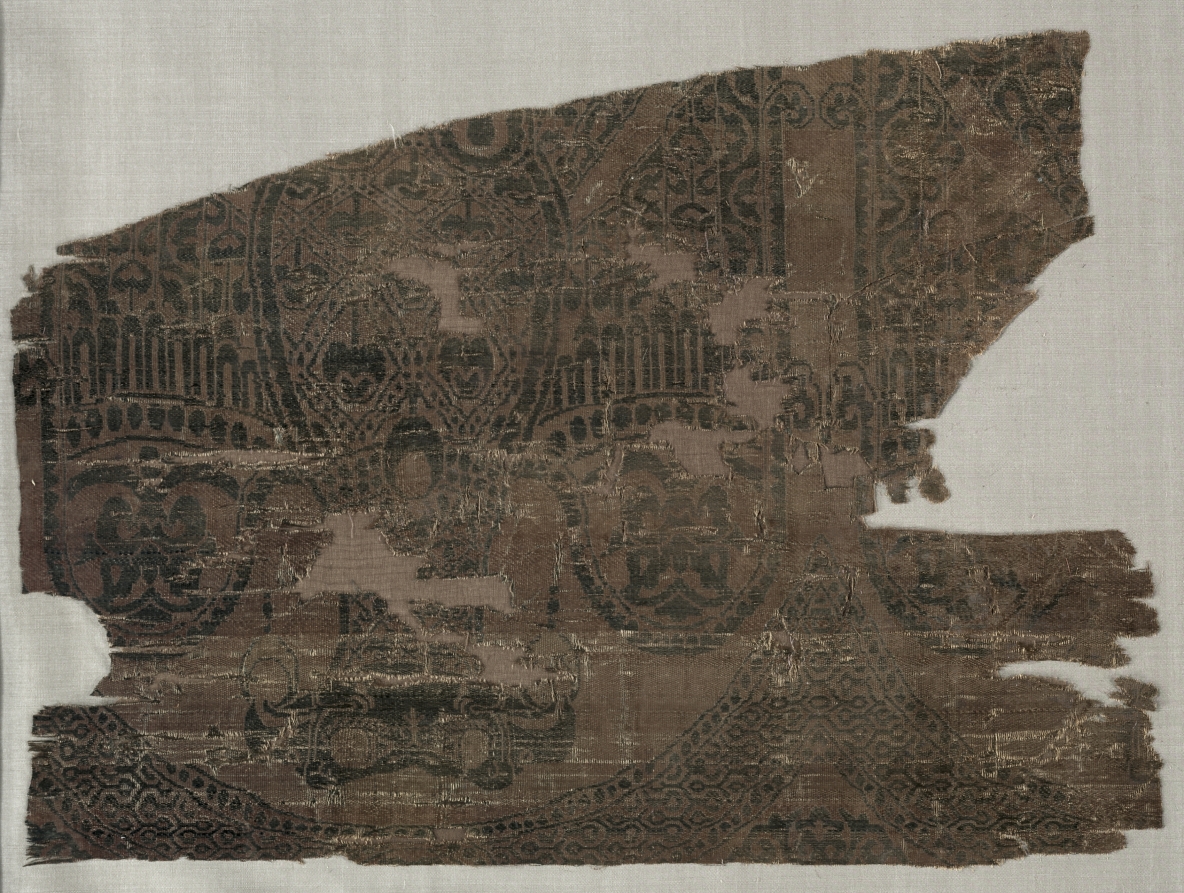
A Discreet Assertion of Epochs: Samite Fragments from the Tomb of Saint Bernard Calvo
To consider these fragments—these remnants of samite silk, unearthed from the sepulchral quiet of a thirteenth-century bishop’s tomb—is to engage in a dialogue with a legacy of unparalleled authority. The material, silk itself, is the foundational text. Its very presence in the Pyrenean see of Vich speaks not of provincialism, but of a connectivity that transcends geography. This is not mere fabric; it is the physical manifestation of a supply chain that was, in its era, as complex and politically charged as any modern luxury conglomerate’s. The yarn, we may posit with some confidence, originated in the mulberry groves and sophisticated throwing mills of Lucca or perhaps even the Norman-silk workshops of Sicily. Its journey to Catalonia was one undertaken by the most discerning of clients: the Church militant and triumphant, an institution whose need for splendour in the service of God was both a theological statement and a political imperative.
The Grammar of Weave: Samite as Imperial Dialect
Samite represents a particular dialect in the language of silk. A heavy, complex weave employing a main warp, a binding warp, and a weft of thicker thread, it results in a cloth where the pattern, floating on the surface, is rendered with a pronounced, almost sculptural relief. The technical proficiency required is not merely mechanical; it is intellectual. The design must be meticulously calculated, translated into the binary logic of the loom’s heddles before a single thread is passed. This is haute couture at the scale of empire. The Byzantine workshops, and later those of the Islamic and Norman worlds, mastered this grammar, producing textiles that were, in effect, portable propaganda. To drape an altar, a prelate, or a reliquary in such cloth was to align oneself with a visual rhetoric of cosmic order and divinely sanctioned power.
The Charge of the Double-Headed Eagle: A Heraldic Conundrum
Upon this sumptuous field of samite, we encounter the charge: the double-headed eagle. Its appearance here is what the trade would term a bespoke anomaly. The eagle, single or double-headed, is of ancient pedigree, a symbol of Roman imperium adopted with fervour by the Holy Roman Empire and the Byzantine Palaiologoi. Yet, this fragment rests in the tomb of a Catalan bishop, Bernard Calvo, a figure enmeshed in the Reconquista and the politics of the Crown of Aragon, not the courts of Constantinople or Swabia.
The interpretation requires a Savile Row sensibility: an understanding of cut, context, and appropriation. The double-headed eagle in the mid-thirteenth century was not yet the rigidly codified emblem it would become. It was a potent, floating signifier of supreme authority, of a sovereignty that looked both East and West, temporal and spiritual. Its adoption on this silk likely signifies one of two scenarios, each revealing. The first is diplomatic gift-giving. The cloth may have been a present from the Hohenstaufen court of Frederick II—a known enthusiast for Islamic and Byzantine art—to a key Iberian churchman, a token in the intricate diplomacy of Christendom. The second, perhaps more intriguing, is aspirational emulation. The weavers of Lucca or Sicily, adept at producing ‘Byzantine-style’ silks for a pan-Mediterranean market, may have incorporated the motif for a client who wished to project an aura of imperial-level authority and sacred kingship onto the episcopal office.
From Tomb to Archive: The Patina of Sanctity
The final, crucial layer of context is the fragments’ provenance: the tomb. Saint Bernard Calvo was interred in his cathedral, clad in his pontifical vestments. These silks were not merely decorative; they were integral to his identity in death as in life. The silk, once a symbol of worldly empire and staggering luxury, underwent a transubstantiation. Woven in a secular, imperial context, perhaps even a commercial one, it was ultimately consecrated by its function. It became a shroud for sanctity, its threads absorbing a new meaning. The double-headed eagle, a symbol of earthly power, now guarded the eternal rest of a saint. The cloth’s durability—the very quality that made samite so prized—ensured it survived as a relic, not of a king or emperor, but of a bishop, thereby transferring the iconography’s associative power to the Church itself.
Conclusion: A Legacy Woven in Thread
These fragments, therefore, are far more than archaeological curiosities. They are a condensed narrative of medieval high culture. They speak of globalised production networks centuries before the term was coined, of technical virtuosity deployed in the service of ideology, and of the fluid appropriation of symbols across political and religious boundaries. The silk carries the legacy of imperial workshops—Byzantine, Islamic, Norman—but it also demonstrates how that legacy was adapted, adopted, and ultimately sanctified by a rising European ecclesiastical power. To hold these fragments is to understand that the true currency of empire was not always coin or land; sometimes, it was the weight of a superb silk samite, its pattern a silent, majestic declaration of an ordered universe, whether that order was dictated from a palace in Constantinople or a cathedral scriptorium in Catalonia. The cut, as always, is impeccable; the provenance, impeccable; the statement, enduring.