The Enduring Prestige of Imperial Silk: A Study of Roundels with Hunters
Introduction: The Artifact as a Testament to Craft
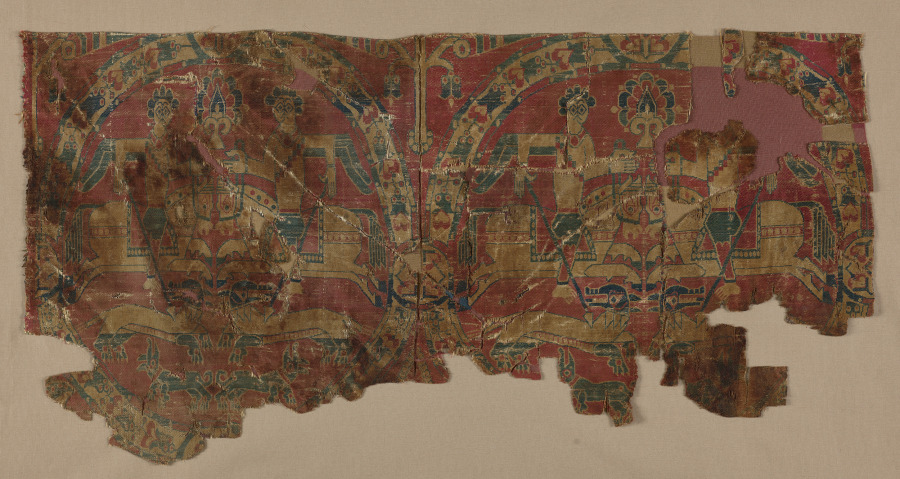
In the rarefied echelons of textile heritage, few artifacts command the same reverence as the silk roundel depicting hunters in pursuit. This piece, a fragment of a larger narrative woven into the very fabric of imperial courts, stands as a testament to the unparalleled mastery of silk weaving that defined the great empires of Asia and the Middle East. For the connoisseur of fine materials—whether in the hushed ateliers of Savile Row or the hallowed archives of the Lauren Fashion Heritage Lab—this roundel is not merely a decorative object; it is a study in materiality, power, and the enduring legacy of craftsmanship that transcends time. The silk itself, with its luminous sheen and tactile resilience, speaks to a lineage of artisans who understood that cloth could be both a canvas and a chronicle.
The roundel format, a circular medallion often used to adorn robes, hangings, and ceremonial regalia, is a hallmark of imperial design. Its geometry imposes a disciplined order on the dynamic scene within: hunters on horseback, their bows drawn, chasing game through stylized landscapes. This juxtaposition of structure and motion is a deliberate aesthetic choice, reflecting the imperial desire to control and commemorate the wild. The silk’s weave—likely a compound twill or lampas—enables a density of detail that is almost architectural, with each thread contributing to a composition that is both robust and refined. For the modern luxury house, this roundel offers a blueprint for balancing heritage with innovation: the same principles of proportion, material integrity, and narrative depth can inform contemporary collections that honor tradition without being bound by it.
Materiality: The Silk as a Medium of Power
Silk is not a passive material; it is an active participant in the story of the roundel. The fibers, harvested from the cocoons of Bombyx mori silkworms, are inherently strong, lustrous, and capable of absorbing dyes with extraordinary fidelity. In the imperial context, silk was a currency of status—its production was state-controlled, its trade guarded, and its consumption reserved for the elite. The roundel’s silk, likely dyed with natural pigments from madder, indigo, and kermes, retains a depth of color that synthetic replicates cannot match. The reds are warm and earthy, the blues profound, and the golds—achieved through gilded thread or yellow silk—catch light with a subtle fire. This materiality is not incidental; it is the foundation upon which the roundel’s significance rests.
The weave structure itself tells a story of technical prowess. Imperial silk weaving, particularly in the Safavid, Ottoman, and Chinese courts, demanded looms of immense complexity, often requiring multiple weavers to operate. The roundel’s pattern—a repeating motif of hunters in a circular frame—necessitates precise registration of warp and weft, a feat achieved through meticulous planning and execution. The density of the weave, measured in threads per centimeter, ensures that the design is not merely printed but embedded within the fabric. This is a cloth that is meant to be touched, to be worn, to be passed down through generations. For the Savile Row tailor, this principle of embedded quality is paramount: a garment’s value lies not in its surface appeal but in the integrity of its construction.
Context: The Legacy of Imperial Silk Weaving
The roundel with hunters is a product of a specific historical moment—the zenith of imperial silk weaving, roughly spanning the 16th to 18th centuries. During this period, the great empires of the Silk Road—the Ming and Qing dynasties in China, the Safavids in Persia, and the Ottomans in Turkey—competed not only for territory but for aesthetic supremacy. Silk was a diplomatic tool, a symbol of sovereignty, and a medium for cultural exchange. The hunter motif, common across these empires, carried layered meanings: it evoked the royal hunt as a metaphor for governance, the mastery of nature, and the pursuit of virtue. In Chinese iconography, the hunter might represent the emperor as a celestial archer; in Persian art, the hunt was a celebration of heroism and courtly life.
The roundel’s design likely originated in a court workshop, where master weavers collaborated with painters to translate two-dimensional sketches into woven form. This collaborative process—akin to the relationship between a Savile Row cutter and a client—required a shared vocabulary of taste and technique. The roundel’s circular shape, often framed with geometric borders, is a nod to the cosmic order, while the hunters’ dynamic poses inject a sense of vitality. This tension between order and energy is a hallmark of imperial aesthetics, and it resonates with the modern luxury ethos: timeless design must be both disciplined and alive. The legacy of this weaving tradition is not confined to museums; it informs the very standards of quality that define high-end textiles today.
Relevance to Contemporary Luxury: Lessons from the Roundel
For the Lauren Fashion Heritage Lab, the roundel with hunters offers more than historical curiosity; it provides a framework for understanding how heritage can be leveraged for contemporary relevance. The roundel’s materiality—its silk, its weave, its dye—reminds us that luxury begins with the raw material. In an era of fast fashion and synthetic substitutes, the roundel stands as a counterpoint: a call to invest in quality, to honor the provenance of fibers, and to prioritize durability over disposability. The roundel’s narrative—the hunters, the hunt, the imperial context—demonstrates that design can carry meaning without being didactic. A modern collection could reinterpret this motif through abstraction, using the roundel’s circular geometry as a starting point for scarves, linings, or embroidered details.
The roundel’s craftsmanship is perhaps its most enduring lesson. The weavers who created it were not anonymous laborers but artists whose skills were honed over decades. Their work demands a similar commitment from today’s artisans: the patience to master technique, the humility to learn from tradition, and the courage to innovate within its bounds. For Savile Row, this ethos is non-negotiable. A bespoke suit is not a product; it is a relationship between tailor and cloth, between heritage and the wearer. The roundel, with its hunters frozen in silk, embodies this relationship. It is a reminder that the finest artifacts are those that connect us to a lineage of making—a lineage that the Lauren Fashion Heritage Lab is dedicated to preserving and reimagining.
Conclusion: A Legacy Woven in Silk
The roundel with hunters is more than a historical artifact; it is a masterclass in the principles that define enduring luxury. Its silk, its weave, its narrative, and its context converge to create an object that is both specific and universal. For the scholar, it offers insights into imperial power and artistic exchange. For the practitioner—the tailor, the designer, the curator—it offers a standard of excellence that is as relevant today as it was centuries ago. As we continue to explore the intersections of heritage and modernity, the roundel stands as a beacon: a reminder that the finest materials, the most meticulous craftsmanship, and the richest stories are those that endure. In the hallowed halls of Savile Row, where tradition is both a foundation and a challenge, the roundel with hunters is a quiet but powerful voice—a voice that speaks of silk, of skill, and of the timeless pursuit of perfection.